Africa
Alex Otti And The Pragmatic Expression Of Labour Party Ideals -By Isaac Asabor
In today’s Nigeria, where most governors operate under the shadow of the federal government or regional godfathers, Alex Otti is breaking the mold. He governs not by proxy, but by principle. His is a quiet hand in the storm, balancing political tension, economic pressure, and party chaos, all while delivering on the very ideals that gave rise to the Obidient Movement.

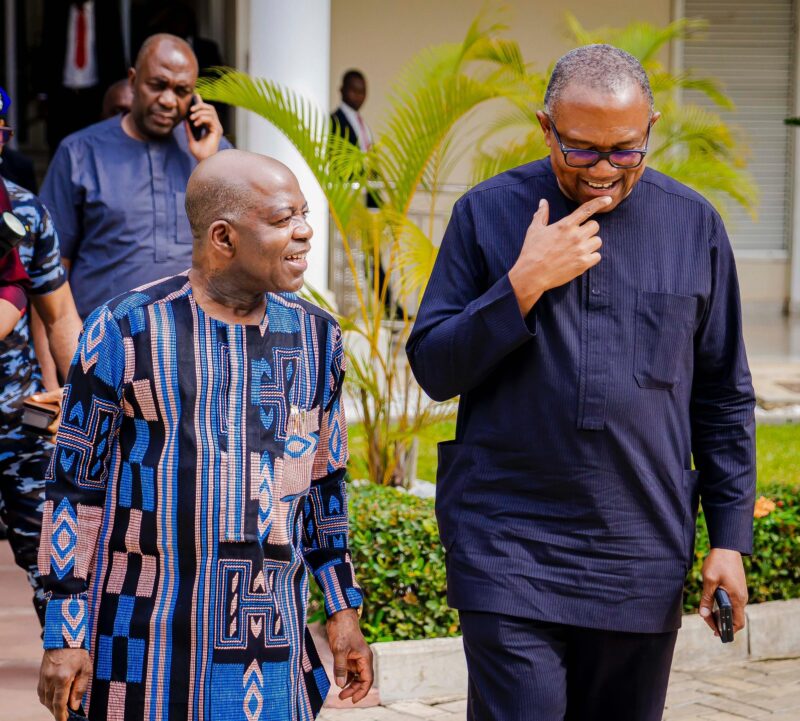
In the boisterous theatre of Nigerian politics, where noise often trumps nuance, and power tends to overshadow principle, one man stands apart. He is not the loudest, the flashiest, nor the most networked. But he is arguably the most consequential political experiment currently underway in Nigeria. His name is Dr. Alex Otti, the Labour Party’s solitary governor. And though he governs in political isolation, he is shaping something deeper: a quiet revolution, one that is slowly redeeming Labour Party’s promise, and making Peter Obi’s ideological legacy more than just a campaign slogan.
At a time when Labour Party’s presence in the 36-state political chessboard barely registers, just one out of 36 governors, Otti is doing more than surviving; he is delivering, and in doing so, making both Labour Party and Obi proud.
Being the only governor from the Labour Party comes with little institutional comfort. There is no southern bloc to lean on, no ruling-party muscle to fall back on, and no political godfathers pulling strings on his behalf. But that is where Alex Otti’s uniqueness begins. He is not beholden to Abuja, and his mandate, born of a groundswell of support during the Obidient wave, has given him an uncommon legitimacy.
It is that mandate he is honoring in Abia State, with work, not words. The first signs of Otti’s governance style can be seen not in press briefings but in construction yards and remote villages. One emblematic project is the Onuinya–Okporoenyi–Oboro Ikwuano rural road, a 13.9 km artery once dismissed by past administrations. By reconstructing it, Otti is reconnecting farmers to markets, schools to towns, and forgotten communities to hope. The road, once overgrown and impassable, is now a pathway to inclusion.
From rural revitalization to urban renewal, Otti’s administration is prioritizing needs over noise. This is not governance by social media trend, it is governance in action. He has vowed to light up rehabilitated roads, bring water to hinterlands, and make rural people visible again, and he has been walking the talk.
In many ways, this quiet governance style is a mirror of Peter Obi’s lean and responsive governance philosophy. But Otti is not just mirroring it, he is embodying it, giving Obi’s ideology a home in public policy.
While many governors celebrate contracts and political appointments, Otti has chosen to celebrate restraint. True to Labour’s mantra of “cutting the cost of governance”, Otti’s administration has not borrowed a single kobo since assuming office. In a state previously burdened by over ₦190 billion in debt, this is no small feat. By reducing Abia’s debt profile to ₦66 billion as of May 2025, Otti is proving that financial discipline is not theory, it is possible.
He has publicly stated that there will be no frivolities: no champagne governance, no private jet purchases, and no inflated contracts. “We no dey give shishi,” he once said, echoing the Obidient slogan. But he added a crucial modifier: “We’ll be very reasonable.” That balance, between austerity and empathy, is the soul of his governance.
Governance isn’t Otti’s only headache. The Labour Party itself has been plagued by factional wars, leadership battles, and a lingering cloud over its internal democracy. In such chaos, it would have been easy, and politically safe, for Otti to jump ship, especially given subtle overtures from the ruling APC. But he didn’t.
Instead, he stood firm. He not only rebuffed defection rumors in January 2025, but also helped host a reconciliatory stakeholders’ meeting with Peter Obi in Umuahia. When national chairman Julius Abure called the gathering “illegal,” Otti kept his cool, describing intra-party friction as “normal” and expressing confidence that the Labour Party would “emerge stronger.”
This type of calm and principled leadership, firm without being fiery, defines Otti’s political personality. He is not the typical Nigerian politician who thrives on chaos. Rather, he is a stabilizing force in a party still struggling with its newfound relevance.
Without a doubt, Peter Obi gave Nigerians the dream of a lean, responsive, citizen-focused government. But Alex Otti is giving it form.
His administration is turning abstract campaign ideals into measurable state performance. Roads are being built, debts are being reduced, rural farmers are smiling, and the noise of governance is being replaced with the hum of bulldozers and tractors.
Though he governs alone, he does not govern without eyes watching. What happens in Abia State under Otti’s leadership will determine if the Labour Party is a movement that can govern, or just one that can campaign. So far, Otti is showing that it can govern.
In today’s Nigeria, where most governors operate under the shadow of the federal government or regional godfathers, Alex Otti is breaking the mold. He governs not by proxy, but by principle. His is a quiet hand in the storm, balancing political tension, economic pressure, and party chaos, all while delivering on the very ideals that gave rise to the Obidient Movement.
In doing so, he is making Labour Party proud, not by pronouncements, but by performance. He is making Peter Obi proud, not by imitation, but by innovation And he is reminding Nigerians that a minority in number can be a majority in impact.