
National Issues
Policing Igbo Identity While Cheerleading for Tinubu: Ohanaeze’s Moral Collapse -By Vitus Ozoke, PhD
The Igbo are not a people easily governed by decree, least of all by an unelected cultural organization seeking to redraw the boundaries of identity. Ohanaeze must choose: reform and realign with the people, or continue down this path of diminishing credibility. History is unkind to institutions that mistake influence for authority – and contradiction for wisdom.

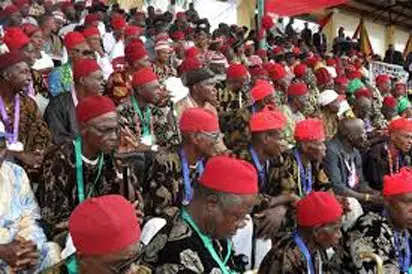
There is something deeply troubling – if not outright alarming – about the recent pronouncement by Ohanaeze Ndi Igbo seeking to abolish the use of the “EzeIgbo” title outside Igbo land. It is not merely the decision itself that rankles; it is the staggering contradiction, the breathtaking hypocrisy, and the creeping arrogance that underpin it.
But even more disturbing than the overreach is the glaring inconsistency. At the very moment Ohanaeze seeks to strip Igbo communities outside their homeland of the right to designate their leaders as “EzeIgbo,” some of its prominent figures have been enthusiastically aligning with – and even ceremonially endorsing – Bola Tinubu. This is where the contradiction becomes impossible to ignore.
If we follow Ohanaeze’s logic, what is the Nigerian presidency if not the ultimate “kingship” over a vast, multi-ethnic entity? The Nigerian president wields authority over more than 350 ethnic groups, including the Igbo. When elements of Ohanaeze – either the shameless City Boys or the South East Former Governors Forum – publicly endorse and symbolically “crown” a non-Igbo political figure in Abuja, what exactly is Ohanaeze doing if not participating in the elevation of a figurative “Eze” over the Igbo people – outside Igbo land?
One cannot, in good conscience, denounce diaspora communities for organizing their leadership structures while simultaneously celebrating centralized political authority that subsumes those very communities. This is not just hypocrisy; it is cognitive dissonance elevated to policy.
The Igbo diaspora, whether in Lagos, Abuja, Kano, or across continents, has historically relied on structures such as the “EzeIgbo” institution for cohesion, representation, and cultural continuity. These titles are not mere ornaments; they are functional mechanisms for community organization in environments where traditional structures do not naturally exist. To undermine them is to weaken the very fabric that sustains Igbo identity outside its geographic origin.
And for what? To assert control? To perform cultural gatekeeping? Or worse, to distract from far more pressing existential challenges facing the Igbo in Nigeria today? At a time when political marginalization, economic exclusion, and security concerns loom large, Ohanaeze has chosen to fixate on titles – titles that, in truth, harm no one and serve a vital purpose for those who bear them. This is not leadership. It is a misplacement of priorities.
More fundamentally, Ohanaeze must confront an uncomfortable truth: it cannot demand obedience where it has not earned legitimacy. Authority without a mandate is fragile; authority exercised inconsistently is farcical. If Ohanaeze wishes to remain relevant, it must return to its foundational purpose – advocacy, unity, and cultural stewardship – rather than regulatory overreach. It must engage, not dictate. Persuade, not proclaim. Otherwise, it risks becoming exactly what it now appears to be: a body out of touch with its people, entangled in contradictions, and increasingly irrelevant in the very space it claims to represent.
The Igbo are not a people easily governed by decree, least of all by an unelected cultural organization seeking to redraw the boundaries of identity. Ohanaeze must choose: reform and realign with the people, or continue down this path of diminishing credibility. History is unkind to institutions that mistake influence for authority – and contradiction for wisdom.
Dr. Vitus Ozoke is a lawyer, human rights activist, and public affairs analyst based in the United States. He writes on politics, governance, and the moral costs of leadership failure in Africa.

























You must be logged in to post a comment Login