Africa
Boosting Multifaceted Relationships, Moscow Holds the 6th BRICS Municipal Conference, by Kestér Kenn Klomegâh

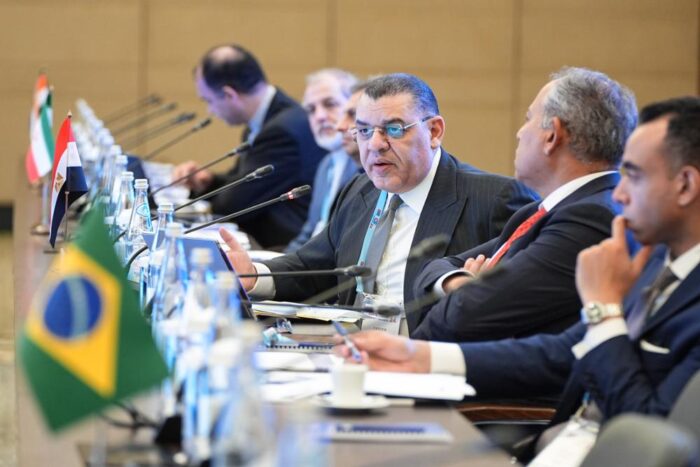
Changing global geopolitical architecture, creating new patterns of economic power, redesigning relations were at the core of the 6th BRICS Municipal Conference held from August 27 to 29. In the wake of heightening tensions, and under Russia’s presidency, BRICS which is an informal association consisting of Brazil, Russia, India, China and South Africa together with four newly admitted members, gathered in Moscow primarily to take stock of previous achievements and consolidate pathways into the future.
Concretely the late August Moscow platform was created to extend opportunity for networking corporate relations among municipal administrators and officials. It is very essential to establish this network as a support for multi-dimensional development, create the basis primarily as an influential and promising economic force capable of building a long-term global partnership based on the principles of mutually beneficial cooperation.
As an integral part of the analysis and general observations, the greatest noticeable achievement is the large turnout of participants to grace the conference. It contributed to the enhancement of cultural exchange and understanding, chance to establish professional relationships and exchange of knowledge and expertise to improve municipal creativity, practices and policies.
During the two-day meetings, several sections moderated by experienced experts, closely examined practical aspects of geopolitics, possible economic opportunities, social and cultural dimensions in Africa, Asia, Latin America and the Middle East, as well as other parts of the world. But the most significant feature here, majority of participants came from Russia’s ‘friendly’ countries, mostly the Global South.
It is not an over-estimation that the practical results have scaled up the position of Russia in BRICS. In speeches and reports that were presented, monitored by this author, the central points are related to the geopolitical processes and its impact on development, society and external relations. The emerging new world also dominated the discussions, that many countries have expressed their preparedness for entering unto the new global stage. In short, the general sentiments expressing the aspiration to form a multipolar world.
Sergey Sobyanin, Mayor of Moscow, noted that “Moscow is one of the most dynamic cities in the world. I have set a task to develop a dynamic model that allows to forecast the development of Moscow and to solve the issues of providing engineering, transport and social infrastructure in an optimal and comprehensive way. A comfortable investment climate has been created in Moscow, which is evidenced by the volume of investments in the capital’s economy in 2023.”
Leonid Tyagachyov, Chairman of the Organising Committee of the International Municipal BRICS Forum, Adviser to the Mayor of Moscow, said: “Today, all BRICS members are interested in strengthening international ties, including trade contacts. The International Municipal BRICS Forum makes a significant contribution to achieving this strategic objective. It is here, through a lively, open discussion, that a common atmosphere of trust is created.”
Valentina Matvienko, Chair of the Federation Council of the Federal Assembly of the Russian Federation, noted: “The Forum is a large-scale and expected event in the sphere of international relations. It is held within the framework of an association that reflects the world’s aspiration to form an equitable polycentric system of global governance against the background of the unsuitability of the unipolar model that restrains the world development. Over the years, the Forum has established itself as one of the strong and sought-after mechanisms for cooperation between countries on domestic and international agendas to exchange best practices and develop sustainable partnerships at the municipal level.”
Sergey Lavrov, Minister of Foreign Affairs of the Russian Federation, asserted: “I will say without exaggeration that today BRICS acts as an “agent” of the interests of the entire non-Western world. The decision to expand the association, made in Johannesburg in August 2023 when our leaders agreed to accept new participants, was a truly breakthrough achievement. From January 1, 2024, Egypt, Iran, the United Arab Emirates, Saudi Arabia and Ethiopia gained their full rights as the members of our association. These countries have significant economic potential, play a significant role not only in their region, but also in the international arena and, most importantly, share the basic values of the BRICS that unite us, including the spirit of solidarity, equality, mutual respect, openness and consensus…”
The conference was supported by the Presidential Administration and the Russian Ministry of Foreign Affairs, as well as by the Federal Agency “Rossotrudnichestvo” and the Government of Moscow. Under the decision of Yuri Ushakov, Assistant to the President of the Russian Federation, the conference included in the Action Plan of the Russian Federation’s Chairmanship in the BRICS Interstate Association in 2024.
In 2022, the Municipal platform was included in the text of the Beijing Declaration of the XIV BRICS Summit (paragraph 70) and is designated as a significant mechanism for promoting urban development and establishing links between twinning cities of the BRICS countries within the framework of the Sustainable Development Agenda until 2030.
In the realm of BRICS 2024, Russia fixed its motto as “Strengthening Multilateralism for Equitable Global Development and Security” which precisely conforms with the current challenges facing the world today. The association now includes 10 countries. Egypt, Ethiopia, Iran, Saudi Arabia, and the United Arab Emirates joined BRICS as full members signifying a growing authority of the association and its role in international affairs. It portrays its strength in the evolutionary multipolar processes of the century.
Russia’s Foreign Minister Sergey Lavrov has also outlined comprehensive future vision for BRICS, emphasizing that “it should remain an association rather than evolving into a full-fledged organization with a secretariat.” Lavrov stated in an interview with the Russian channel NTV that BRICS is not an organization but an association, describing it as a “future umbrella” symbolizing the aspirations and considerations of the world’s majority of developing countries.
Lavrov expressed extraordinary skepticism about transforming BRICS into a formal organization at this stage, emphasizing that it may not be necessary for a relatively long time. He underscored the importance of BRICS as a platform where countries collaborate based on mutual interests and equality, contrasting it with Western organizations lacking fair rules and genuine consensus.
Membership ascension has been suspended, and this was announced by Sergey Lavrov. Countries aligning with BRICS will simply be classified into supporting “partners” group of BRICS. The association, consisting of Russia, Brazil, India, China, and South Africa, and now welcomed new members, including Egypt, Ethiopia, Iran, the UAE, and Saudi Arabia from January 2024. Some experts say the expansion will significantly raise its status and could further amplify association’s declared ambition to become a champion of the Global South. According to historical records, the first meeting of the association began in St. Petersburg in 2005. It was called RIC, which stood for Russia, India and China. Then, Brazil and subsequently South Africa joined later, which is why it is referred to as BRICS.