Africa
Do Uzodinma And Akpabio’s Gaffes Echo Luke 6:45?” -By Isaac Asabor
Luke 6:45 is not just for preachers and pews, it is for presidents and parliaments too. In Nigeria’s context, it serves as a reminder that what our leaders say, especially when they do not mean to, reveals who they really are and what they truly believe.

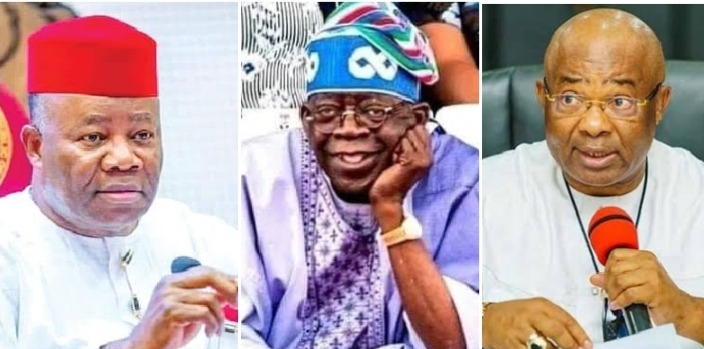
There is a disturbing trend playing out in Nigeria’s political space that goes beyond slips of the tongue. In a matter of weeks, two prominent figures, Senate President Godswill Akpabio and Imo State Governor Hope Uzodinma, made the same blunder: referring to President Bola Ahmed Tinubu as “President Muhammadu Buhari.” For many Nigerians, these gaffes were amusing. But for those who are spiritually inclined or politically discerning, the question arises: Could these verbal missteps be more revealing than they appear? Could they be unconscious admissions that the current government is not much different from the last?
Against the backdrop of these twin blunders, one scripture leaps to mind: Luke 6:45, which states, “A good person produces good out of the good treasure of the heart, and an evil person produces evil out of the evil treasure. For the mouth speaks what the heart is full of.” This verse emphasizes that a person’s words reflect their inner character, highlighting the importance of having a good heart to speak good things.
A breakdown of the foregoing scripture shows that good comes out of good. Explanatorily put, a person with a good heart, filled with kindness, compassion, and love, will naturally speak words that are positive, helpful, and encouraging. Conversely, a breakdown of the scripture shows that evil comes out of evil. Interpretatively put, someone with a heart full of negativity, bitterness, or malice will likely speak words that are hurtful, critical, or deceitful.
Another interpretation of the scripture says the mouth speaks what the heart is full of: This part of the verse explains the connection between inner thoughts and outward speech. What a person thinks and feels deeply will inevitably come out in his or her words.
Implicatively, this verse encourages individuals to cultivate good hearts, filled with positive and virtuous qualities, so that their words will reflect those qualities. It also suggests that by listening to what people say, one can gain insight into their inner character.
“As a man is, the mouth speaketh.” The full verse states, “A good man out of the good treasure of his heart brings forth good; and an evil man out of the evil treasure of his heart brings forth evil: for out of the abundance of the heart his mouth speaketh.” This scripture lays bare a simple truth: what resides deeply within a person eventually spills out, especially through speech. What if Uzodinma and Akpabio were not making mistakes, but momentarily revealing what lies in their subconscious?
For the benefit of those who are yet to grasp with the kernel of this piece, it is germane to put these gaffes under a magnifying glass. At a recent public function, Governor Hope Uzodinma, in trying to heap praises on the sitting President Bola Tinubu, mistakenly referred to him as “President Buhari.” Though he quickly corrected himself, the moment was already caught on camera and had gone viral within minutes. It sparked laughter and debates. Was it just a slip, or something more telling?
For context, Uzodinma is one of Tinubu’s fiercest loyalists and a loud cheerleader of his Renewed Hope Agenda. But could it be that in Uzodinma’s heart and mind, the governance style and policy trajectory of Tinubu are so indistinguishable from Buhari’s that the two leaders have blended into one? Could his mouth have simply echoed what his subconscious registered as truth?
Barely had the dust settled on Uzodinma’s mistake when Senate President Godswill Akpabio made a similar blunder. While attempting to extol Tinubu’s leadership, he also referred to him as “President Buhari.” Again, a quick correction followed, but by then, the seed had been sown, and public perception was already shaping the narrative.
For two influential figures to make the same error, one after the other and within such a short space of time, raises eyebrows. These are seasoned politicians, accustomed to speaking before cameras and microphones. They are not novice public speakers, yet they made the same glaring error. Coincidence? Perhaps. But is it really?
The scripture in Luke 6:45 is not just a moral teaching, it is a diagnostic tool. It reminds us that language, especially unguarded language, is often a direct pathway to the heart. Politicians, perhaps more than anyone else, are trained to be guarded in speech. When they slip, it’s like a crack in a dam. It lets us peer into the reservoir of their thoughts and motivations.
If we take this scripture at face value, then the repeated referencing of Tinubu as Buhari might be interpreted as more than mental fatigue. It could be the manifestation of a deep-seated truth, that this administration is a continuation of Buhari’s government in principle, policies, and performance.
Let us not forget that during the 2023 campaign, Tinubu’s team was desperate to distance him from the unpopularity of Buhari’s tenure. Tinubu himself declared, “Emi lokan” (It’s my turn), as if to signal a break from the past. Yet, here we are, barely two years in, and his loyalists are calling him Buhari, not once, but twice.
The implications go beyond semantics. Nigerians have been groaning under continued hardship. Inflation, high cost of living, insecurity, and poor governance, these were the trademarks of Buhari’s era. Sadly, many of these challenges have only deepened under Tinubu’s watch through fuel subsidy removal without a functional palliative system, floating of the naira which has worsened the cost of imports, harsh fiscal policies that burden the average Nigerian while the political class continues to wallow in luxury, and security lapses, with terrorists and bandits still reigning supreme in parts of the North.
In all fairness, Tinubu may have inherited a battered system, but the failure to offer any marked difference in leadership approach has led to one undeniable reality: many Nigerians feel as though Buhari never left. Perhaps Akpabio and Uzodinma simply voiced what many already think, that Tinubu’s Nigeria is Buhari’s Nigeria in a different agbada.
Another dimension to explore is the spiritual weight of the spoken word. The Bible is replete with verses that speak to the power of the tongue. Proverbs 18:21 says, “Death and life are in the power of the tongue: and they that love it shall eat the fruit thereof.” When national leaders speak carelessly, it reflects not just on their cognition but on the spiritual state of the nation. If these gaffes were merely humorous to some, they were spiritually symbolic to others.
In leadership, speech is not just communication, it is prophecy, policy, and power rolled into one. When leaders confuse one era of government for another, they risk muddying the national consciousness and exposing the continuity of mediocrity and misrule.
Rather than dismiss these mistakes as comedy relief, Nigerians must begin to interpret them as red flags. When leadership begins to mirror the past in rhetoric and in governance, history warns us that nothing good comes of it. Buhari’s years in office were marked by disappointment on many fronts. If Tinubu is seen as another Buhari, then his presidency is already in trouble, and so is the country.
Furthermore, it is time political leaders take seriously the biblical wisdom that “out of the abundance of the heart, the mouth speaketh.” Their words give away what their public relations teams are paid to hide. No amount of image laundering can scrub away what the heart reveals when the mouth slips.
In the final analysis, the gaffes made by Uzodinma and Akpabio are more than coincidental. They are linguistic fingerprints left by the subconscious. They tell a story, of a political continuity, of a lack of transformation, and of the inability to disassociate from a past administration that many Nigerians would rather forget.
Luke 6:45 is not just for preachers and pews, it is for presidents and parliaments too. In Nigeria’s context, it serves as a reminder that what our leaders say, especially when they do not mean to, reveals who they really are and what they truly believe.
So the next time a leader calls Tinubu “Buhari,” do not just laugh. Ask yourself: What is he really telling us? Because as a man is, so the mouth speaketh.