Global Issues
From Boom to Bust: What Really Led to the Cocoa Price Fall -By Adeyinka Adebayo
The cocoa crash from historical highs doesn’t come from one shock alone. It was not merely weather, nor oversupply, nor demand destruction. It was all of it that hit at once. The weather-driven supply crisis became a weak demand oversupply scenario. Prices may stabilize around here and they may not. A true recovery is going to require more than just another supply shock. It is going to require people actually purchasing chocolate again. Until then, this whole boom-and-bust cycle is a pretty good reminder of something you see over and over in commodities: what goes up that fast rarely comes down slow.

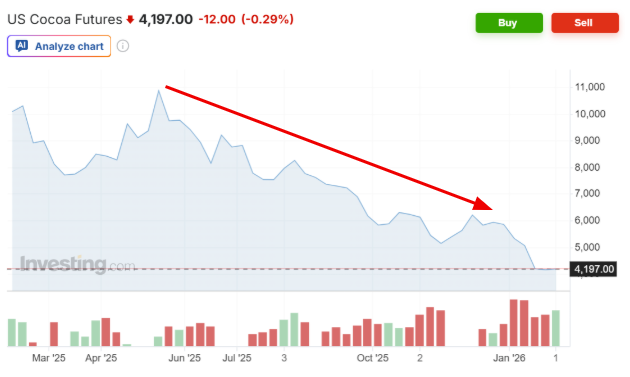
If you want a refresher, the cocoa market in May 2025 skyrocketed to nearly USD 11,000 per metric ton, sort of one of the wildest rides you will ever see in commodities markets. And I mean wild. By February 2026, the price of cocoa was estimated to be nearly USD 4,197 per ton, a 62% drop over a staggering nine months if you do the math, isn’t it brutal. This shocking price swing is one of the most dramatic cocoa price pivots in recent time.
For West African farmers, for traders who watched their screens, for anyone who bought close to the top price, it’s been hard to watch. The question everyone is asking is pretty clear: how did we go from, “we are running out of cocoa,” to having more than enough to last at a rate approaching zero in less than a year? The answer in fact contains a myriad of things. Recovering supply, sure. But also new ramping up of production somewhere people did not watch closely enough. And it gets neglected in the sense that demand simply fell off a cliff.
The Supply Side: Abrupt Change from Scarcity to Surplus
Let me explain to you how it went from shortage to uh, we have a lot of Cocoa in inventory. First, a quick geography lesson. Cocoa production is exceedingly concentrated. For example, a few countries control almost everything:
- Côte d’Ivoire (the Ivory Coast) produces around 2.4 million tons.
- Ghana does about 650,000 tons — roughly 12%.
- Indonesia produces close to 640,000 tons but primarily consumed in Asia-Pacific.
So, when things go wrong in West Africa, the entire market senses it. In late 2024 and early 2025, West Africa was hit with unfavorable weather, disease knocking into the trees, and many old cocoa farms just couldn’t produce like they used to. That means output from Côte d’Ivoire and Ghana fell widely, and suddenly everyone’s panicking whether there’s going to be enough chocolate for the holidays. Prices went through the roof.
Strong Recovery in Côte d’Ivoire and the Global Production Surplus
Now, this is where it gets interesting, the story is flipped in all directions. A recent estimate indicates global cocoa supply surplus at over 287,000 tons. A surplus after shortage panic. Sentiment swung quickly once traders began to realize we were no longer in deficit territory. Like, really fast. Côte d’Ivoire came roaring back. The one story here, and honestly the one that really changed everything is this harvest that happened in Côte d’Ivoire between October to December 2025. Their main crop harvest reported 30-40% more than the previous year. After what had been, by most accounts, a disaster of a season, that’s massive. Because when you’re making 42% of the world’s cocoa, just one good harvest from you could tip the entire global balance in your favor. It doesn’t really matter what’s going on everywhere else. One country with that significant influence.
The Volume Surge from Ecuador
Ecuador is quietly building something but I think there’s also this broader shift that’s happening that people are underestimating. Ecuador had been steadily increasing production through better farming techniques, higher-yield varieties and better export infrastructure. Some analysts believe Ecuador could eventually overtake Ghana as the world’s second-biggest producer. Which, if you were to say that five years ago, people would’ve laughed. What this indicates for the market is that supply is becoming less concentrated. West Africa still leads, of course, but we are no longer as vulnerable to regional shocks as we used to be. That helps to dampen the volatility. Or at least it should.
The Other Side of the Story – Demand Downtrend
Part of the fall is explained by the recovery in supply but does not explain the speed and level of this sell-off, not even close. The more important factor has been pattern of demand, especially in the major consuming regions. People stopped buying as much chocolate as before. Or more accurately, chocolate makers cut back purchase. Cocoa grinding figure, which is widely regarded as a reliable proxy for how much people demand chocolate – dropped so hard. This indicator went down dramatically:
- Europe was 7.2% lower year on year
- Asia down with over 16%
- North America dipped slightly by 2.8%
Those numbers are not minimal amounts. What happened was pretty predictable, to tell the truth. High cocoa prices squeezed manufacturers as they could simply passed those costs on to the consumer (who then bought less chocolate) or absorbed the pain and saw their margins squeezed. Either way, demand suffered. Some companies began reformulating products. Some just postponed buying, hoping prices would be lower. Which, to be fair, they did.
The Missing January Rally
From historic lens, January was supposed to save everything. Unfortunately, it did not. The fact is, cocoa markets are the most vibrant in January as chocolate makers bulk buy after the holidays, buying picks up again, prices get a little support. It’s seasonal, but reliable and it was meant to be. This January, buyers remained at the sidelines. And honestly, you can see why:
- Many of the companies had massive inventories while prices were rising.
- The volatility was draining everyone.
- There was this sense that prices still had plenty more to drop. So why rush?
Without that normal January bump, the market fell apart. Just in January 2026, prices fell 44%. From approximately $6,159 a ton to $4,260. That’s a lot over the course of just one month.
So, What Happens to the Market Next?
Cocoa at currently level gets close to what many people consider support level. Essentially, the price at which it no longer makes sense for many producers to keep farming. But that doesn’t mean we have reached bottom. Even so, supply is still flowing and demand is still shaky. And until we get actual signs of recovery around the consumption side, there’s certainly room for more downside. Variables to keep an eye on:
- Can Côte d’Ivoire actually sustain this rebound or was it a one-off good season?
- Ecuador’s expansion and export growth.
- When is the time to start seeing a demand stabilization in Europe and Asia? (Because, at this moment, it’s not looking good.)
- Are processors finally drawing down those huge inventories?
What This All Means
The cocoa crash from historical highs doesn’t come from one shock alone. It was not merely weather, nor oversupply, nor demand destruction. It was all of it that hit at once. The weather-driven supply crisis became a weak demand oversupply scenario. Prices may stabilize around here and they may not. A true recovery is going to require more than just another supply shock. It is going to require people actually purchasing chocolate again. Until then, this whole boom-and-bust cycle is a pretty good reminder of something you see over and over in commodities: what goes up that fast rarely comes down slow.
Adeyinka Adebayo is a finance professional experienced in managing global trading operations for cocoa and other agri-commodities.