Africa
Ganduje, Fubara and the Politics of 2027 -By Oluwafemi Popoola
What Nigeria needs is not just a new crop of players, but a new political ethos. A redefinition of politics itself — one that centers on transparency, inclusion, and the public good. Anything less is just rearranging chairs on a sinking ship.


The stage never really goes dark in Nigeria’s political theater. It merely pauses for scene changes. And now, as the spotlight swings back with full intensity, the drama resumes with a familiar cast, old scripts, and the kind of suspense that only seasoned watchers can predict. The latest episode features the usual tropes: betrayal, power plays, whispered deals in dark corridors, and plot twists everyone saw coming.
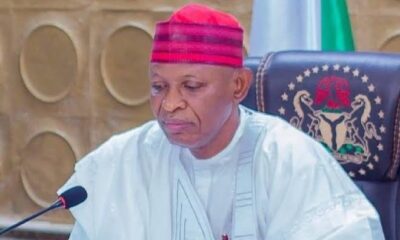
Front and center is the political decapitation of Abdullahi Ganduje, the now-former National Chairman of the ruling All Progressives Congress (APC). His ouster was neither graceful nor surprising. It was a carefully choreographed move by party stakeholders, reportedly blessed by the Grand Patron himself, President Bola Ahmed Tinubu. Ganduje’s removal underscores a recurring theme in Nigerian politics: everything is about the next big election.
Ganduje’s tenure was underwhelming, uninspiring at best, disastrous at worst. Many believed the chairmanship was either a retirement gift or hush money for his loyalty during the 2023 elections. But loyalty in Nigerian politics is perishable. And Ganduje’s shelf life expired sooner than he expected.
What truly set the political tongues wagging, however, was not just the fall of Ganduje, but the calculated reason behind it. Tinubu, who is the grandmaster of silent power, is already positioning himself for 2027. At the center of this evolving chessboard is Rabiu Musa Kwankwaso, Ganduje’s longtime nemesis and leader of the red-cap-wearing Kwankwasiyya movement.
Kwankwaso and Ganduje have been political enemies for years, locked in a bitter Kano rivalry. But Nigerian politics has no permanent friends or enemies — only interests. And in pursuit of those interests, Tinubu is allegedly courting Kwankwaso into the APC. Naturally, Ganduje had to go. The two cannot cohabit the same party structure without igniting fresh chaos or another leaked dollar-bribe video.
Tinubu’s fingerprints are all over this political reconfiguration, even as he maintains his signature public silence. It’s the same strategy he deployed in Lagos, refined within the APC, and now applies nationwide. It is the Jagaban Doctrine: rule by silence, reposition by stealth.
Meanwhile, on the other side of the ring, a counter-offensive is taking shape. Former Vice President Atiku Abubakar and former Kaduna State Governor Nasir El-Rufai are building a new political alliance — a coalition party intended to “rescue Nigeria.” Yet, beneath the grand slogans lies the same old ambition: dislodge Tinubu at all costs.
Both men, seasoned political tacticians with contrasting styles, are driven less by shared ideological vision than by political survival. Their coalition, like many before it, appears to be another Frankenstein experiment — patched together with duct tape, ambition, and desperation. It reflects not the birth of a new political order, but the preservation instinct of Nigeria’s political elite.
The result is a political landscape bereft of clear ideological direction. Rather than invest in inclusive, transparent institutions or articulate reformist values, Nigerian politicians continue to trade in fragile alliances, opportunistic pacts, and last-minute crossovers. For ordinary Nigerians still reeling from economic hardship, insecurity, and institutional decay, the 2027 elections already look like another referendum on elite self-interest — far removed from national development.
And then, there is Rivers State — where another power script is unfolding, one that deserves its own tragic musical score.
Governor Siminalayi Fubara, once seen as the accidental hero in a war against political godfatherism, has finally traded in his brief moment of independence for political survival. After months of defiance against his estranged benefactor, Nyesom Wike, Fubara has bowed to pressure — orchestrated, again, under the shadow of the same presidency that suspended him as state governor.
The man who once stood as a symbol of resistance has now become its latest casualty or worse, its latest convert.
The final embarrassment came in full public glare on Saturday at burial ceremony at Rumuepirikom, Wike’s stronghold in Obio/Akpor LGA. Fubara stood awkwardly beside Wike and the suspended Speaker of the Rivers House of Assembly, Martins Amaewhule. A once-defiant governor reduced to a subdued attendee — smiling politely, nodding submissively, playing nice. It was a picture worth a thousand words and none of them flattering.
Fubara, once celebrated as the face of a new political order in Rivers, now appears as a man desperate to cling to power, even if it means crawling back into Wike’s pocket. This is not reconciliation, it is capitulation.
His public submission, barely days after “peace efforts” from the presidency, marks a full-circle betrayal of all those who backed his rebellion. Those who refused to allow Wike’s cronies seize the Assembly, who stood up against intimidation and backroom deals have now been abandoned like weather-beaten campaign posters. The revolution they were promised has been auctioned off for political insurance. And not even a token apology from the presidency has been offered.
What links Ganduje’s fall, the Frankenstein alliance of Atiku and El-Rufai, and Fubara’s submission in Rivers is one unchanging truth: in Nigeria, loyalty is currency, and betrayal is politics as usual.
Our political class oscillates between victimhood and opportunism depending on the season. Governance is reduced to survival tactics and strategic positioning. The people? Mere pawns in a high-stakes chess game.
As Nigeria hurtles toward 2027, the signs are ominous. With no major party offering a real break from the transactional culture of godfatherism, opportunism, and betrayal, we risk recycling the same power blocs and personalities that have long kept the country stuck in neutral.
The tragedy isn’t just about the betrayals of individuals or the collapse of temporary alliances. It’s about the deepening erosion of public faith in the democratic process. Until the political class is held accountable — not just at the polls, but by a vigilant and empowered citizenry — the promise of democracy will remain elusive.
What Nigeria needs is not just a new crop of players, but a new political ethos. A redefinition of politics itself — one that centers on transparency, inclusion, and the public good. Anything less is just rearranging chairs on a sinking ship.
The events of the past few days should provoke sober reflection — not just about who will win in 2027, but whether anyone truly deserves to.
Oluwafemi Popoola is a journalist and political analyst. He can be reached via bromeo2013@gmail.com.