Africa
Is Nigeria Not At War? -By Pius Mordi
The government has even refused to designate Boko Haram a terrorist organisation, the least classification the group deserved well before now. Former President Muhammadu Buhari rather preferred to send combat troops after the Independent Peoples of Biafra (IPOB) and designate the group a terrorist organisation.
By all definitions and parameters, Nigeria is engaged in an existential war with Boko Haram, ISWAP and other Islamist groups seeking to overthrow the Nigerian state. With religious chants while carrying out their monstrous killings, they wreak havoc on civilians, kidnapping, looting and destroying communities.

When Pope Leo XIV gave his inaugural sermon during the Mass formally commence his pontificate, it was so gratifying he re-echoed the message his predecessor, Pope Francis, had always harped on throughout his headship of the Catholic Church. Addressing the “powerful people of the world,” he said the bloodletting in conflict zones in the world was unacceptable and called for “lasting peace”, admonishing that there should be “no more war”.
Thankfully, President Bola Tinubu was among the distinguished audience and powerful people of the world the Pontiff addressed. But the problem is how Pope Leo Leo XIV’s message was received by Tinubu. Despite the bloodletting and massive killings going on in virtually all parts of Nigeria, the federal government sees the killings as act of banditry. The perpetrators have been given several names that downgrade the unchecked attacks and massacres. Bandits, unknown gunmen, kidnappers, cattle rustlers and herders-farmers conflict are some of the nomenclatures given to the killings.
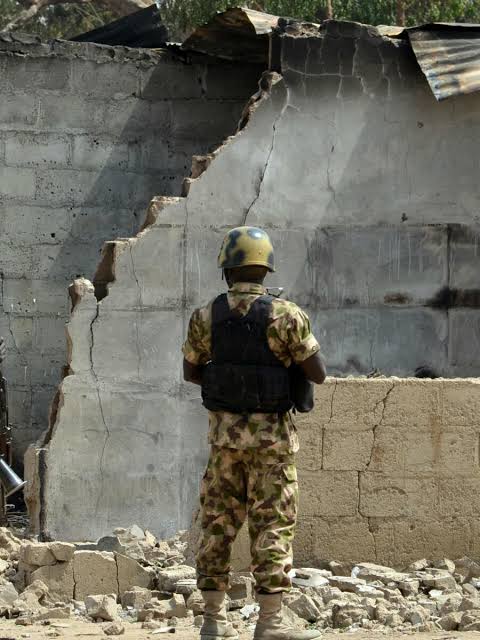
But the casualty figures are more than what is being recorded in actual war zones. This illustrates the ferocity, impunity and massacres going on in Nigeria. When military outposts and barracks are attacked, overrun and soldiers brazenly killed, what is the fate of civilians? Of course, they are routinely massacred, their lands, homes and farms occupied. How is it different from what is happening in war zones? Yet, the federal government insists on not calling it what it truly is – war.
What has been going on Nigeria since the advent of the Boko Haram insurgency is outright war. The Oxford Dictionary says war is the state of armed conflict between different countries or different groups within a country.
According to the United Nations perception of what constitutes war, it is an armed conflict between the armed forces of states, or between governmental forces and armed groups that are organized under a certain command structure and have the capacity to sustain military operations, or between such organized groups.
While the UN has a set of rules and conventions that govern wars and failure to observe those rules classified under humanitarian laws lead to charges of crime against humanity even while the conflict is still on, the armed groups fighting federal forced observe no rules. It is what led to charges of crime against humanity against Benjamin Netanyahu and some elements in the Israeli military in the ongoing war against Hamas. It is why the world is outraged by the bestial killing Russia’s Vladimir Putin is carrying out in Ukraine.
However, contrary to the UN rules of engagement in wars, what is going on in Nigeria has no rules and nobody is held to account. All the elements of war, intense war against a well armed and organized enemy, are there in the Nigerian situation. In fact, more people, mainly defenceless civilians, are killed in Nigeria than in actual war zones. Even the military is almost overwhelmed by the multiple fronts they have to fight and defend simultaneously. Our young soldiers and commanders are being regularly killed as their barracks are attacked and sometimes overrun. Its all down to the fact that the military hierarchy deploy their men to the theatres of conflict without their being conditioned as men going to real war.
The gallant but inadequately equipped soldiers are deployed to confront the insurgents without back ups and reinforcements. When overwhelmed, as has been happening lately with greater frequency, they are hopelessly lost. It is the cost of pretending that the situation in Nigeria is a routine internal conflict.
It is not and the people have been saying that for years.
After sustained attacks and loss of some towns and villages, Babagana Zulum, Borno State governor, had to make an SOS appeal to the federal government not to let Marte town fall to terrorist insurgents. The appeal was informed by the advance of the well-oiled insurgents that had been overrunning some communities. Marte town, Zulum explained, was resettled about four years ago, but unfortunately, by the second week of May, it was ransacked and the people displaced again.
“About 20,000 people left Marte for Dikwa. This huge number is a threat, as allowing them to stay in the camp may make most of the younger ones become vulnerable to recruitment by the insurgents”, the governor warned.
In December 2020, the Catholic Bishop of Gboko, Bishop William Avenya, testifying at a US congressional hearing, alerted the world to what he said is the “genocide” of Christians in his area. “The mass slaughter of Christians in Nigeria’s Middle Belt, by every standard, meets the criteria for a calculated genocide from the definition of the Genocide Convention,” Bishop William Avenya told the hearing of the Tom Lantos Human Rights Commission, a bipartisan congressional commission, on “Conflict and Killings in Nigeria’s Middle Belt.”
Five years after Bishop Avenya’s testimony, the situation has exacerbated with the killings spreading to the rest of the southern part of the country hitherto thought to be relatively safe. Civilians across Nigeria continue to face intense violence and near-daily attacks and kidnapping by armed groups. Suspected Boko Haram insurgents have continued to launch attacks in their stronghold regions of Yobe and Borno states and beyond.
The government has even refused to designate Boko Haram a terrorist organisation, the least classification the group deserved well before now. Former President Muhammadu Buhari rather preferred to send combat troops after the Independent Peoples of Biafra (IPOB) and designate the group a terrorist organisation.
By all definitions and parameters, Nigeria is engaged in an existential war with Boko Haram, ISWAP and other Islamist groups seeking to overthrow the Nigerian state. With religious chants while carrying out their monstrous killings, they wreak havoc on civilians, kidnapping, looting and destroying communities.
President Tinubu has to discard all pretentions and trying to be politically correct by laying the groundwork for effectively the evil forces seeking to kill the country.
Until the federal government desists from giving the armed groups fanciful names and acknowledge that Nigeria is dealing with an existential war, the battle for the survival of the country may not not be won.