Africa
Miss Nafisah, the English Champion and her N200,000 Home Gift -By Usman Abdullahi Koli
Nigeria must stop dimming the dreams of its brightest children. We cannot keep clapping for dancers and athletes while ignoring the Nafisahs who show us that talent can rise from the roughest soil. If we want respect in the world, we must first respect knowledge at home.

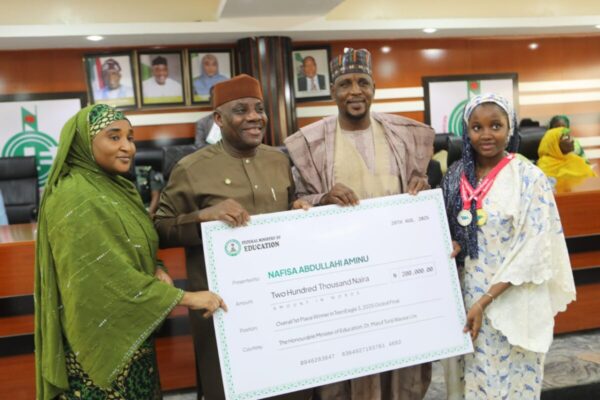
Miss Nafisah Abdullahi is only 17 years old, yet she has already taken Nigeria to places many nations only dream of reaching. From Yobe, a state too often mentioned only in the language of poverty and conflict, she stood before more than 25,000 contestants from 69 countries in the TeenEagle Global Final Competition and emerged as the champion. She carried Nigeria’s name to the intellectual stage and defeated children from nations where English is not just learned in classrooms but lived in homes. That was her priceless gift to Nigeria. And what did Nigeria offer her in return? A handshake, a press release, and two hundred thousand naira that cannot even pay for a single semester in a good university. A priceless victory reduced to pocket change.
Nafisah’s story is about values. It is about what we choose to honor as a people. In this country, when footballers return with medals, they are welcomed with parades and rewards. When entertainers make noise abroad, we turn them into national idols. But when a young girl conquers the world with her mind, we greet her with silence. That silence is not empty; it is a lesson. It tells millions of children that brilliance does not count here. It tells them that books are useless, that talent of the mind will never be celebrated in their own land.
Think of where she comes from. Yobe is not a place filled with world-class schools or endless opportunities. It is a place battered by poverty, scarred by insecurity, and haunted by the highest figures of out-of-school children in the country. It is a place where girls are too often married off young, their dreams cut short before they can even begin. Nafisah could easily have been one of those forgotten numbers. Instead, she fought through the darkness, studied where others gave up, and rose to defeat students from the United States, the United Kingdom, and Canada in their own language. That is not only radiant. That is defiance. That is resilience. That is Nigeria at its best.
Other nations know how to treat their treasures. Pakistan stood by Malala Yousafzai until she became a Nobel Prize winner and a global voice for education. India lifted Gitanjali Rao, a teenager named TIME Kid of the Year, and gave her platforms to inspire millions. Kenya celebrates its brightest minds with scholarships and presidential recognition. In the United States and the United Kingdom, children who win with their minds are given opportunities that change their lives forever. These countries understand that the true strength of a nation lies not only in athletes or entertainers but in the prowess of its children.
Nafisah’s victory should not be another forgotten headline. It should be the spark of a national movement. She deserves a scholarship that secures her future. She deserves to be made an ambassador for girl-child education, carrying her story into classrooms and villages where girls are still told their only destiny is marriage. The First Lady should stand with her. The Yobe State Government should lift her up publicly so her story becomes a source of pride and hope. Philanthropists, NGOs, and corporate leaders should support her not as charity but as an investment in the future of Nigeria.
And if tomorrow Nafisah leaves Nigeria for a country that values her, who will we blame? If she becomes a professor abroad, a world-class innovator, or even a global leader, will we cry about brain drain? What moral right do we have to lament when we refused to keep her light burning here?
Nigeria must stop dimming the dreams of its brightest children. We cannot keep clapping for dancers and athletes while ignoring the Nafisahs who show us that talent can rise from the roughest soil. If we want respect in the world, we must first respect knowledge at home.
History will not remember the leaders who ignored genius. It will remember those who lifted it. Let it not be written that Nigeria built stadiums for athletes, celebrated singers with riches, and abandoned a 17-year-old girl from Yobe who conquered the world with English. Her triumph is Nigeria’s triumph. Our silence, however, is Nigeria’s shame.
Usman Abdullahi Koli

Continue Reading