Africa
Natasha Akpoti-Uduaghan, the World Has Heard You—Do Not Apologize for the Sake of African Women and Girls -By John Egbeazien Oshodi
Natasha Akpoti-Uduaghan, do not apologize. Not now. Not ever. Not for them. Not for the comfort of cowards who fear a woman they cannot control. Do not apologize because your voice is no longer just yours—it belongs to all of us. It belongs to every woman who has ever whispered her dreams in the dark, too afraid to say them out loud. It belongs to every girl who has ever been told no. It belongs to every mother who has ever held her daughter close, praying she will live in a world that treats her as an equal.

Natasha Akpoti-Uduaghan, you are standing at a crossroads that few women ever reach. You are carrying a burden that should not be yours alone. You have become the symbol of a war that has raged for centuries—a war against the silencing of women, the erasure of their voices, the brutal retaliation they face when they dare to step outside the boundaries men have set for them. You are the latest warrior in a battle that has cost generations of women their dignity, their freedom, and sometimes, even their lives.
They have taken everything from you, Natasha. They have stripped you of your title, as if your work, your years of struggle, your election by the people, meant nothing. They have removed your security, leaving you defenseless in a country where political assassinations are carried out in the shadows. They have cut off your salary, starving you of the very means to fight back, hoping that financial ruin will force you into surrender. They have locked your office, turned you into a ghost within the very institution you once stood in with pride. And now, after everything they have done, they look you in the eyes and demand that you apologize.
Apologize for what?
Apologize for the courage it took to speak? Apologize for refusing to lower your head in the presence of those who abuse their power? Apologize for being a woman who did not shrink in the face of intimidation? Apologize to a system that has robbed you of justice, humiliated you, exiled you, and dared to expect your gratitude?
No, Natasha. Do not apologize.
Do not apologize, because your pain is not just your own. It belongs to every African woman who was silenced before her time. It belongs to every girl who was told she must be quiet, obedient, invisible. It belongs to the mothers who watched their daughters grow up in fear, the women who walked into boardrooms only to be dismissed, the widows who lost everything because the law was never written for them. Your pain carries the weight of history—the weight of every woman who has been punished for being too strong, too outspoken, too unwilling to bow.
And yet, Natasha, your deepest wound does not come from the men who are doing this to you. It comes from the women who have stood by and let it happen. The women of Africa—millions of them—want to support you, to stand with you, to fight alongside you. But in Nigeria, so many of them have been conditioned to stay on the side of the men, to defend their oppressors, to believe that submission is survival. They whisper in private that they admire you, that they wish they had your strength, but in public, they remain silent. Because that is what generations before them were taught—that to speak out is to invite destruction, that to challenge power is to invite pain.
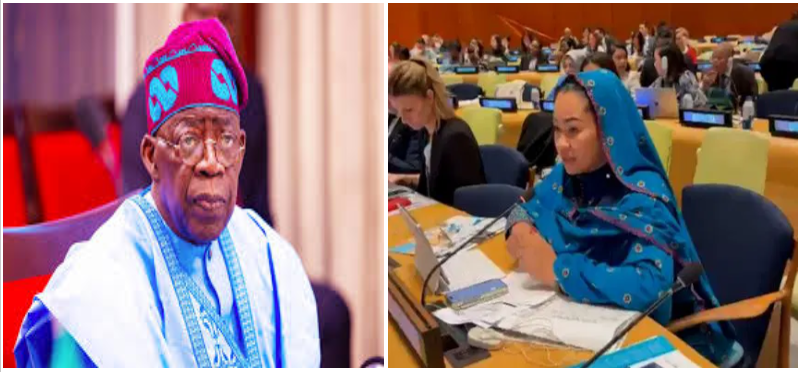
But Natasha, do not let their silence become your silence. Do not let their fear become your fear. Because today, you stood before the women of the world—the women from nations where democracy still has meaning, where justice still holds weight. They heard you. And they will act.
You were not speaking into a void. Your voice did not disappear into the air. Those women at the United Nations, those women from democratic nations, those women who have fought their own battles for gender equality, leaned in and listened. They did not dismiss you. They did not laugh at your pain. They did not turn away in cowardice. They understood you, because they have been you.
And they will do something.
They are speaking in whispers now, but soon those whispers will turn into action. There will be meetings behind closed doors. There will be reports. There will be diplomatic discussions that Nigerian officials will not want to have. There will be pressure, quiet but firm, coming from places Nigeria cannot afford to ignore. There will be foreign journalists asking why a female senator was punished while her alleged abuser remains in power. There will be human rights organizations adding your name to their lists of persecuted women.
Nigeria thought it could silence you. Instead, it has made you louder than ever.
And now, President Bola Tinubu, you can still remain silent just because of politics. You can still pretend that this is not happening, that this is not your fight. But guess what? You will speak soon.
Guess what, Tinubu? Your friend, Senate President Godswill Akpabio, the man who ensures your bills go through, the man you trust to protect your legislative interests, will soon learn the cost of his actions. He abused, yet he presided over the punishment of his own victim. He was accused, yet he was the one given the power to erase his accuser. He should have stepped aside. He should have faced scrutiny. But instead, he chose to wield power like a weapon, believing himself untouchable.
And you, President Tinubu, said nothing. Not one sentence. Not one condemnation. Not one word of support for justice.
But I bet you, you will speak soon.
I bet that Akpabio and others in leadership, the ones who thought their positions made them invincible, will step down soon—no matter how powerful you all believe you are in Nigeria. The world is on you now. This is bigger than your political alliances. This is bigger than your Senate deals. This is bigger than Nigeria’s power games.
The world is watching.
The international stage is shifting. Nigeria’s government will soon learn that when power is abused so brazenly, it does not go unnoticed.
And Natasha Akpoti-Uduaghan?
She will remain.
Natasha, you have lost so much, but they could not take the one thing that matters most—your voice. They have done everything to silence you, and yet, here you are. Still speaking. Still standing. And that terrifies them.
Let them tremble.
Natasha Akpoti-Uduaghan, do not apologize. Not now. Not ever. Not for them. Not for the comfort of cowards who fear a woman they cannot control. Do not apologize because your voice is no longer just yours—it belongs to all of us. It belongs to every woman who has ever whispered her dreams in the dark, too afraid to say them out loud. It belongs to every girl who has ever been told no. It belongs to every mother who has ever held her daughter close, praying she will live in a world that treats her as an equal.
If you apologize, you tell them that they were right. That women should remain silent. That power belongs to men. That the struggle for justice is meaningless. But if you do not—if you hold your head high, if you keep standing, if you keep fighting—you tell them that their time is up.
So stand, Natasha Akpoti-Uduaghan. Stand for the women who could not. Stand for the girls who will. Stand for Africa. Stand for the future.
And above all, do not apologize.
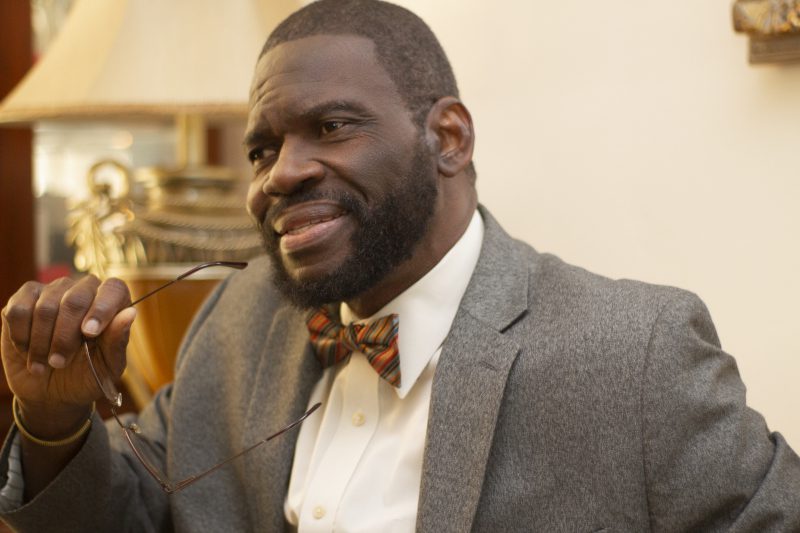
John Egbeazien Oshodi
Oshodi Open Door, also known as Oshodi Open Door Public Training (OOPDT, pronounced opidt), is a public awareness initiative promoting transparency, accountability, and integrity in Africa through educational articles and resources at jos5930458@aol.com, and offers specialized Timely Response Solutions (TRS) training at minimal or no cost.
Professor John Egbeazien Oshodi is an American psychologist, educator, author specializing in forensic clinical psychology, cross-cultural psychology, police prison science, social justice. Born in Uromi, Edo State, Nigeria, he is the son of a 37-year veteran of the Nigeria Police Force, a background that shaped his commitment to justice, security, psychological research.
A pioneer in forensic psychology, he introduced state-of-the-art forensic psychology to Nigeria in 2011 through the National Universities Commission (NUC) Nasarawa State University, where he served as an Associate Professor in the Department of Psychology. His contributions extend beyond academia into psychological health behavioral change initiatives through the Oshodi Foundation the Center for Psychological Forensic Services.
Professor Oshodi has held faculty positions at Florida Memorial University, Florida International University, Broward College, Nova Southeastern University, Lynn University. He is also a contributing faculty member in the doctoral undergraduate psychology programs at Walden University serves as a virtual professor with Weldios University and Iscom University.
Beyond academia, he is a government consultant for forensic-clinical psychological services in the USA previously served as Interim Associate Dean Assistant Professor at Broward College, Florida.
He has published extensively on mental health, justice, institutional reform is the founder of the Psychoafricalysis theory, which integrates African sociocultural perspectives into psychology.
Professor Oshodi remains an influential force in advancing psychology institutional reform globally, particularly in Africa.