Africa
Shettima’s Bombshell -By IfeanyiChukwu Afuba
Shettima could have spoken differently at Adoke’s book presentation. There are various perspectives and approaches to history. He could have eulogised Adoke in other ways, in subtle tones. But he chose to make such strong observations with telling effect. The message was loaded and penetrating at the same time. It seemed like a call for resolution of political differences. Whatever the motive, the historical update is a significant contribution in the quest for enthronement of democratic values.

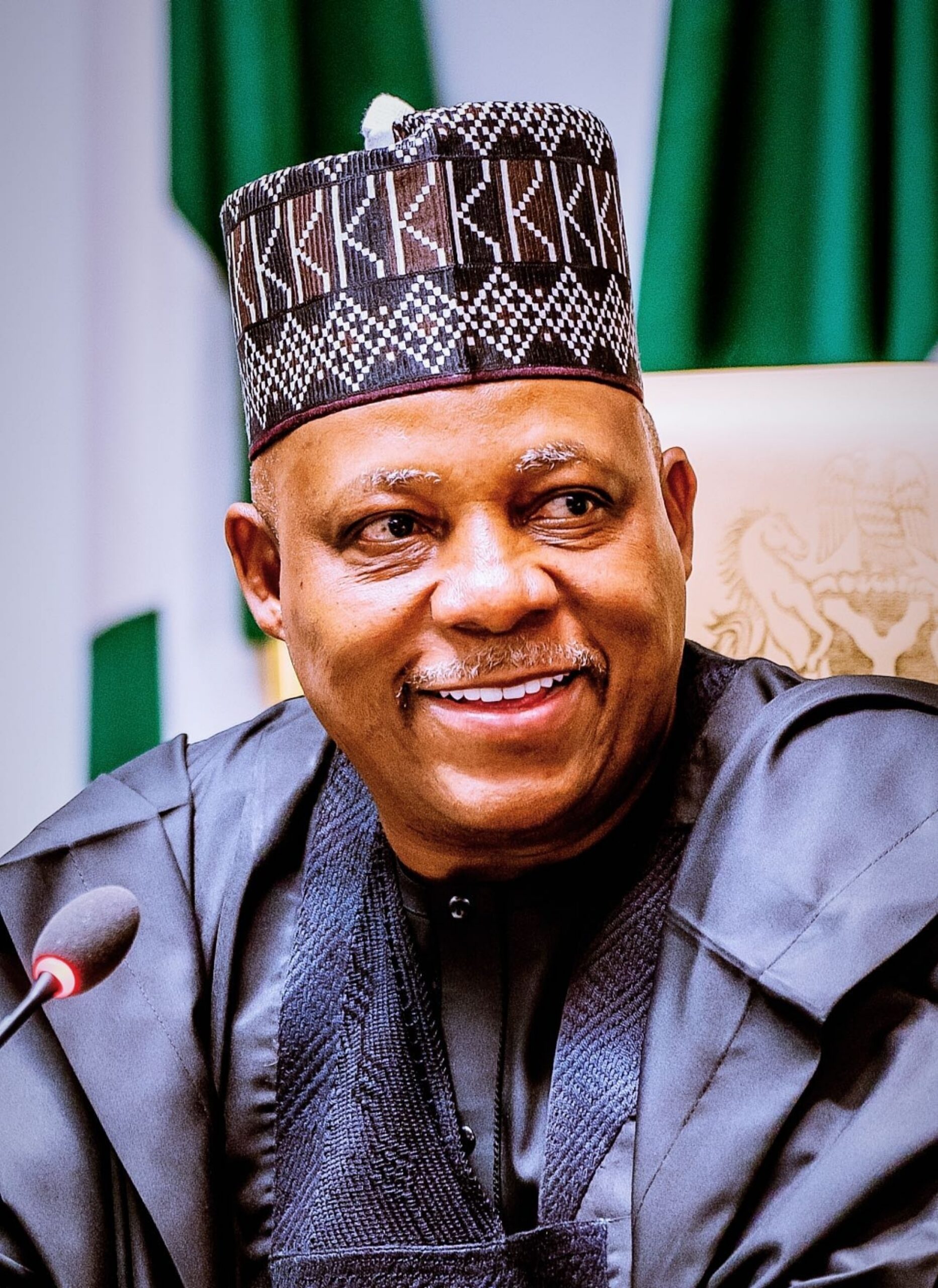
It was only a matter of time. What nobody could predict was how soon, in what way(s) and where. You don’t publicly put the Vice President in a tight spot and expect him not to react. Notwithstanding the limitations the Constitution has placed on the powers of the number two citizen, the vice presidency is still a very significant office. Yes, for obvious reasons, it’s a downgraded position in the presidency – but only in the presidency. Yet, this diminished status is sometimes altered by the political clout of the occupier. A Yomi Osinbajo does not wield the same influence as an Atiku Abubakar in the same position. One was a legal technocrat concerned about the meeting point of government and civil society. The other was a former presidential aspirant, mindful of the leverage the office presented for pursuing political ambition. His Excellency, Kashim Shettima did not assume the office as a neophyte. Shettima had been a two term State Governor; Governor of the troubled Borno State for that matter. He is now defining his vice presidency. That is the import of Shettima’s recent amplification on the nature of a governorship mandate. Shettima’s insight on how he continued in office as Governor despite a state of emergency in Borno State at the presentation of former attorney general, Bello Adoke’s book, _The Inside Story of the $1.3b Oil Block_ , was a bang. A timeless bang. The damning revelation sparked up for me a line from the poet Onyema Chukwu: “If I were an ant, I would sting the earth into a crisis.”
What were the President’s men thinking when they embarked on the excursion of Bola Ahmed Tinubu’s second term quest that did not include his current running mate? A spate of APC summits and conferences had recently endorsed the party leader Tinubu to fly the party’s presidential flag again in 2027. Curiously, none of these caucuses appeared to factor in the man with whom the President ran in 2023 as a fait accompli in their declarations, prompting speculations on the health of the ticket. Weighing in on the discussion which had political and media value for their principal, the President’s loyalists dismissed the concern over the blackout on Shettima. Last month, about mid June 2025, APC national secretary, Ajibola Basiru and presidential adviser, Bayo Onanuga, stated that discussion for a running mate was not on the table. They both held that the matter would be due for the President’s decision after the party’s convention at which the presidential candidate will be chosen. This position seems not to anticipate the discomfiture to be felt by exclusion of the vice president in considerations of a second term ticket. Or perhaps, chooses not to acknowledge it and come to terms with it. Whichever way, the vice president is a mortal with feelings like all of us. He experiences the flow of emotions and is not immune to our conflicting human psyches. What man does not have an iota of self esteem? To put a man of Shettima’s standing on the spotlight of political relevance or irrelevance and assume he would be unbothered by the avoidable, piercing scrutiny, is a wild assumption.
What happened at the APC northeast stakeholders conference last month should be seen as a barometre of reelection political mood. Media reports were consistent in describing the meeting in the vice president’s zone as ending in chaos. Daily Sun (June 15, 2025) account of the event noted that APC national chairman, Ganduje, was spirited out of the boiling venue to safety. Excerpts from the report offer a better grasp of the showdown.
“The high-level consultative meeting convened by key party stakeholders from the six states of the Northeastern states, including Governors of Borno, Yobe and Gombe and National Chairman, Abdullahi Umar Ganduje and other officials of the party ended in disarray when the national vice chairman (North East), Mustapha Salihu omitted Shettima’s name while endorsing Tinubu for a second term.
Immediately after Salihu’s remarks, angry supporters of Shettima demanded that he take back his statement and ensure that Shettima was endorsed to continue with Tinubu. That led to fracas. During the commotion, chairs and other objects were seen flying among dignitaries.” Other mainstream media narratives also centred on the deep – seated resistance to sidelining of Shettima in the 2027 presidential ticket. Again, could the Vice President be unconcerned about the drama building around him? Could he be indifferent to the agitation of his teeming supporters?
Then, on Thursday, June 10, 2025, the political earthquake of the decade happened when the Vice President took a trip down memory lane. His disclosure of how the plan to oust him as Governor through emergency rule failed, rings very loud bell. The plot collapsed on ground of constitutional incompetence. The following excerpts capture the heart of the revelation.
“Certain decisions are taken in a very small circle—the president, vice president, Senate president and the speaker of the House.
“At one of those conclaves, former President Goodluck Ebele Jonathan—whom I have sheath the sword with and have now recalibrated our relationship—was mooting the idea of removing this Borno governor. Aminu Waziri Tambuwal, the then speaker, had the courage to tell him, ‘Your Excellency, you don’t have the power to remove an elected councillor.’
The president was still not convinced. He raised the issue at the Federal Executive Council. I admire Mr Mohammed Bello Adoke fundamentally for his courage, convictions, and capacity to stand for what he believes in. He told the president, ‘You do not have the power to remove a sitting governor, not even a councillor.’
They sought the opinion of another SAN in the cabinet, Kabiru Turaki, who said, ‘I am concurring with the opinion of my senior colleague’. That was how the matter was laid to rest.”
Aside the doctrine of necessity on which Jonathan was declared acting President, the above testimony should rank as the next outstanding political development of the Fourth Republic. It assumes a prominent position in national discourse for a number of reasons. We are supposed to be running a federalist democracy and the principles of electoral mandate and rule of law are at the core of the system. Secondly, the views affirming superiority of democratic mandate to state of emergency are remarkable by virtue of the competent offices involved. Tambuwal and Adoke as House of Representatives Speaker, and Attorney General respectively, gave informed analysis on the issues at hand. Their considered advise to then President Goodluck Jonathan qualified as expert comment. Thirdly, the statements of the public officers were conclusive. They left no room for elastic interpretation of the provision for state of emergency. The submissions were not just definitive; they were emphatic on the limits of intervening authority in the exercise of state of emergency. Although the Mohammadu Buhari government did not declare a state of emergency in any State in it’s eight years of office, the instrument was grossly abused by the Olusegun Obasanjo administration. The Obasanjo presidency invoked the emergency clause in Plateau and Ekiti States with barracks mindset. The retired general announced the suspension of the Governors and appointment of administrators in their stead but was unable to tell Nigerians which lines of Section 305 of the Constitution or any other part of the Constitution that approved such democratic reversals. Demonstrating palace mentality, the Obasanjo presidency ignored assessments that the measures it pronounced were an importation into the emergency provisions, possibly a carryover instinct from the First Republic parliamentary system. Had the Jonathan experience revealed by Shettima been made public much earlier, chances are that focus on the stability intendment of state of emergency would have gradually evolved. This presupposes a shift from power obsession to protection of constituted authority.
Reacting to the positive reception of Kashim Shettima’s comments, the Presidency accused sections of the media of twisting the narrative.
In a statement, Senior Special Assistant to the President on Media and Communications, Stanley Nkwocha, protested that the
“sensational reporting disappointingly tried to erect a highly mendacious argument about the state of emergency declared in Rivers State and the subsequent suspension of Governor Siminalayi Fubara.
We wish to state categorically that Vice President Shettima’s comments were made within the specific context of acknowledging the author’s past professional conduct during his tenure as Attorney General of the Federation. His remarks were historical references to events that occurred during the Jonathan administration, and constituted nothing more than an intellectual discourse on Nigeria’s constitutional evolution.” Rising in defence of the controversial suspension of Governor Fubara, Nwokocha stated:
“President Tinubu followed the constitutional process with honest precision. The President’s proclamation properly invoked Section 305(2), which was subsequently ratified by an overwhelming bipartisan majority in the National Assembly.” It concluded by asserting that “Vice President Shettima stands shoulder to shoulder with President Tinubu in implementing these difficult but indispensable actions to safeguard our democracy.”
It’s understandable that the Presidency was disturbed, if not alarmed by the excitement generated by the Vice President’s pungent remarks. A government that is keen on dominating the polity would naturally be averse to a set of strict controls that impedes acquisition of power. The positive reception of what the Vice President said is not about any media slant. The verbatim content is on tape and all over the social media. Every Nigerian who can read and write will comprehend the lesson that Jonathan learnt; namely that presidential power, even when backed by legislative approval, has no jurisdiction over electoral mandate. Is there a correlation between the Jonathan experience and the Rivers State scenario? The latter pends at the Supreme Court and accordingly is not up for dissection. It should suffice to observe that the suit seeking to invalidate the state of emergency in Rivers State was filed by eleven state governors. That is an indication of the strong disagreement on the propriety of the said emergency rule measures. And nobody can downplay the value of history. Edward Carr reminds us that “history is an unending dialogue between the present and the past.” Shettima like every other concerned Nigerian knows that the relay pages of our national history, including gains in rule of law, cannot be wished away. In the end, the superintending officials of the Presidency might be left with only the card of collective responsibility. If he wanted to, Shettima cannot distance himself from the gamble in Rivers State by virtue of the inclusive ambit of government. Meritorious argument, no doubt – except that the logical conclusion would be extension of tenure – renewing platform to the second fiddle of Tinubu’s presidency.
Shettima could have spoken differently at Adoke’s book presentation. There are various perspectives and approaches to history. He could have eulogised Adoke in other ways, in subtle tones. But he chose to make such strong observations with telling effect. The message was loaded and penetrating at the same time. It seemed like a call for resolution of political differences. Whatever the motive, the historical update is a significant contribution in the quest for enthronement of democratic values.