Africa
Why Removing Churches and Mosques from Public Offices Is the Needed Move to Push Nigeria into the Path of Constitutional Renewal and Global Respect -By Prof. John Egbeazien Oshodi
One bold Executive Order, applied consistently and courageously, could shift Nigeria from a country of contradictions to a republic of principles. This is the moment for constitutional courage, not political caution — the moment to act, to correct, and to lead. When the law and conscience finally stand together, Nigeria will not only redeem its Constitution but restore its dignity before its own people and before the world.

Nigeria stands at a turning point that will test not only its laws but its soul. One decisive action from President Bola Ahmed Tinubu could begin to heal decades of constitutional confusion, political compromise, and moral hesitation. One bold Executive Order—removing all religious structures from public institutions—could become Nigeria’s first real step toward constitutional renewal and international respect. It would be a small administrative act with historic meaning, signaling that President Tinubu’s government is finally ready to live by the secular principle clearly written into the nation’s Constitution. What is at stake is not just Nigeria’s international reputation but the credibility of its democracy and the psychological trust of its people in the fairness of their own government.
The international pressure confronting Nigeria today is unlike any in its modern history. Under the renewed scrutiny of former U.S. President Donald Trump and current U.S. lawmakers such as Senator Ted Cruz and Representative Riley Moore, Nigeria has become a moral and geopolitical test case for religious freedom and constitutional integrity in Africa. Washington’s designation of Nigeria as a Country of Particular Concern (CPC) was not made lightly. It is a diplomatic warning reserved for nations that permit or ignore systematic religious persecution. The United States invoked this measure after years of horrifying evidence: the massacre of Christian villagers, the public lynching of Deborah Samuel Yakubu for alleged blasphemy, and the Nigerian judiciary’s continued failure to punish the perpetrators.
Trump’s administration, in particular, championed the idea that Nigeria could no longer hide under the rhetoric of being “religiously balanced.” His government’s actions were not simply punitive; they were psychological—a way to expose Nigeria’s deep constitutional contradictions to the world. The U.S. Congress followed that lead, framing Nigeria’s failure as both a legal and ethical breakdown. The message was clear: a government that funds churches and mosques on public grounds while claiming to be secular is living a national lie.
This is the environment President Tinubu now inherits—an atmosphere thick with mistrust abroad and hypocrisy at home. For him, this is no longer a moment for speeches; it is a moment for courage. The world is watching how he responds to the charge that Nigeria claims to be secular but tolerates discriminatory systems, especially in northern states where Sharia criminal codes still coexist with the Constitution. Whether or not Nigeria agrees with Washington’s framing, perception drives diplomacy. The only language the world believes is policy. Tinubu can defend Nigeria’s sovereignty not with anger but with integrity—by visibly aligning governance with constitutional truth.
To do this, he must take a single, transformative step: issue an Executive Order that ends the visible sponsorship of religion by the federal government. This order should direct that all churches, mosques, and prayer centers built or maintained with public funds on federal premises—ministries, universities, military barracks, secretariats, and agencies—be decommissioned, repurposed, or privately managed. It would further mandate that public resources, staff, and maintenance budgets can no longer support religious functions. This is not an anti-faith policy; it is a pro-Constitution act. It tells Nigerians that religion belongs to conscience, not to the payroll; to the heart, not to the ministry corridor.
Such a move would instantly recalibrate Nigeria’s standing in global diplomacy. It would be a tangible, verifiable proof to Washington and to international observers that the Tinubu administration is taking “substantial steps” to correct the very failures cited in the CPC report. It would create a lawful basis for the U.S. Secretary of State to recommend lifting the sanctions threat. It would also demonstrate that Nigeria is capable of moral self-correction without foreign intervention. By one courageous stroke of the pen, Tinubu could move Nigeria from being a suspect nation to a reforming nation—restoring credibility, stabilizing investor confidence, and resetting the tone of international engagement.
But such an act will not be easy. The domestic backlash will be immediate and loud. From the pulpit to the minaret, from northern governors to southern bishops, the cries will come: “The President is attacking God.” Politicians will warn of unrest. Religious groups will accuse the government of bowing to America. Yet the truth must be spoken clearly—leadership is not about pleasing everyone; it is about guiding the nation toward maturity. The President must communicate that this reform is not an attack on belief but a defense of fairness. When the state stops funding religion, it protects all faiths equally. When religion stands on its own, it becomes purer and freer.
Psychologically, this reform carries profound meaning. For decades, many civil servants have relied on office chapels and mosques as emotional sanctuaries in an often unjust system. For Christian workers in Sharia-governed states, small chapels have become symbols of identity and survival. For Muslim staff in southern offices, prayer rooms have been their assurance of belonging. These spaces comfort, but they also conceal a deeper injustice—the failure of the state to protect everyone equally. Removing these structures may feel painful, but it is a form of national therapy. It replaces false comfort with real security—the kind that comes when every Nigerian knows the government will defend them, not because of faith, but because of citizenship.
In reality, Nigeria’s crisis has never been a crisis of religion; it is a crisis of fidelity—to the Constitution, to equality, and to moral principle. We recite “one nation under God,” but act as if the state must serve two gods. We build twin sanctuaries in public offices and call it balance, when it is really institutionalized contradiction. Every chapel and mosque maintained with public funds is a monument to constitutional disobedience. The Executive Order would begin the cleanup—not of faith, but of hypocrisy.
This is President Tinubu’s test of statesmanship. He can choose the difficult path of reform and lead Nigeria toward unity and credibility, or he can continue the comfort of avoidance and leave the next generation to face isolation and shame. America’s renewed scrutiny under Trump’s influence, and the continuing watch from the U.S. Congress, are reminders that the world expects proof, not promises. A visible Executive Order will not erase Nigeria’s complex religious history, but it will signal the birth of a new political honesty—one that finally separates divine belief from public policy.
In the end, this is about legacy. Tinubu has a rare opportunity to do what no leader before him has dared: to end the illusion of neutrality and establish true constitutional balance. The decision to remove religious structures from public offices would not destroy faith—it would dignify it. It would tell Nigerians that prayer no longer needs state sponsorship to be sacred. It would tell the world that Nigeria’s democracy, though wounded, can still heal itself.
Conclusion
History will not remember who built the largest mosque or cathedral inside a government compound. It will remember who had the courage to remove them for the sake of the law — not just in Abuja, but across every local council, state institution, and federal agency, including the Presidency itself.
The Executive Order that President Tinubu must sign should go beyond symbolism. It must be rooted in conscience, enforced with integrity, and implemented across all levels of government. Every public building and office must reflect the neutrality of the state. No employee should attend or conduct worship during official work hours, and no government compound should continue to host mosques, chapels, or prayer centers of any kind within its premises. Such practices undermine productivity, distort public purpose, and violate the secular spirit of the Nigerian Constitution.
All existing religious structures inside government offices should be closed, repurposed, or relocated outside administrative environments. Ministries and agencies must adopt clear administrative rules making continued use of these facilities during work hours a punishable offense under the civil service code. Public institutions belong to every citizen; therefore, public time and property must not be devoted to sectarian activity.
This reform is not an attack on faith but an affirmation of fairness. It calls on the nation to distinguish between private belief and public duty, between spiritual devotion and constitutional obligation. Only by restoring this boundary can Nigeria recover the professionalism, focus, and equality that true democracy demands.
One bold Executive Order, applied consistently and courageously, could shift Nigeria from a country of contradictions to a republic of principles. This is the moment for constitutional courage, not political caution — the moment to act, to correct, and to lead. When the law and conscience finally stand together, Nigeria will not only redeem its Constitution but restore its dignity before its own people and before the world.
About the Author
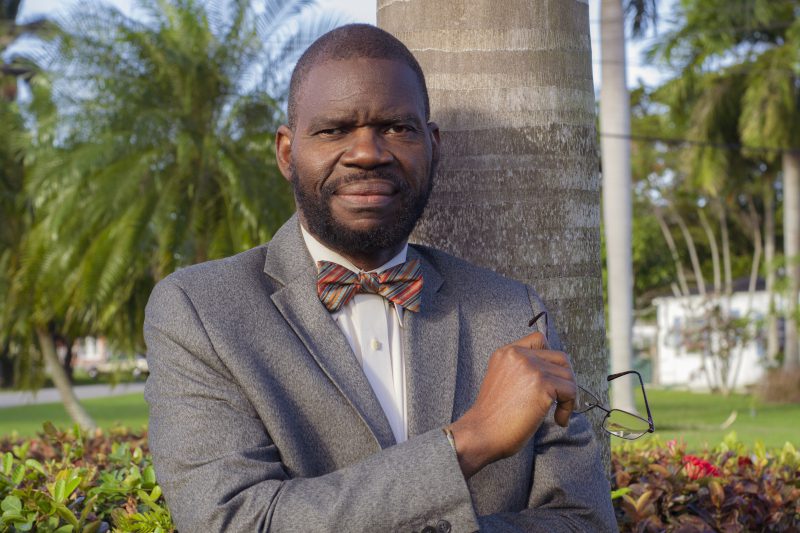
Prof. John Egbeazien Oshodi is an American psychologist and educator with expertise in forensic, legal, clinical, cross-cultural psychology, public ethical policy, police, and prison science.
A native of Uromi, Edo State, Nigeria, and son of a 37-year veteran of the Nigeria Police Force, he has dedicated his professional life to bridging psychology with justice, education, and governance. In 2011, he played a pioneering role in introducing advanced forensic psychology to Nigeria through the National Universities Commission and Nasarawa State University, where he served as Associate Professor of Psychology.
He currently serves as contributing faculty in the Doctorate in Clinical and School Psychology at Nova Southeastern University; teaches across the Doctorate Clinical Psychology, BS Psychology, and BS Tempo Criminal Justice programs at Walden University; and lectures virtually in Management and Leadership Studies at Weldios University and ISCOM University. He is also the President and Chief Psychologist at the Oshodi Foundation, Center for Psychological and Forensic Services, United States.
Prof. Oshodi is a Black Republican in the United States but aligns with no political party in Nigeria—his allegiance is to justice alone. On the matters he writes about, he speaks for no one and represents no side; his voice is guided solely by the pursuit of justice, good governance, democracy, and Africa’s advancement. He is the founder of Psychoafricalysis (Psychoafricalytic Psychology)—a culturally rooted framework that integrates African sociocultural realities, historical awareness, and future-oriented identity. A prolific thinker and writer, he has produced more than 500 articles, several books, and numerous peer-reviewed works on Africentric psychology, higher education reform, forensic, police and correctional psychology, African democracy, and decolonized models of therapy.