Africa
Why The Resistance To Nigeria’s Electoral Reform Raises More Questions Than Answers -By Isaac Asabor
Nigeria stands at a crossroads where electoral legitimacy will increasingly depend on verifiable processes rather than institutional assurances. Electronic transmission of results is not the entirety of reform, but it is a decisive step toward restoring confidence in electoral outcomes.

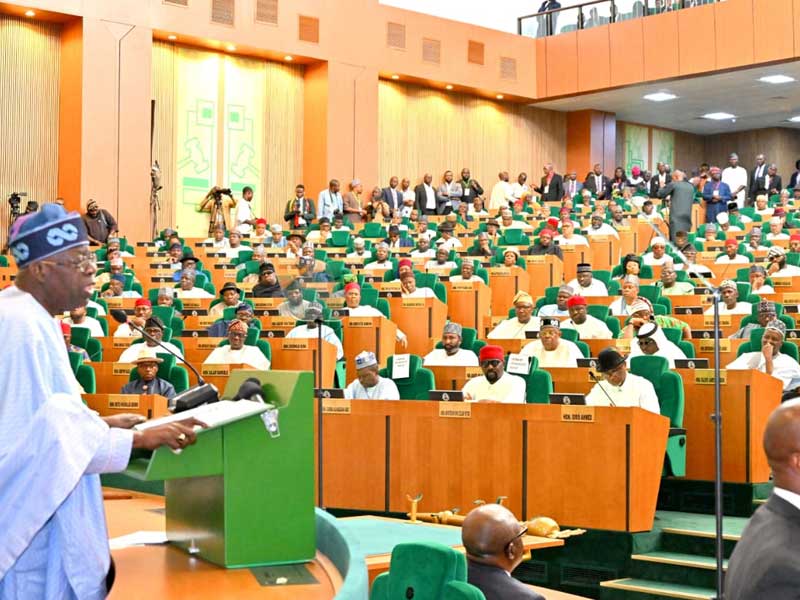
There is no denying the fact that transparency is the reason why the latest confrontation inside the House of Representatives of Nigeria over the Electoral Act (Amendment) Bill, 2025 is not just another parliamentary disagreement, it is a defining moment that demands scrutiny.
The immediate trigger was straightforward: a motion by Francis Waive to rescind the earlier passage of the amendment bill so lawmakers could revisit provisions in light of emerging electoral reforms. The Speaker, Abbas Tajudeen, put the matter to a voice vote. The majority rejected it. Protests followed. A proposal to deliberate privately was also rejected before lawmakers eventually moved behind closed doors.
On the surface, this may appear procedural. But beneath the parliamentary drama lies a deeper national question: why would lawmakers resist reopening a bill tied to the credibility of elections, particularly at a time when electronic transmission of results remains one of the most contested reforms ahead of 2027?
This is not merely about legislative process. It is about political incentives, institutional trust, and the future architecture of Nigeria’s elections.
Without any iota of exaggeration in this context, it is very obvious that the central issue to the ongoing electoral imbroglio is control versus transparency.
Without a doubt, electronic transmission of election results represents a structural shift in how political power is verified. This is as it reduces human discretion at collation centres, limits manipulation between polling units and final declaration, and introduces a digital audit trail. In essence, it shrinks the space where electoral outcomes can be negotiated rather than counted.
That reality explains why debates around result transmission are never technical alone, they are fundamentally political.
At this juncture, it is expedient to opine that resistance to revisiting an electoral reform bill in this climate naturally fuels suspicion. If reforms promise greater transparency, opposition to those reforms invites a simple question: who benefits from opacity?
Legislators may argue procedural sufficiency or legislative finality. But the public reads signals differently. When reforms linked to electoral integrity meet institutional resistance, citizens do not interpret caution; they interpret self-preservation.
In fact, Nigeria’s history with electoral reform is marked less by outright rejection than by strategic hesitation. Reform proposals are rarely dismissed in principle; instead, they are slowed, diluted, or procedurally complicated. The effect is the same, transformation is deferred.
Electronic transmission of results has followed this familiar path. It is widely supported by civil society, endorsed by many voters, and repeatedly debated within government. Yet implementation has remained contested, conditional, or inconsistently applied.
This pattern reveals a structural tension: democratic legitimacy requires transparency, but political survival often depends on control over uncertainty. Where election outcomes are predictable through transparent processes, incumbency advantage weakens. Where ambiguity persists, influence remains negotiable. That tension is the real battlefield behind legislative maneuvers.
In fact, the attempt to rescind passage of the amendment bill was framed as an effort to align legislation with evolving reforms. In principle, this is normal legislative housekeeping. Laws must adapt to new realities. So why the resistance?
In fact, since the controversies and agitations surrounding Nigeria Electoral Reform Bill, particularly one of its key elements, which is the adoption of the etranmission of results, several possible motivations have emerged.
One is the fear of reopening settled compromises. This is as electoral bills are typically products of delicate bargaining. Therefore, reopening them risks undoing agreements that benefited certain blocs. In fact, lawmakers who secured favorable provisions have little incentive to revisit them.
Two, is the anxiety over technological accountability. This is as electronic transmission limits discretionary authority during collation. It shifts power from political actors to systems. For those accustomed to influence at critical counting stages, reform represents a loss of leverage.
Third, is the strategic timing of the electoral reform before 2027. With another general election approaching, institutional actors are recalculating risk. Any reform that reduces electoral unpredictability may disadvantage those relying on traditional mobilization structures or localized control mechanisms.
Four, is institutional self-protection. However, legislatures often resist changes perceived as externally pressured, whether from public agitation, civil society, or electoral bodies. Opposition may reflect not only political interest but institutional defensiveness. Again, none of these motivations are publicly declared. Yet each aligns with observable political behavior.
Perhaps the most revealing aspect of the episode was not the rejection of the motion itself, but the resistance to open deliberation followed by eventual retreat into a closed session.
In fact, democracy depends not only on outcomes but on visible process. When debates about election laws move behind closed doors, suspicion multiplies. Citizens are left to interpret silence.
Again, closed-door sessions are not inherently illegitimate. Sensitive negotiations sometimes require privacy. But in matters directly affecting electoral credibility, opacity carries heavy symbolic cost. It suggests that the public is an observer, not a participant, in decisions shaping their political future. That perception damages confidence more than any legislative clause.
In fact, the controversy cannot be reduced to parliamentary procedure because the Electoral Act governs the mechanism through which political authority is renewed. Its design determines whether elections are competitions or contests of influence.
Again, electronic transmission of results is not a technological luxury. It is a trust infrastructure. It addresses long-standing allegations of tampering between polling units and final announcements, the very stage where public confidence has historically eroded.
In a similar vein, Nigeria’s democratic journey has survived transitions, crises, and contested outcomes. But survival alone is no longer sufficient. Citizens increasingly demand credibility, not just periodic elections, but verifiable ones.
Also in a similar vein, electoral legitimacy in the digital age depends on auditability. Voters must not only cast ballots; they must believe results reflect those ballots. Electronic transmission addresses that psychological contract.
Again, when lawmakers appear hesitant to strengthen mechanisms of verification, they unintentionally communicate a troubling message: that uncertainty remains politically useful. This is as trust cannot coexist with perceived reluctance toward transparency.
Against the backdrop of the foregoing view, it is germane to opine that as we look ahead to 2027 that the agitation surrounding electronic transmission is not fading. It is intensifying because the next general election will test whether Nigeria’s democratic institutions have evolved or merely endured.
In fact, if reforms are stalled, diluted, or ambiguously implemented, the 2027 election risks inheriting the same credibility disputes that have shadowed previous cycles.
Conversely, decisive legislative clarity would signal institutional confidence, a declaration that electoral outcomes need no protective ambiguity. In fact, the choice before lawmakers is therefore not technical but historical: whether to reinforce democratic trust or manage democratic skepticism.
At this juncture, permit this writer to note, as a reminder to Nigerian lawmakers that they may offer procedural explanations for their stance. They may cite legislative order, technical caution, or policy sufficiency. But the public’s question is simpler and more persistent: If reforms strengthen transparency, why resist them?
Until that question is answered openly and convincingly, every procedural maneuver will be interpreted through the lens of hidden motive. And in politics, perception often carries more weight than intention.
The confrontation in the legislature is a symptom of a larger democratic tension, the struggle between institutional control and public accountability.
Nigeria stands at a crossroads where electoral legitimacy will increasingly depend on verifiable processes rather than institutional assurances. Electronic transmission of results is not the entirety of reform, but it is a decisive step toward restoring confidence in electoral outcomes.
Given the backdrop of the foregoing view, it is not out of context to opine that lawmakers face a choice that extends beyond legislative procedure. They must decide whether democratic trust is strengthened through openness or managed through control.
If resistance to reform persists without clear justification, suspicion will not only endure, it will deepen. And when citizens begin to doubt the mechanisms of choice,
In fact, the events in the legislature have therefore done more than stall a motion. They have exposed a question that Nigeria can no longer postpone: Is electoral reform being debated in the interest of democracy, or negotiated in the interest of power?
Until that question is answered in the open, the tension witnessed in parliament will remain a mirror of a larger national uncertainty: whether the future of Nigeria’s elections will be counted in daylight or contested in shadow.