
Opinion
Azerbaijan and Congo Agree On Oil & Gas Refinery Projects, Economic Cooperation, By Kestér Kenn Klomegâh
After gaining independence in 1991, Azerbaijan became a member of the International Monetary Fund, the World Bank, the European Bank for Reconstruction and Development, the Islamic Development Bank, and the Asian Development Bank.

Congolese President Denis Sassou-Nguesso has engaged in game-changing strategy, widening the search for reliable partner ready to explore its oil reserves, undoubtedly due to Russia’s inability to fulfill bilateral promises and delay in acting on its limitless signed agreements. Russia’s Vladimir Putin held an official meeting with Sassou-Nguesso, in Novo-Ogaryovo near Moscow during which both leaders assertively agreed on strengthening economic cooperation.
Several packages of documents that were signed that year included intergovernmental agreements on cooperation in the peaceful use of nuclear energy and also on exploration of natural resources. Russia’s Pipe Metallurgical Company (TMK) was awarded the sole contract for building a major oil pipeline, running more than 1,300 km from the port city of Pointe-Noire in the Republic of Congo to the border with Cameroon.
In an interview with TASS News Agency, Sassou-Nguesso underscored the fact that “Russia is an important country, a strategic partner that may play its role in the period when Africa is looking for cooperation in building a new world in the region, building infrastructure, new economic and security systems. The African people want to develop their economy and to establish themselves on the global arena. Russia may hold a strategic position on this issue.”
Despite the praise given to Russia, the leadership of Congo has now shifted to Russia’s neighbour Azerbaijan, which is by description a transcontinental country located at the boundary of Eastern Europe and West Asia. As a former Soviet republic, it adopted a declaration of independence in October 1991. Geographically, three physical features dominate Azerbaijan: the Caspian Sea, whose shoreline forms a natural boundary to the east; the Greater Caucasus mountain range to the north; and the extensive flatlands at the country’s center.
What is most import here is that two-thirds of Azerbaijan is rich in oil and natural gas resources. There are many pipelines in Azerbaijan. The goal of the Southern Gas Corridor, which connects the giant Shah Deniz gas field in Azerbaijan to Europe, is to reduce European Union’s dependency on Russian gas.
After gaining independence in 1991, Azerbaijan became a member of the International Monetary Fund, the World Bank, the European Bank for Reconstruction and Development, the Islamic Development Bank, and the Asian Development Bank.
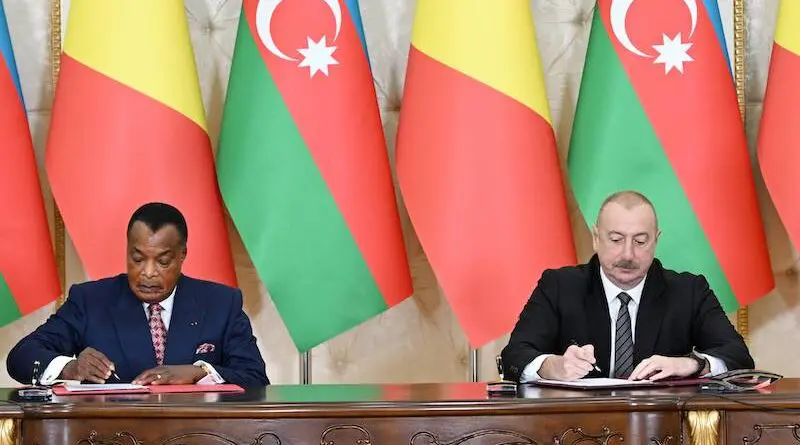
These make its significant importance for business, to establish corporate relations. And particularly, in the 21st century, a new oil and gas boom helped improve the situation in Azerbaijan’s science and technology sectors. It is not by mistake that Congo has established relations here. Azerbaijani President Ilham Aliyev held both tete-a-tete and expanded negotiations with Congolese President Denis Sassou Nguesso in early April 2024, a statement on the Azerbaijani leader’s website said.
The report monitored by this author, indicated that Azerbaijan and Congo signed a package of documents aimed at expanding bilateral cooperation following high-level negotiations in Baku, capital of Azerbaijan.
It therefore implies that the State Oil Company of Azerbaijan (SOCAR) and the National Oil Company of the Congo, by the signed agreement, both will jointly on specified conditions develop and expand Congolaise de Raffinage oil refinery. Congolaise de Raffinage specializes in the processing of light oil, its website says. The refinery’s capacity is 1 million tonnes of oil per year. Production started in 1982.
Both will jointly pursue various projects by the protocol of intent signed between the Ministry of Ecology and Natural Resources of Azerbaijan and the Republic of Congo’s Ministry of Environment and Sustainable Development on cooperation in the field of the environment, sustainable management of natural resources and climate change.
Nearly 80% of the population still live in abject poverty despite the fact that the country boasts of huge resources. The Republic of Congo has become the fourth largest oil producer in the Gulf of Guinea, providing the country with a high degree of potential prosperity despite its internal ethnic conflicts and economic disparity. It has large untapped mineral wealth, large untapped metal, gold, iron and phosphate deposits. In 2018, the Republic of the Congo joined the Organization of Petroleum Exporting Countries.



























