Africa
CJN Kekere-Ekun, Justice Dongban-Mensem—What Have Justice Barka, Otisi, and Others Done to My Political Structure? I Beg, How Soon Can You Return Those C of Os?, by John Egbeazien Oshodi

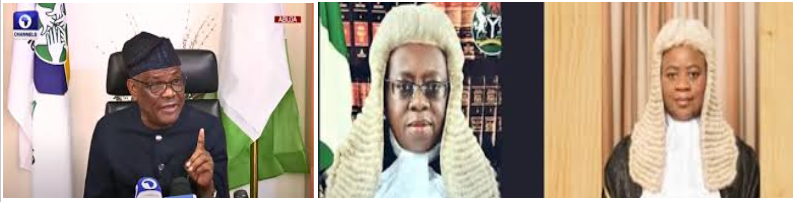
Minister of the Federal Capital Territory, Nyesom Wike, long reportedly celebrated as the “Golden Boy of the Judiciary” for his reported mastery in leveraging legal and political relationships, has encountered an unprecedented cascade of judicial defeats. Justice Hamma Barka’s appellate panel, alongside decisions by other judicial bodies, has delivered crushing blows to the very foundation of Wike’s political empire. His once-reliable playbook of influence, pomp, and alleged judicial maneuvering now lies in tatters, exposed to the unyielding principles of the rule of law.
A Time for Justices With Conscience
In a nation like Nigeria, where judicial corruption has often defined the country’s legal history, there comes a time when justices with conscience rise to defend the integrity of their calling. Despite decades of systemic rot, political manipulation, and external pressures—be it extravagant gifts, construction projects, or land allocations—some judges have chosen to prioritize justice over personal or political gain.
These justices recognize that the judiciary is not a tool for the powerful but the watchtower for society and the people. Justice Barka’s, Justice Otisi’s, and Justice Abdullahi’s panels, alongside others who have taken bold stands, represent this awakening. Their rulings remind us that despite systemic pressures, the judiciary’s ultimate duty is to uphold the rule of law, protect the constitution, and safeguard the public interest.
Enugu Court Ruling: Samuel Anyanwu’s Sack—A Tactical Disaster for Wike
The Court of Appeal in Enugu delivered a resounding verdict against Wike’s ally, Samuel Anyanwu, further dismantling Wike’s political machinery. The ruling upheld Anyanwu’s removal as the PDP National Secretary, validating the South East PDP caucus’s nomination of Ude Okoye as his replacement. This decision came in the wake of Anyanwu’s controversial return to the position after his failed gubernatorial bid.
Justice Ridwan Abdullahi’s judgment sent a clear message: internal party politics would no longer serve as an avenue for factional control. The judiciary refused to yield to Wike’s influence within his party. This was not just a personal loss for Wike but a symbolic defeat that highlighted the diminishing reach of his political maneuvers.
The Enugu ruling was also a significant victory for judicial independence. It reflected a growing consensus within the judiciary to resist becoming pawns in the political games of powerful figures. Wike’s influence, once perceived as unstoppable, now appears fractured and vulnerable.
Should Wike Ask for the CofOs Back: A Joke Wrapped in Realism
If Wike were to demand the return of his Certificates of Occupancy (CofOs), the judiciary’s response should be both direct and unapologetically realistic: “If we need buildings, court complexes, or residences for judges, we will put it in our own budget! Come and take your CofOs if you want—we are tired of the bad public perception, we are tired ooo!”
The judiciary must put an end to accepting infrastructure projects or so-called “gifts” from politicians, especially those entangled in legal cases involving themselves or their allies. These “donations” are not acts of goodwill; they are calculated maneuvers designed to curry favor and influence judicial outcomes.
Wike’s long-standing strategy of constructing court buildings and donating judicial residences has always been a transactional tactic cloaked in generosity. The judiciary’s recent rulings must set a new standard: such compromises are no longer acceptable. Courts must secure their resources transparently through government budgets, free from the strings of political patronage.
Severing the judiciary’s dependence on political largesse is essential to restoring its independence and integrity. Accepting such “gifts” not only erodes public trust but also reduces justice to a mere bargaining chip in the hands of powerful individuals. The judiciary must reclaim its rightful role as a neutral arbiter, untainted by political gamesmanship.
Wike’s Birthday Shock: Justice Barka’s Panel Sends a Resounding Message
On what should have been a day of celebration, Wike received a bitter dose of judicial reality. Justice Barka’s appellate panel delivered a ruling that dismantled the core of Wike’s political strategy. The judgment quashed his attempts to reinstate 27 ousted legislative allies, upheld local elections he sought to control, and denied maneuvers to secure federal allocations for his faction.
The timing of the ruling, on Wike’s birthday, added a poetic layer to the moment. It was a stark reminder that justice does not cater to personal milestones or political ceremonies. Wike’s reliance on extravagant gestures, such as luxurious events and strategic favors, failed to shield him from the judiciary’s renewed commitment to the rule of law.
Justice vs. Influence: The Collapse of Wike’s Tactics
Wike’s political playbook has long relied on a blend of theatrics and judicial manipulation. Through land allocations, Certificates of Occupancy (CofOs), and lavish hospitality, he cultivated an image of invincibility within judicial and political circles. However, Justice Barka’s rulings exposed the fragility of this facade, proving that such tactics can no longer guarantee protection.
The judiciary’s actions demonstrated a turning point: influence and material inducements would no longer dictate outcomes. Wike’s carefully orchestrated maneuvers, once seen as ingenious, now symbolize the collapse of a strategy built on questionable practices.
The Otisi Panel: Another Fatal Blow to Wike
In November, a panel led by Justice Onyekachi Otisi nullified a Federal High Court ruling that had barred the Independent National Electoral Commission (INEC) from releasing voter registers for Rivers State local government elections. Justice Peter Lifu’s earlier judgment, which had invalidated the elections on procedural grounds, was exposed as a politically motivated decision influenced by Wike’s allies.
Justice Otisi’s panel emphasized that local government elections fall under state jurisdiction, not federal oversight. The judgment restored credibility to the electoral process and underscored that the judiciary would not be a pawn in political power struggles. This was another decisive blow to Wike’s factional tactics, further isolating him from judicial and political allies.
CofOs and Exploitation: The Real Game
Wike’s approach to leveraging Certificates of Occupancy to possibly gain judicial favor is now laid bare as a calculated ploy. For years, he strategically used land allocations and construction projects to position himself as a benefactor to the judiciary. However, these so-called acts of goodwill were thinly veiled attempts to manipulate outcomes and secure loyalty.
The judiciary’s recent rulings must signal the end of such practices. Judges and courts should reject external funding tied to political figures, as these compromises erode independence and public confidence. The judiciary’s role is to serve justice, not politicians.
Conclusion: The Rule of Law Rewrites the Rules
The judiciary’s response to Wike’s tactics marks a watershed moment for Nigeria’s legal system. By rejecting political influence and material inducements, courts are reclaiming their role as custodians of justice. Should Wike request the return of his CofOs, the judiciary’s reply must be unequivocal: “We are not for sale. Our infrastructure and resources should come from transparent budgets, not from those with vested interests.”
For Wike, the era of unchecked influence has ended. Justice Barka’s, Justice Otisi’s, and Justice Abdullahi’s rulings collectively reaffirm the rule of law as the cornerstone of governance and accountability. This is a defining moment for Nigeria, where the judiciary has taken a bold stand to ensure that justice serves the people, not the powerful. The rules have been rewritten, and the message is clear: integrity and fairness must prevail.

Professor John Egbeazien Oshodi, born in Uromi, Edo State, Nigeria, is an American-based police and prison scientist, forensic/clinical psychologist, public policy psychologist, and legal psychologist. He’s a government advisor on forensic-clinical psychological services in the USA and the founder of the Dr. John Egbeazien Oshodi Foundation for Psychological Health. With a significant role in introducing forensic psychology to Nigeria through N.U.C. and Nasarawa State University, he’s also a former Secretary-General of the Nigeria Psychological Association. He’s taught at esteemed institutions like Florida Memorial University, Florida International University, Nova Southeastern University, and more, and is currently an online faculty member at ISCOM University, Weldios University and Walden University.