
Africa
David Umahi: Once A Visionary Governor, Now A Proactive Minister, by Isaac Asabor

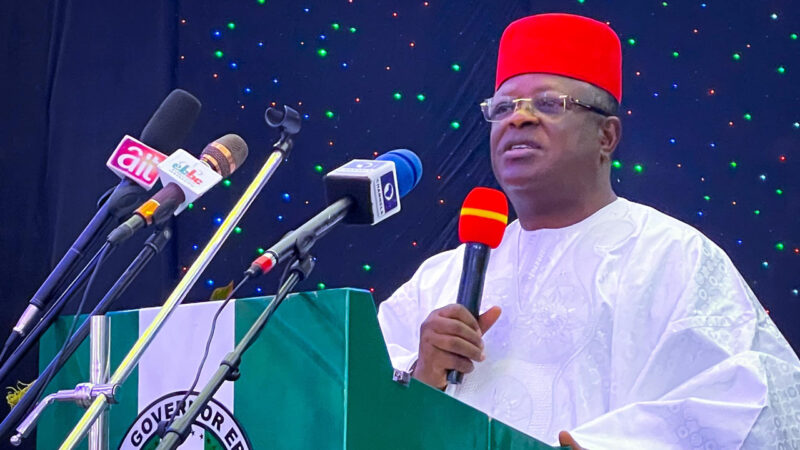
David Umahi, the former Governor of Ebonyi State, has carved a niche for himself in Nigeria’s political and developmental landscape. Known for his ingenuity and tenacity, Umahi’s two-term tenure as governor was marked by unprecedented infrastructural development and economic transformation in Ebonyi State. Today, as Nigeria’s Minister of Works, he continues to display the same proactive leadership that has become his hallmark, applying it to tackle the nation’s pressing infrastructure challenges.
When David Umahi took office as Governor of Ebonyi State in 2015, the state was widely regarded as one of the least developed in Nigeria. Faced with dilapidated infrastructure, high poverty rates, and a lack of industrial growth, Umahi’s leadership was tested from the outset. However, he rose to the challenge, executing a bold and ambitious agenda that would transform Ebonyi into a state synonymous with progress and innovation.
Umahi’s most notable achievements in Ebonyi were in infrastructure. His administration embarked on a massive road construction drive, using innovative concrete pavement technology to ensure durability and cost efficiency. Over 1,500 kilometers of roads were built or reconstructed, many of which remain in pristine condition today. Flyovers and bridges sprang up in strategic locations, including the now-iconic Akanu Ibiam and Offia Nwali flyovers in Abakaliki. These projects not only enhanced transportation within the state but also opened up Ebonyi to trade and investment.
Beyond roads, Umahi’s administration prioritized urban renewal. Abakaliki, the state capital, was transformed into a modern city with well-lit streets, functional drainage systems, and aesthetically pleasing public spaces. He also initiated the construction of the Ebonyi Shopping Mall and the International Market, providing platforms for commerce and boosting local businesses.
Umahi understood that infrastructure alone could not drive sustainable development. His administration invested heavily in education and healthcare, focusing on human capital development. In education, scholarships were awarded to thousands of students, while teachers underwent rigorous training programs to improve the quality of teaching. The establishment of the King David University of Medical Sciences was another milestone, aimed at making Ebonyi a hub for medical training and healthcare delivery in Nigeria.
In the healthcare sector, Umahi’s government upgraded hospitals across the state and built new ones in underserved areas. The state’s fight against maternal and child mortality earned commendations, as did its response to public health emergencies such as the COVID-19 pandemic. His administration’s comprehensive approach to governance set Ebonyi apart as a beacon of development in Nigeria’s southeast.
David Umahi’s performance as governor did not go unnoticed. In 2023, he was appointed Minister of Works by President Bola Ahmed Tinubu, a position that offered him the opportunity to replicate his success on a national scale. Many viewed his appointment as a strategic move, given Nigeria’s dire need for infrastructure development and Umahi’s proven track record in the field.
Since assuming office, Umahi has hit the ground running. His proactive leadership style is evident in his hands-on approach to addressing the nation’s infrastructure challenges. He has conducted on-site inspections of major road projects across the country, engaging contractors and stakeholders to ensure adherence to quality and timelines. His emphasis on accountability and transparency has introduced a new sense of urgency to the Ministry of Works.
Umahi’s tenure as Minister of Works has been characterized by bold initiatives aimed at addressing Nigeria’s long-standing infrastructure deficit. One of his key strategies has been the promotion of public-private partnerships (PPPs) to fund and execute major road projects. Recognizing the limitations of government funding, he has called on private sector players to invest in infrastructure, offering incentives such as tax rebates and long-term concessions.
Another hallmark of his leadership is the adoption of sustainable construction practices. Drawing from his experience in Ebonyi, Umahi has advocated for the use of concrete pavement technology for federal roads, citing its durability and cost-effectiveness. This approach is expected to reduce maintenance costs and ensure the longevity of Nigeria’s road network.
Umahi has also prioritized stakeholder engagement. He has held numerous meetings with state governors, community leaders, and contractors to address bottlenecks in project execution. His ability to foster collaboration among diverse stakeholders has been instrumental in driving progress.
Nigeria’s infrastructure challenges are well-documented. The country’s road network, estimated at over 200,000 kilometers, is plagued by potholes, poor maintenance, and inadequate connectivity. Many major highways, including the Lagos-Ibadan Expressway and the East-West Road, have suffered delays and cost overruns. Umahi’s task as Minister of Works is daunting, but his track record inspires confidence.
One of his first moves as minister was to undertake a comprehensive review of ongoing federal road projects. This review has identified areas where contractors failed to meet quality standards, leading to corrective measures. Umahi has also announced plans to introduce performance-based contracts to hold contractors accountable for project outcomes.
In addition to roads, Umahi has expressed interest in improving Nigeria’s bridge infrastructure. The Second Niger Bridge, completed in 2023, serves as a model for what can be achieved with political will and efficient project management. Umahi’s goal is to replicate such successes across the country.
Despite his proactive efforts, Umahi faces significant challenges. Nigeria’s infrastructure deficit requires enormous financial resources, and the government’s budgetary constraints are a limiting factor. Corruption and inefficiencies in project execution also pose threats to progress. Furthermore, the vast geographical expanse of Nigeria means that infrastructure development must be equitable to avoid regional imbalances.
Umahi’s ability to navigate these challenges will depend on his strategic acumen and political dexterity. His insistence on transparency and accountability is a step in the right direction, but sustained progress will require broader institutional reforms.
David Umahi’s leadership style resonates with ordinary Nigerians. His hands-on approach and commitment to delivering results have earned him the moniker “The People’s Minister.” Citizens and stakeholders alike have praised his accessibility and willingness to engage with those affected by infrastructure projects. His emphasis on quality and efficiency has also restored public confidence in the Ministry of Works.
David Umahi’s journey from a visionary governor to a proactive minister is a testament to his dedication to public service. His ability to combine innovative thinking with practical solutions has set him apart as one of Nigeria’s most effective leaders. As Minister of Works, he has the opportunity to leave an indelible mark on Nigeria’s infrastructure landscape.
Umahi’s story is not just about roads and bridges; it is about building a nation. His vision for a connected and developed Nigeria aligns with the aspirations of millions of citizens who yearn for a better future. While challenges abound, Umahi’s track record suggests that he is more than capable of rising to the occasion.
In a country where leadership often falls short of expectations, David Umahi stands as a beacon of hope. His transformation from a visionary governor to a proactive minister is a reminder that with the right leadership, Nigeria can overcome its challenges and achieve greatness. As he continues his journey, Nigerians can look forward to a future where infrastructure serves as the backbone of national development.




















You must be logged in to post a comment Login