Africa
Florence Ita-Giwa and Ireti Kingibe’s Harmful Views: A Warning to African Girls and Women -By John Egbeazien Oshodi
African women and girls deserve better role models, better leaders, and a better future. We must push for systemic change, demand zero tolerance for harassment, and refuse to allow men or their enablers to dictate how women should respond to oppression. Akpoti-Uduaghan’s bravery in speaking out should be celebrated, not condemned. The narrative must shift—from one that silences survivors to one that holds perpetrators accountable.

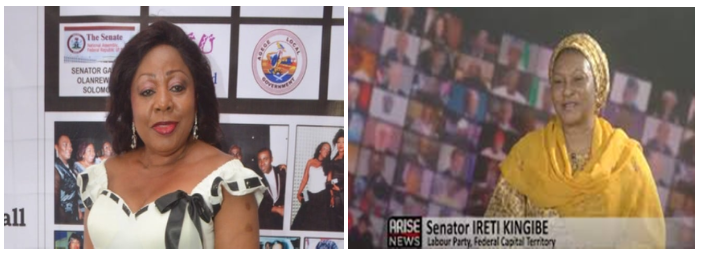
The insidious nature of victim-blaming has once again reared its ugly head in African politics, this time through the voices of two women who should know better—Senator Florence Ita-Giwa and Senator Ireti Kingibe. Instead of standing as allies to women in power, instead of using their positions to dismantle the entrenched culture of harassment that silences women in leadership, they have chosen to uphold the very structures that keep women oppressed. Their recent remarks concerning Senator Natasha Akpoti-Uduaghan’s allegations of sexual harassment by Senate President Godswill Akpabio are not just disappointing; they are a direct attack on the fight for justice, equality, and basic human dignity.
The damage caused by women who align themselves with the forces of oppression cannot be overstated. Ita-Giwa’s public shaming of Akpoti-Uduaghan, portraying her courage as a sign of weakness, is a textbook example of how internalized misogyny fuels the silencing of survivors. Her words do not just embolden perpetrators—they actively work to discourage victims from ever seeking justice. By implying that women in power are somehow immune to harassment or should simply endure it without complaint, Ita-Giwa and Kingibe are sending a chilling message to African women and girls: if you are harassed, it is your fault. If you speak out, you are weak. If you demand justice, you are a disgrace.
Florence Ita-Giwa’s remarks, broadcast on Arise TV, were not just problematic—they were a betrayal of every woman who has fought against sexual harassment, gender-based violence, and workplace discrimination. In her words, “By the time you contest elections and get to the Senate, you have passed that stage of your life of being sexually harassed.” The sheer ignorance and cruelty embedded in this statement reveal a profound misunderstanding of how power and abuse operate. Ita-Giwa further declared that women should “build so much confidence and make [themselves] unapproachable in the midst of men.” This dangerous and outdated mindset suggests that the responsibility for avoiding harassment falls on women, rather than on the men who perpetrate it. This is victim-blaming in its purest form.
Sexual harassment does not disappear once a woman reaches a certain level of power. If anything, it often intensifies, as powerful men seek to intimidate, humiliate, and control women who dare to challenge them. From boardrooms to political chambers, women in leadership often find themselves targeted for abuse precisely because they refuse to be subordinate. Ita-Giwa’s suggestion that Akpoti-Uduaghan should have simply hardened herself and endured in silence is a betrayal of every woman who has suffered in silence, fearing retribution, career destruction, or social exile.
Ita-Giwa’s remarks are especially dangerous because they come from a woman who has spent decades in Nigerian politics. Instead of using her platform to amplify the voices of women who have been silenced for too long, she has instead chosen to serve as an enabler of the very forces that oppress women. It is an act of profound hypocrisy for someone of her stature to turn her back on a fellow female senator who is courageously standing up to male dominance. By reinforcing the harmful notion that women should tolerate abuse in silence, Ita-Giwa has aligned herself with the oppressors, not the oppressed.
Senator Ireti Kingibe, though less overt in her rhetoric, has been no less complicit in silencing Akpoti-Uduaghan. Kingibe’s insistence that Akpoti-Uduaghan’s protest over being sidelined in the Senate chamber was merely a matter of “rules and decorum” completely ignores the underlying gendered power dynamics at play. Rather than acknowledging the institutionalized sexism that led to Akpoti-Uduaghan’s mistreatment, Kingibe chose to uphold the very system that has historically kept women in check. This is the hallmark of institutional sexism—when women who conform to oppressive structures are rewarded with acceptance, while those who challenge them are branded as troublemakers.
These attitudes do not just harm one woman; they harm every African girl and woman who has ever been made to feel powerless. When women in positions of power publicly dismiss harassment allegations, belittle survivors, and reinforce toxic masculinity, they make it even harder for ordinary women—those without political connections, wealth, or social standing—to find justice. Their words are not just opinions; they are weapons that strengthen the very system that allows sexual harassment and abuse to flourish.
The psychological consequences of such rhetoric are devastating. Victim-blaming erodes self-esteem, making survivors believe that they somehow deserved their abuse. It creates a culture of fear, where victims are too afraid to speak out because they know they will be dismissed, shamed, or retaliated against. It emboldens perpetrators, giving them the confidence to continue their predatory behavior without fear of consequences. The mental health toll of victim-blaming is severe—it contributes to depression, anxiety, PTSD, and even suicidal ideation among survivors. By reinforcing these toxic ideas, Ita-Giwa and Kingibe are not just making political statements; they are contributing to the ongoing psychological suffering of countless women and girls.
African women must reject this harmful mentality in its entirety. The idea that women should tolerate harassment, remain silent, and bear the burden of preventing abuse is not just outdated—it is fundamentally unjust. Women do not exist to be silent recipients of male aggression. They have the right to demand accountability, to call out injustice, and to exist in spaces of power without fear.
Ita-Giwa and Kingibe must be held accountable for the damage their words have caused. They have publicly reinforced an oppressive ideology that protects predators and punishes victims. If they refuse to retract their statements, they must be recognized for what they have become: enablers of a system that actively harms women. Their positions in history must not be that of pioneers, but of betrayers—women who had power but chose to wield it against other women instead of for them.
African women and girls deserve better role models, better leaders, and a better future. We must push for systemic change, demand zero tolerance for harassment, and refuse to allow men or their enablers to dictate how women should respond to oppression. Akpoti-Uduaghan’s bravery in speaking out should be celebrated, not condemned. The narrative must shift—from one that silences survivors to one that holds perpetrators accountable.
To Ita-Giwa and Kingibe, I say this: your words have not just disappointed women—they have endangered them. You have used your influence to defend oppression rather than fight it. History will remember you not as allies, but as obstacles in the struggle for women’s rights.
Let it be known that this writer has no personal or official relationship with any party here. All he cares about is fairness and goodness.
To African women and girls, I say this: do not be silenced. Do not let the Ita-Giwas and Kingibes of the world convince you that your suffering is your own fault. Your voice matters. Your pain is real. And your right to justice is undeniable.
This fight will not be lost. Women’s voices will not be silenced. Our rights will not be denied. And no amount of victim-blaming will ever erase the truth. The movement for justice, dignity, and equality will continue—with or without the support of those who have chosen to side with oppression.
Today, African girls and women are telling the two Madams that we will not give in to weakness. They will not back down. They will never stop fighting.
Madams make una nor vex with me ooo

John Egbeazien Oshodi
Oshodi Open Door, also known as Oshodi Open Door Public Training (OOPDT, pronounced opidt), is a public awareness initiative promoting transparency, accountability, and integrity in Africa through educational articles and resources at jos5930458@aol.com, and offers specialized Timely Response Solutions (TRS) training at minimal or no cost.
Professor John Egbeazien Oshodi is an American psychologist, educator, author specializing in forensic clinical psychology, cross-cultural psychology, police prison science, social justice. Born in Uromi, Edo State, Nigeria, he is the son of a 37-year veteran of the Nigeria Police Force, a background that shaped his commitment to justice, security, psychological research.
A pioneer in forensic psychology, he introduced state-of-the-art forensic psychology to Nigeria in 2011 through the National Universities Commission (NUC) Nasarawa State University, where he served as an Associate Professor in the Department of Psychology. His contributions extend beyond academia into psychological health behavioral change initiatives through the Oshodi Foundation the Center for Psychological Forensic Services.
Professor Oshodi has held faculty positions at Florida Memorial University, Florida International University, Broward College, Nova Southeastern University, Lynn University. He is also a contributing faculty member in the doctoral undergraduate psychology programs at Walden University serves as a virtual professor with Weldios University and Iscom University.
Beyond academia, he is a government consultant for forensic-clinical psychological services in the USA previously served as Interim Associate Dean Assistant Professor at Broward College, Florida.
He has published extensively on mental health, justice, institutional reform is the founder of the Psychoafricalysis theory, which integrates African sociocultural perspectives into psychology.
Professor Oshodi remains an influential force in advancing psychology institutional reform globally, particularly in Africa.