Africa
Jungle Justice And Criminal Justice System In Nigeria: Its Evaluation And Implication -By Mukaila Habeebullah
Mob justice has been something rampant in our society and it is the rationale behind the death of many innocent people through lynching, killing and all sorts. It’ll be good if the government can consider the highlighted implication above and act upon the recommendations.


In recent times, Nigeria has been facing a lot of injustice in the name of seeking justice for a wrongful act or omission done by any person to the person of another by taking law into their hand due to the inefficiency and corruption in the formal legal system and law enforcement agency. This paper aims to examine the meaning of Jungle or Mob justice, its implication and the need for the government to bridge the gap for the loophole.
INTRODUCTION
Ideally, emotion does its course over the world which usually leads to the infliction of punishment unlawfully on anyone who goes against the law. The problem of taking law into one’s hand whenever anything happens to the individual and because of the leniency and slow recourse to justice marking the judges corruptive action of the police and other law enforcement agency and they believe justice delayed is justice denied that’s why they prefer taking law into their hand rather than follow a righteous channel to seek justice which eventually result to unlawful way of resolving dispute which is referred to as “Mob or Jungle Justice”
EXAMINATION OF JUNGLE JUSTICE IN NIGERIA
Lest we forget, in 1995, Gideon Akaluka was in police custody, after being accused, through his wife, of desecrating the holy Qur’an, and a mob broke into the cell where he was kept , brought him out, killed and beheaded him. His bodiless head was then paraded round the streets of Kano. None of the perpetrators was ever apprehended, let alone, tried, or prosecuted till today.
In the same vein, in 2022, a Christian lady, Deborah Samuel who was then a student of Shehu Shagari College of Education Sokoto, was gruesomely murdered in Sokoto over alleged blasphemy against the religion of Islam. Although, The killer never suffers any consequences for it.
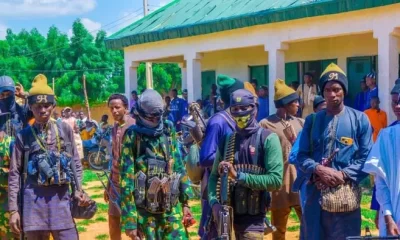
On Thursday, March 27, 2025, when a group of hunters of Northern extraction, reportedly based in Port Harcourt, were on their way to Kano to celebrate Salah. The same pattern is bound to be repeated. While transiting from Port Harcourt in Rivers State to Kano State, through Edo State, the victims were said to have been stopped and searched by a group of vigilantes in Uromi. The local vigilantes reportedly found some Dane guns, and machetes on them. Some accounts say, with a huge amount of cash. Those, I assume to be their work tools, and proceeds from their trade, respectively. The travellers were allegedly killed by those men of the vigilante group in the headquarters of the Esan North East Local Government Area of the state on suspicion of being criminals (kidnappers). Reports have it that the environment had suffered incidents of kidnapping by some bandits believed to be herders from the north.¹ But what begs for answers are, does that justify the barbaric act ? The truth without fallacy is no. Is there no law enforcement agency in the country? Is there no criminal justice system and procedure that stipulates how a suspected person will be prosecuted ? The answer is not only clear but glaring. However, people have lost confidence in them and the reason is not far-fetched. Our law enforcement agents sometimes act as though they’re for hire. Even if they are at the scene of a crime, they feign ignorance, or turn a blind eye, claiming that nobody has come to report anything to them. This is just to mention, but a few cases of jungle justice/mob-killings, across the country over the past couple of decades for the purpose of not swaying from the focus of the paper.
JUNGLE JUSTICE DEFINED AND CRIMINAL JUSTICE SYSTEM IN NIGERIA
Jungle Justice is a form of self help, whereby a person, people or a mob takes the law into their hand and mete out “justice” on a suspect, by lynching, wounding, or killing him, instead of handing him over to the police, or other law enforcement agency, to underdo due process of law, because they feel law is lenient, slow, or the person will escape justice if he’s handed over to the law.
The problem of jungle justice is that an innocent sometimes might be mistakenly labeled and dealt with for the offence he knows nothing about thereby leading to usurpation of law and orderliness that the law seeks to achieve because facts and truth are distinct. Facts may suggest or clearly point to somebody, and yet the facts and conclusion may not be true. Thus, the facts that point may not be true. Accordingly the fact may not stand scrutiny when subjected to investigation, judicial trial or due process of law. Moreso, the witness may not stand the examination in the court.² The consequences of mob or jungle justice are shown in many cases, including R. Aniogo (1970) 1 ECSLR 43
In the case the accused was woken up by the hue and cry of fellow villagers who were pursuing a thief at night. He came out of his house with a gun. He saw a man running towards him, being followed by a crowd. Suspecting that the man was a thief. The accused was charged with unlawful killing. The court held: that he was guilty of manslaughter, instead of murder.
In the celebrated Nigeria case of Kaza v. State (2008) 7 NWLR (PT. 1085) 125 SC 2 the supreme court frowned at the lynching of a muslim by his muslims brothers who accused him of insulting prophet Mohammed and slaughter him at the outskirts of the city as a result. In dismissing their appeal and upholding the sentence of death by hanging imposed on them by the High Court of Lebbó State for Culpable homicide. The Supreme Court condemned the evil of mob justice in these punchy words:
“The appellant in this appeal did not show to any of the courts that he had the requisite authority to take the life of the deceased. He thus unlawfully deprived the deceased the opportunity to defend the allegations leveled against him before any court of law or authority. The village head of Kadi who was contacted by the appellant and others, for authority to execute the deceased, flatly refused authority as he fully well knew that he was not the right authority to grant such a leave. A learned person known as Ustaz Mamma drew attention of the appellant and his co-accused persons that they had no authority to take away the life of the deceased, yet they kept deaf ears and even described the Ustaz as an infidel. I cannot see how these kinds of people shall have no sympathy for the banishment of such busy bodies who respect no human life due to their high degree of misapprehension of the law or, should I say, complete ignorance of the law. The appellant failed to convince me through his explanations. But he’s free to make further and better explanations to the hangman, though belatedly.”
THE LEGAL IMPLICATION OF MOB OR JUNGLE JUSTICE
It’s not only clear, but glaring, that mob justice has a lot of legal implications, due to the fact that the law really frowns at taking law into one’s hand. On this premise, the following are the legal implication of mob or jungle justice
Breaking of law and order
Potential for further violence and Instability
Killing of Innocence People
Unwanted revenge and Tribalism
Violation of fundamental human right
Breaking of law and order: law was made as a cement that synchronized all the society in an harmonious way, so imposition of punishment upon anyone without adherence to the due process of law is a violation of law and orderliness, by implication led to the commission of another crime which might eventually results for the charging the person to court.
Potential for further Violence and Instability: it’s not novel that whenever people mobs against the victim or the person in question it often leads to further violence as many a people might raise up to fight for their brother without listening to what he has done, and if eventually he was not guilty which would thereby lead to instability of village, community and nation at large.
Killing of Innocent Person: Most times the victim of mob justice might not be the actual person that committed the crime but because they did not follow the due process of law, better still hand him over to the police or any other law enforcement agency that’s responsible to scrutinize his offence that might inflict the punishment that outweigh the offence alleged him to have committed by killing him. Which is known as Manslaughter. Besides, the law has stipulated that everyone is presumed innocent until the contrary is proved. See: Section 36 (5) of the Federal Republic of Nigeria Constitution 1999 as amended.³
Violation of Fundamental Human Rights: the constitution of Federal Republic of Nigeria strictly protect the right of every citizens specifically chapter IV Section 33, it protect life and does not condone any torture or degrading violence unless with due process of law. As a result of this, taking law into one’s hand without compliance with law is a violation of Fundamental Human Rights.
CRIMINAL JUSTICE SYSTEM IN NIGERIA
The present Nigeria criminal justice system has a strong historical effect because of the diversity of culture and traditions. However by the advent of colonialism, Nigeria adopt British system in consonance with some of their customary offence provided that it’s not repugnant to natural justice, equity and good conscience nor incompatible either directly by implication with any law for the time being in force and the Evidence Act adds the test of contrary to public policy. See Section 26 (1) High Court of Lagos State, Section 34 (1) High Court Law of Northern States and Section 14 (3) of Evidence Act to which was codified into Criminal Code Act and Penal Code. Notably, the Criminal Code Act is applicable in the southern part of Nigeria whereas the Penal Code is applicable in the Northern part of Nigeria. These codes were put in place as a substantive law that defines and prescribes punishment for any offence committed by any person which was made by the National Assembly.
It’s worthy of note that no one can be convicted for a criminal offence unless that offence is defined and the punishment thereof is prescribed in a written law. This is evident in Section 36 (12) of the 1999 Constitution of Federal Republic of Nigeria (2023 as amended) also the celebrated case of Aoko v. Fagbemi.
Additionally, the National assembly further made law in which any person suspected to have committed any criminal offence may be brought to court to seek redress and this can be found in our ground norm i.e constitution and some related statutes like Criminal Procedure code, Criminal Procedure Act and so forth.
Virtually all the international organizations have passed resolutions against extra Judicial killing. The Universal Declaration of Human Rights (UDHR) states that “everyone has the right to life, liberty and security of person. ‘UDHR also recognizes the inherent dignity (and title) , equal and inalienable rights of all members of the family.⁵
The General Assembly also reacted in response to arbitrary execution and politically motivated killing. On December 15, 1980, it adopted a resolution in which it urged member states to abide by the provisions of Articles 6, 14 and 15 of the International Covenants on Civil and Political rights that cover the right to life that equally guarantee fair and impartial judicial proceedings.
Recommendations
Nigeria as a nation is a state where a lot of people did not know their right and obligation, this usually results in committing an offence over an offence in the name of taking law into one’s hand. In view of this, it’s humbly recommended that — Both Federal Government and State Government should find a way to enlighten the citizens about their rights, legal responsibilities and the appropriate legal procedures to do when a crime is committed. Public sensitization campaigns through media, schools, religious centres, and community outreach would go a long way.
Additionally, the Judiciary Arm should navigate the act of spending more time on a case, results have shown that 67% of Nigeria prison’s population are behind the bars some have not been convicted⁶, meaning — they are still on trial due to court adjournment. Worst still, many have not even been brought before the judges at all, and law presumes that they are innocent so why would an innocent be languishing in detention for years?
Thirdly, Judges should strive to restore and uphold public confidence in the judiciary by ensuring fairness, impartiality, and timely delivery of justice.
Last but not the least, Law enforcement agencies, especially the Nigerian Police Force, must adopt a transparent, accountable, and corruption-free approach in discharging their duties. This will help reinforce the rule of law and restore citizens’ trust in the justice system.
Conclusion
Mob justice has been something rampant in our society and it is the rationale behind the death of many innocent people through lynching, killing and all sorts. It’ll be good if the government can consider the highlighted implication above and act upon the recommendations.
1. https://www.thecable.ng/uromi-16-and-jungle-justice-nobody-should-pretend-not-to-know-how-we-got-here/
2. The Nigeria Legal Method by Eze Malemi pg.442
3. The 1999 Constitution of Federal Republic of Nigeria
4. Total Population by Convicted and Awaiting Trial Persons as of March 2025. Intelpoint.com
5. The he learned 2015, by Law Students’ Association, CAIL Chapter.
Mukaila Habeebullah is a prospective legal researcher, Drafter, Poet, and Campus reporter at Digest Press, UDUS with a keen interest in IP Law, Tech AI and more. He bagged his National Diploma in Law at Kwara State College Of Arabic and Islamic Legal Studies, Ilorin (KWCAILS) obtained with Distinction, In furtherance to pursue his LL. B, he currently studies Law at Usmanu Danfodiyo University, Sokoto. You can connect with him on all social media, especially LinkedIn @Mukaila Habeebullah.