Africa
Lalong And Poverty Of Middle Belt Leadership -By Pius Mordi
In the politics of the north, leaders in the Middle Belt are always available as chairs and spokesmen of what is often portrayed as a unified and monolithic north – the Arewa Consultative Forum. That plays only when their numbers are used to taunt the rest of the country that the north holds all the aces on who emerged president.

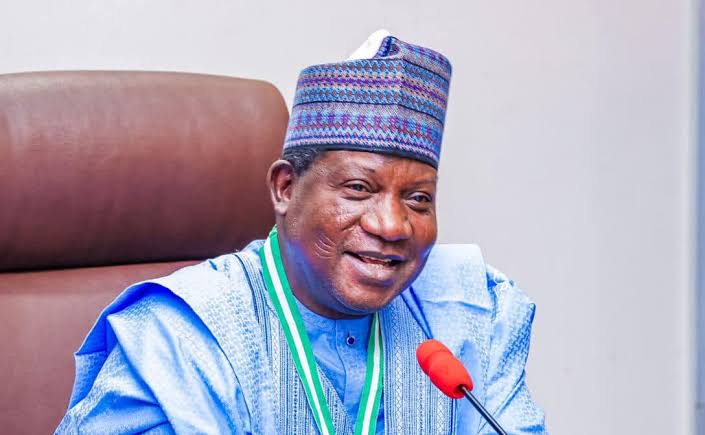
As governor of Plateau State, Simon Lalong took delight in taunting his Benue State counterpart at the height of attacks and killings by Fulani terrorists. Governor Samuel Ortom had switched from APC to PDP after his first term, apparently dissatisfied with the response of late Muhammadu Buhari, then President, and security agencies to his cries for help in getting succour for his people following repeated killings by Fulani militias. Earlier, he had signed into law a bill that banned open crazing of cattle just as many other states had done, especially those in the south.
It was a direct response to the various strategies unfolded by Buhari to carve out crazing routes and create so-called “cattle colonies” across the country for Fulani herders. Miyetti Allah Cattle Breeders Association made good their vow to make Benue ungovernable with Buhari giving a tacit nod by ensuring the federal Police never enforced the law while Fulani militants had a field day killing people in Benue villages. Lalong did not believe in the anti-grazing law. Rather, he believed that Fulani herders should be courted and appeased. He thought his Plateau State had been spared the onslaught. It was a posture that condemned the Middle Belt to series of unchecked killings in the hands of Fulani herders with no concerted response from the governors.
Lalong did not stop there. Now as senator representing Plateau South senatorial district, he took his belief of kowtowing to the Fulani by sponsoring a bill to make the Sultan of Sokoto and leader of the Muslim ummah the prime and permanent chairman of the council of national council for traditional rulers that “seeks to accord formal recognition to, as well as facilitate the important roles and functions of our traditional rulers” alongside the Ooni of Ife as co-chair. It was a daring proposition that triggered chain reactions from the various zones and traditional kingdoms across Nigeria. From the Middle Belt with fiercely proud kingdoms and traditional rulers to the Southeast with its legion of republican communities and the a nascent Hausa group that saw it as ill-informed, Senator Lalong’s bill was roundly condemned. It was the condemnation the bill attracted that made him to belatedly claim that there was no such proposal in the bill. But he did not table the bill before the public to give credence to his claim. The bill is puzzling. The Gbong Gwom Jos is one of the most prominent royal institutions in the country, not just in the Middle Belt, that never answered to an internal coloniser.
What could have inspired Lalong to table such a bill that will subjugate traditional rulers in his zone to the seeming pre-eminence of the Sultan and Ooni? The successor political elites to the pioneer leaders in the region failed to imbibe the vision of getting the region excised from the northern region as Midwestern was done from the Western region. They failed then, but the dream never died. A key political figure in the Middle Belt was late Senator Joseph Tarka. He was one of the founding members of the United Middle Belt Congress (UMBC) in the immediate post-Independence era, an organization dedicated to advocating for the interests of the Middle Belt region. The UMBC played a significant role in Nigerian politics, particularly in representing the diverse ethnic groups of the area.
Unfortunately, the successor elite are bereft of the vision that drove Tarka and his crop of leaders. Apart from Audu Ogbeh who passed on recently, most of the ones that emerged during the second republic had dubious inspiration and aspirations. Ogbeh was one of the leaders that stood out under late President Shehu Shagari. He did not compromise on his principles and was one of the few that stood up to Olusegun Obasanjo who saw party leadership as an adjunct of the Presidency unlike what obtained under Shagari.
The poverty of leadership in the region got its ugly manifestation with the coming of Hyacinth Iormem Alia, a Roman Catholic priest, as governor of Benue State. While his state burned and Fulani terrorists routinely and daily killed his people, he even sought to stifle reportage of the killings. When President Bola Tinubu came calling to ostensibly commiserate with the people over the overnight mass murder of over 200 people, Alia deployed school children to line the streets under heavy down pour to give the President a “rousing welcome” that turned to a raining welcome. While the Middle Belt Forum chided the President for a “disturbingly casual” response to the ongoing violence and displacement plaguing the North Central region. The group also accused the President of ignoring what it said was an “ethnic cleansing campaign” allegedly carried out by Fulani militias. But for the Reverend Father, it was all about the politics of 2027.
In the politics of the north, leaders in the Middle Belt are always available as chairs and spokesmen of what is often portrayed as a unified and monolithic north – the Arewa Consultative Forum. That plays only when their numbers are used to taunt the rest of the country that the north holds all the aces on who emerged president.
Where are the Joseph Tarkas of contemporary politics needed to effectively reshape the “north”? They have lost Audu Ogbeh. But someone has to step up to the plate and provide leadership to the people that have almost become refugees and internally displaced persons in the unfolding land grab in the region.