National Issues
Nigerian Airways, Air Nigeria and the air we breath -By Prince Charles Dickson, PhD

“The secret of change is to focus all of your energy, not on fighting the old, but on building the new.” –Socrates.
One of the greatest preachers who ever lived, Charles Haddon Spurgeon, called the “prince of preachers,” loved to tell this story: It seems there was a Duke who once boarded a galley ship and went below to talk to the convicts manning the oars.
When he asked several of them what their crimes were, almost every man claimed that he was innocent, blaming someone else, or even accused the judge of taking a bribe.
There was one young man whose reply was different. He said. “I deserve to be here, sir. I stole some money. No one is at fault but me. I am guilty.”
When the Duke heard this he shouted, “You scoundrel, you! What are you doing here among all these honest men? Get out of their company at once!” The Duke ordered the young prisoner to be released.
So, the young man was set free, while the rest of the prisoners were left to continue to tug at the oars. The key to his freedom was his admission of guilt.
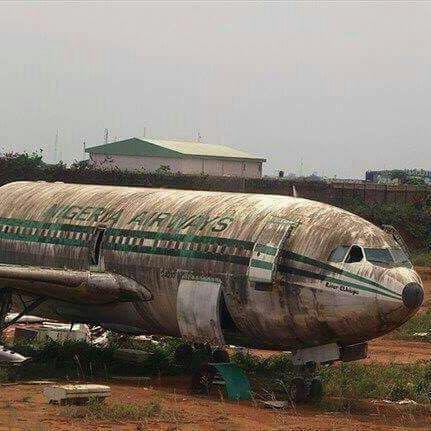
In the last few weeks, I have “touchlighted”, the Nigerian Railways, the old NITEL, I am randomly picking on what was once the fabric of this truly great nation called Nigeria, and this time, I sadly am xraying what was equally known as the Nigerian Airways.
The story of Nigerian Airways! It’s a tale of ambition, progress, and unfortunately, ultimate decline.
Nigerian Airways didn’t simply emerge; it soared from the remnants of colonial influence, embodying a newly independent nation’s dreams. Born from the West African Airways Corporation (WAAC), a joint venture of British colonies, Nigeria seized its moment, taking majority control and eventually full ownership. This marked a significant step, not just in aviation, but in Nigeria asserting its autonomy on the world stage.
The 1960s and 70s were a time of rapid expansion, mirroring Nigeria’s own post-colonial growth. Nigerian Airways became a symbol of progress and modernity. Investment in new aircraft, the establishment of international routes connecting Lagos to major global cities, and a burgeoning workforce all testified to the airline’s ambition. It wasn’t just about transporting passengers; it was about connecting Nigeria to the world, facilitating trade, tourism, and cultural exchange.
This ambition was further fueled by the oil boom of the 1970s. Nigeria’s newfound wealth translated into the acquisition of state-of-the-art aircraft like the DC-10, a symbol of technological advancement. Nigerian Airways even had the distinction of operating the last DC-10 ever built, a testament to its prominence in the aviation world. The airline became a major player in African aviation, a source of national pride, and a key contributor to the continent’s growing interconnectedness.
Sadly, the narrative takes a somber turn. Despite its promising beginnings, Nigerian Airways became entangled in a web of mismanagement, corruption, and political interference. What were once symbols of progress – expansion and modernization – became burdens as the airline struggled to manage its growing fleet and complex operations.
Debt began to accumulate, and the airline found it increasingly difficult to maintain its aging aircraft. This led to a decline in service quality, with delays, cancellations, and safety concerns becoming more frequent. Competition from both established international airlines and emerging African carriers further exacerbated the situation.
The 1990s and early 2000s saw various attempts to salvage the airline. Restructuring plans, privatization efforts, and even rebranding exercises were implemented, but none could overcome the deep-rooted problems. The airline was ultimately grounded in 2003, weighed down by insurmountable debt and unable to compete in a rapidly changing aviation landscape.
Now in academic parlance let me give us a short comparative analysis, using two national carriers. The first RwandAir, the flag carrier of Rwanda, known for its relatively young age (founded in 2002) and impressive growth. It has become a symbol of Rwanda’s post-genocide resurgence and ambitions in the aviation sector. RwandAir’s main hub is the Kigali International Airport (KGL), a modern and growing airport that serves as a gateway to East Africa. RwandAir focuses on connecting East Africa to the rest of the world. It flies to over 25 destinations across Africa, the Middle East, Europe, and Asia.
While operating a modern fleet of Airbus and Boeing aircraft, including A330s for long-haul routes and Boeing 737s for regional flights. It has built a reputation for its excellent customer service, having won awards for its cabin crew and overall passenger experience. It’s also committed to safety and has obtained the IATA Operational Safety Audit (IOSA) certification.
Like many African airlines, RwandAir faces challenges such as competition from larger carriers, infrastructure limitations, and the need for continued investment to support its growth. It is growing in leaps and bounds…
Meanwhile, the Ethiopian Airlines, a continental giant and flag carrier of Ethiopia and one of the largest and most successful airlines in Africa, has a long history, dating back to 1945. Her Addis Ababa Bole International Airport (ADD) major hub is a significant aviation center for the continent.
Ethiopian Airlines boasts an extensive network covering over 130 destinations across Africa, Asia, Europe, North America, and South America. It plays a crucial role in connecting Africa to the world. She operates a large and diverse fleet, including Boeing 787 Dreamliners, Airbus A350s, and Bombardier Q400s, allowing it to serve a variety of routes.
A Star Alliance Member, the world’s largest airline alliance, providing passengers with seamless connections and benefits. Ethiopian Airlines is known for its profitability and operational efficiency. It has consistently been ranked among the top airlines in Africa and has won numerous awards for its service and performance. Ethiopian Airlines plays a key role in promoting aviation development within Africa, with a vision to become the leading aviation group on the continent.
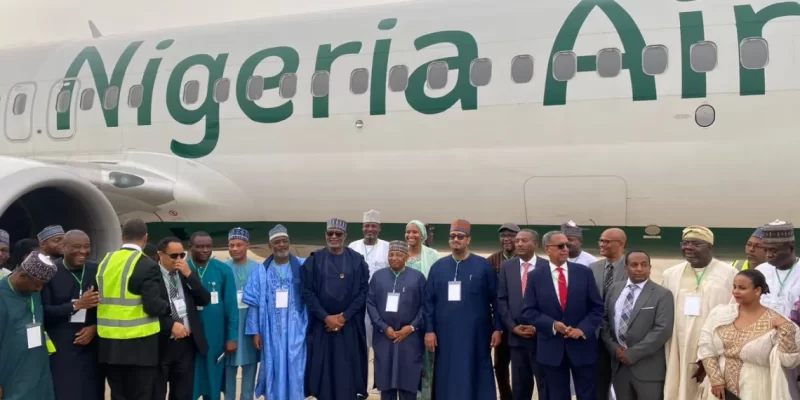
Let me not go into the botched story of the last Air Nigeria fraud, but simplistically put it this way, we have remained deaf, blind and dumb to the greatness that we possess. Like Ethiopian Airlines like Rwandair. Trust me these nations have very dynamic governance issues and it’s not all gold glittering but we as Nigerians are on a bad patch. Our consolation being that we would get there and then my question is get where and, really we think anyone is waiting for us to get there. When we either do not want to get there or we are afraid of there, and don’t even know there.
By 2030 Air Nigeria will still not be beyond the logo, that’s one airline that crashed without flying once. We will never know how much all the drama has cost us as a nation. Why did Virgin Atlantic leave Nigeria, what killed Bellview or Aero, why is Arik sick. Will Ibom and the humanitarian AirPeace stand the test. What’s Rwanda doing differently that we need to copy?
When all our leaders are saints, and no one is guilty of any infraction, no one is sorry for the mess Nigeria currently is, we will remain far from redemption, let the blame game continue; May Nigeria win…when—Only time will tell
—
Prince Charles Dickson PhD
Team Lead
The Tattaaunawa Roundtable Initiative (TRICentre)
Development & Media Practitioner|
Researcher|Policy Analyst|Public Intellect|Teacher
234 803 331 1301, 234 805 715 2301
Alternate Mail: pcdbooks@yahoo.com
Skype ID: princecharlesdickson