Africa
Revolution of Values: Prof. Oloyede as a Model of Transformational Leadership -By Richard Odusanya
The attributes of Prof. Oloyede embodies—a developmental mindset, openness to feedback, and rejection of entitlement—are becoming increasingly critical in the face of rising demands for public sector accountability. Nigerians are no longer willing to accept mediocrity or self-serving leadership. There is a growing call for a culture shift—one that values service over status and people over power.

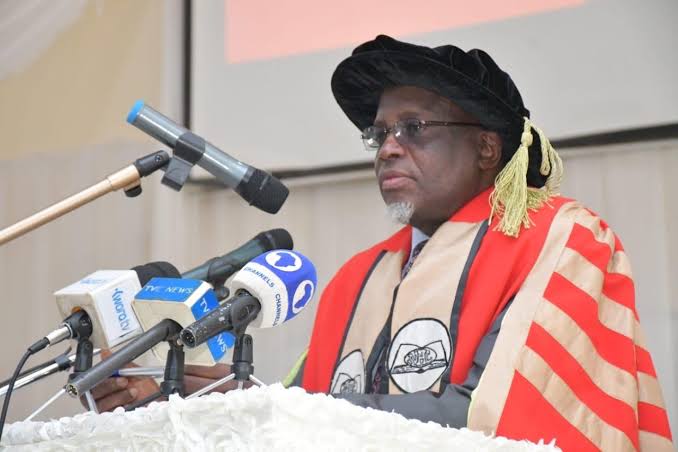
In an era where public service is often clouded by inefficiency and distrust, Professor Is-haq Olanrewaju Oloyede’s leadership at the Joint Admissions and Matriculation Board (JAMB) stands as a powerful testament that honesty and competence can—and must—coexist in public institutions. His tenure exemplifies what it means to lead with integrity, purpose, and a deep sense of accountability to the public good.
The erudite Professor and a former distinguished Vice Chancellor is widely regarded as a no-nonsense administrator, known for his principled leadership and commitment to institutional reform. This reputation was recently reaffirmed in his candid response to the widespread complaints over the 2025 UTME results, where he openly acknowledged that technical glitches had negatively impacted some candidates’ scores. In a nation where denial and blame-shifting are too often the norm, his public admission of fault was a rare and commendable act of leadership.
Servant Leadership in Action
By accepting responsibility and offering a public apology to parents and students, Prof. Oloyede demonstrated the core attributes of servant leadership: humility, transparency, empathy, and a commitment to continuous improvement. Leadership, after all, is not only about achieving results but about lifting others in the process. As the saying goes, “A man of success achieves his goals, but a man of significance changes his world.” Prof. Oloyede belongs firmly in the latter category.
Leadership Tested in Crisis
The true test of leadership is not how one responds to praise, but how one navigates dissent and adversity. In addressing the UTME controversy head-on during the press briefing of May 14, Prof. Oloyede modeled what it means to listen, communicate transparently, and act in the public interest—even when it is uncomfortable to do so. That is leadership rooted in integrity, not image.
Institutional Strength Begins with Personal Character
Reflecting on leadership as a learned skill, I believe one of its most essential components is the ability to align an organization’s vision with the deeper needs of its people. It requires self-awareness—knowing one’s strengths and limitations—and the courage to confront uncomfortable truths. Prof. Oloyede’s example shows that strong institutions are built on the shoulders of individuals willing to lead with truth, humility, and resolve.
As we strive to rebuild Nigeria’s institutions, let his leadership serve as a benchmark. We must hold our public officials to higher standards—where honesty is not seen as weakness, but as the cornerstone of public trust.
A New Era of Accountability
The attributes of Prof. Oloyede embodies—a developmental mindset, openness to feedback, and rejection of entitlement—are becoming increasingly critical in the face of rising demands for public sector accountability. Nigerians are no longer willing to accept mediocrity or self-serving leadership. There is a growing call for a culture shift—one that values service over status and people over power.
The Call for a Revolution of Values
With the benefit of hindsight, one truth stands out: we need a radical transformation in both mindset and systems. This brings to mind the prophetic words of Rev. Dr. Martin Luther King Jr., who in his 1967 speech Beyond Vietnam, called for a revolution of values:
> “We must rapidly begin the shift from a thing-oriented society to a person-oriented society. When machines and computers, profit motives and property rights are considered more important than people, the giant triplets of racism, extreme materialism and militarism are incapable of being conquered.”
He went on to challenge us to go beyond charity—to restructure the systems that perpetuate inequality and suffering:
> “True compassion is more than flinging a coin to a beggar. It comes to see that an edifice which produces beggars needs restructuring.”
Towards a New Nigeria
This message remains deeply relevant to Nigeria’s current realities. Institutions matter. And when they are led by men and women of vision and values, they become agents of transformation. Prof. Oloyede’s example is not just an exception—it should be the new expectation.
Let his courage and candor remind us that a better Nigeria is not only possible—it is achievable. But it begins with each of us demanding and exemplifying a higher standard of leadership, service, and integrity.
A New Nigeria is Certainly Possible