Africa
Ruminating Over The News Warning Dowry Debtors In Ebonyi Community To Beware, by Isaac Asabor
As gathered from the online newspaper, “The people of Ndieze Inyimegu Autonomous Community in Izzi Local Government Area of Ebonyi State have given men who married their daughters without paying dowries until Easter 2025 to fulfil this obligation.

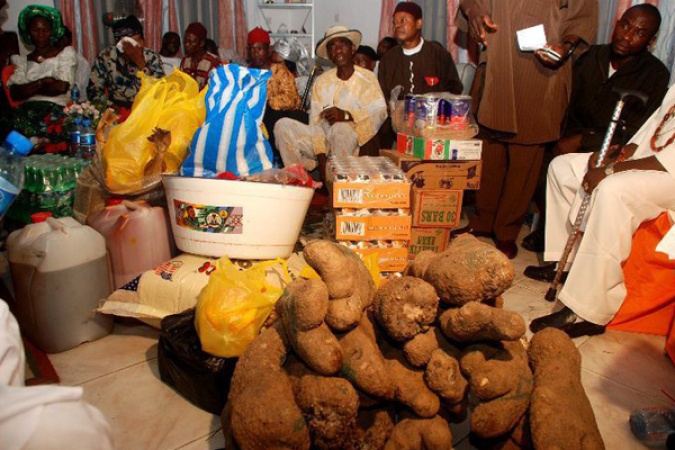
Without a doubt, the news, more often than not, can get a little bit quirky with unusual headlines that make readers to chuckle.
In fact, news headlines are often serious, informative, and impactful. But every now and then, amidst the weighty matters of politics, economics, and global affairs, not a few readers stumble upon headlines that makes them raise an eyebrow, giggle, or even burst into laughter. These quirky news stories serve as delightful reminders that life is not always grim.
Against the foregoing backdrop, it is expedient to explore one of the most amusing headlines that recently graced News Express. The headline published on the online edition of the newspaper reads on June 10, 2024, thus: “Dowry debtors beware: Ebonyi community sets Easter 2025 deadline for payment”.
As gathered from the online newspaper, “The people of Ndieze Inyimegu Autonomous Community in Izzi Local Government Area of Ebonyi State have given men who married their daughters without paying dowries until Easter 2025 to fulfil this obligation.
“The community leaders stated that the ultimatum aims to preserve marriage customs and bolster the value of women in society. They emphasized that failing to pay a dowry is considered a crime.
“The decision was reached during a visit to the new traditional ruler, His Royal Highness (HRH) Eze Hyacinth Ogbonna Nwokpor, on Saturday.
“According to a press release issued by Jonathan Nwokpor, Special Assistant to the traditional ruler, the village heads decreed that anyone who marries a woman in their community without paying dowry commits a crime and has until Easter 2025 to rectify the situation or face community action.
“In addition to the dowry ultimatum, the community also resolved to prohibit the smoking of Indian hemp and the sale of land within Ndieze. They warned that anyone found in violation of these prohibitions would face severe consequences.
“The statement emphasized that these resolutions demonstrate the village heads’ commitment to maintaining peace, order, and progress in Ndieze. (Daily Sun)”.
Without a doubt, the foregoing news story can unarguably make anyone to chuckle, scratch his or her head, or simply appreciate the absurdity of life. Because sometimes, amidst all the seriousness, a quirky headline can brighten our day and remind us that laughter is the best headline of all.
In fact, the news story may appear to be quirky to not a few readers of this piece, but it is a serious issue that should not be joked with as marriage business, so to say, in virtually all parts of Nigeria is not like being in Boyfriend-Girlfriend-Relationship as it sacrosanct.
Certainly! In many Nigerian cultures, dowry (also known as “bride price” or “bride wealth”) plays a significant role in marriage traditions. At this juncture, it is incumbent on this writer to delve into why it is taken seriously and the cultural context surrounding it.
In fact, across all communities in Nigeria, the significance of dowry is not something that should be taken for granted. The reason for the foregoing view cannot be pooh-poohed with mere waves of the hands as it is a symbol of respect and recognition. This is as paying dowry is a way for the groom’s family to honor and recognize the bride’s family, and also signifies respect for the bride’s parents and their role in raising her. Not only that, the only way to acknowledge the bride’s worth and contribute to the new family unit is through the payment of bride price.
In a similar vein, dowry also strengthens family bonds as its ceremonies bring families together, even as they provide an opportunity for both families to meet, interact, and establish connections. In fact, by negotiating and exchanging gifts, families build trust and strengthen their relationship.
Looking at the essence of dowry in Nigerian marriage from the perspective of economic and social security, it is germane to further opine in this context that historically, dowry served as a form of economic security for the bride. It provided her with resources (such as livestock, land, or money) that she could use if needed. The foregoing is common in the Northern parts of the country.
In some cases, the dowry also acts as insurance against divorce or widowhood, even as it strengthens cultural tradition and identity.
Though, dowry practices vary across Nigeria’s diverse ethnic groups as each group has its own customs, rituals, and expectations. However, these traditions are deeply ingrained and contribute to cultural identity and continuity.
Arguing from a similar perspective in this context, dowry has both legal and social implications. In fact, while dowry is not legally required, it holds immense social weight, and failure to pay it can lead to strained relationships and societal disapproval, even as some communities view it as a prerequisite for a valid marriage.
However, this piece is not ignorant of the fact that there is a school of thought that is majorly made of feminists that have been challenging the essence of dowry, and therefore has continued to criticize the practice. This is as the school has continued to criticize it by arguing that dowry can perpetuate gender inequality, and saying that it sometimes reduces women to commodities and reinforces patriarchal norms.
Be that as it may, there are ongoing efforts been made by some elitist parents as they usually strike a balance ostensibly to preserve cultural heritage and promoting gender equality. They often strike the balance by either gifting a furnished building or buying a car for the newly wedded. Some of the elitists, in some cases go the extra mile by opening business for the newly wedded, and even collecting just a token from the groom as bride price, and in some cases forgo the bride price by merely giving consent to the marriage.
In summary, while dowry is a serious matter, it is essential to approach it with cultural sensitivity and awareness. This is as marriage is indeed more than a casual love affair as it involves families, traditions, and responsibilities.