
Africa
Russia – Republic of the Congo: New Prospects for Humanitarian Cooperation” -By Louis Gouend & Kestér Kenn Klomegâh
A.F. Berdnikov, Executive Secretary of the Russian-African Club of Lomonosov Moscow State University, quoted Juliana Lumumba, whose words, in his opinion, express the spirit of Russian-Congolese relations from the USSR to the present day: “The relations between our countries have always been built on the principles of mutual respect and mutual assistance. These relations have never been condescending; they have been relations of equal partners, and we would like to go even further in deepening them.”

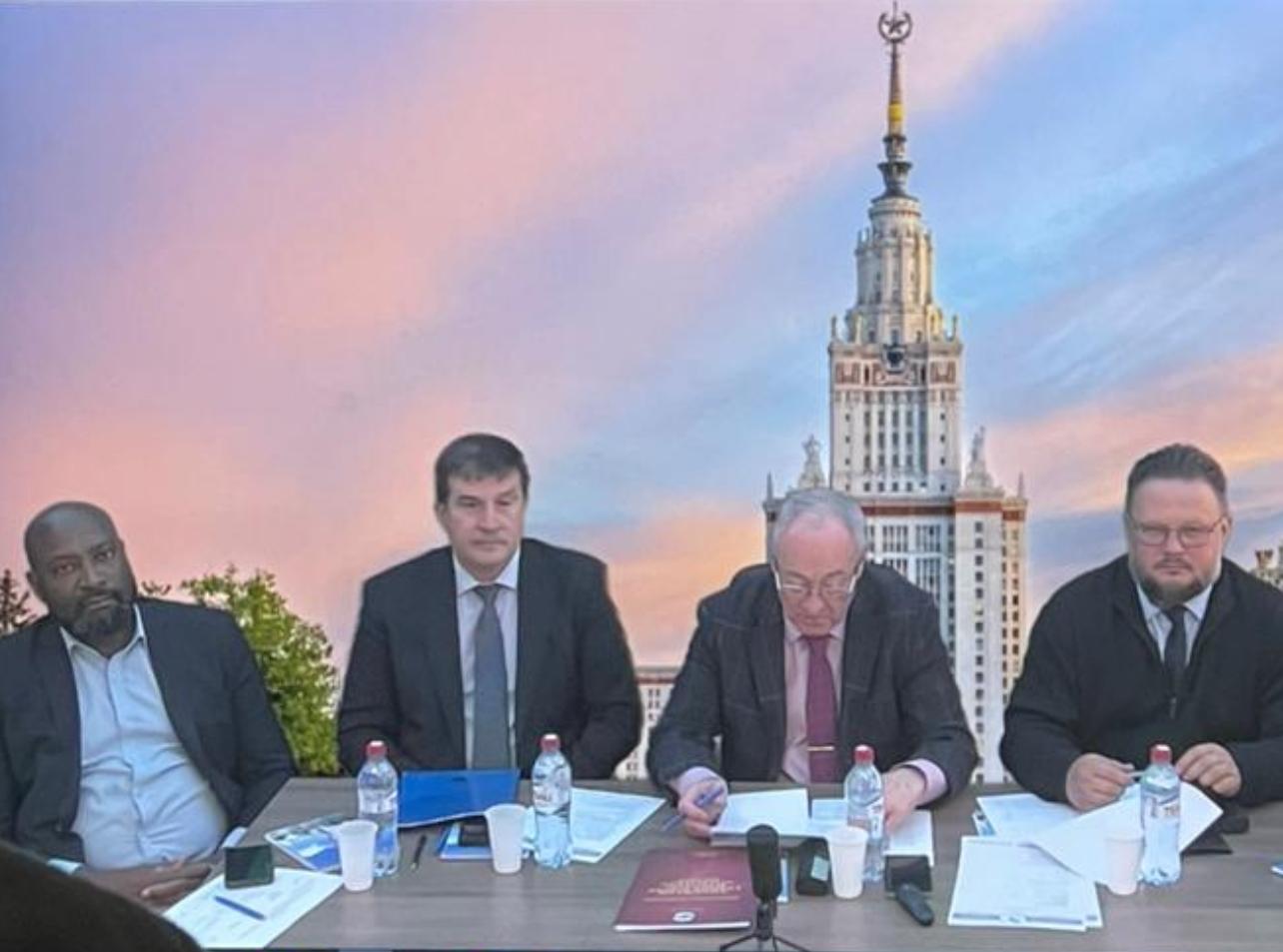
On September 30, 2025, the telebridge “Russia – Republic of the Congo: New Prospects for Humanitarian Cooperation” was held at the webinar studio of the Faculty of Global Studies of Lomonosov Moscow State University. The event was organized by the Russian-African Club of Lomonosov Moscow State University. Co-organizers of the telebridge were the Faculty of Global Studies of Lomonosov Moscow State University and the Public Diplomacy Foundation.
The telebridge brought together representatives of state authorities, political figures, leading scientists, activists of public associations, and journalists from the Russian Federation and the Republic of the Congo.
The telebridge was opened by Alexander Fyodorovich Berdnikov, Executive Secretary of the Russian-African Club of Lomonosov Moscow State University. He spoke about the events in which the Club has participated, noting in particular that the Russian-African Club of Lomonosov Moscow State University is directly involved in promoting the opening of the Museum of African Cultures in Moscow, scheduled for 2026-2027.
A welcome address was delivered by Vladimir Viktorovich Kochetkov, Head of the Department of Social Global Processes and Youth Work at the Faculty of Global Studies of Lomonosov Moscow State University, Doctor of Sociological Sciences. In his opinion, the “Russia – Republic of the Congo” telebridge is an important initiative in bringing the two countries closer together. He noted the increasing number of Congolese students at Russian universities and emphasized that the doors of Russian education are always open for students from African countries.
Louis Gouend, Director of the Commission for Diaspora and Media Relations of the Russian-African Club of Lomonosov Moscow State University, also welcomed the participants, expressing hope that African graduates of Russian universities would become more actively involved in joint projects between Russia and Africa across various fields of cooperation.
Among the main areas of Russian-Congolese cooperation, participants paid special attention to interaction in education, science, and youth development.
A report was presented by Ivan Shalov, a representative from the Education and Science Department of Rossotrudnichestvo. He stated that the demand for Russian education in the Republic of the Congo is growing rapidly. Registration for applicants for study quotas has already begun. The most sought-after fields of study are medicine and pharmacy. In recent years, interest in engineering specialties has increased.
At the Rossotrudnichestvo representative office, known as the “Russian House” in Brazzaville, public activists and journalists from the Republic of the Congo gathered. Maria Albertovna Shakhurutdinova, Director of the “Russian House,” mentioned that a Congolese team of specialists and enthusiasts, united by their love and interest in Russia, provides significant assistance in the work of the Russian House. She noted that many graduates of Soviet and Russian universities now hold key positions in government bodies and major enterprises of the Republic of the Congo. A prime example is the current Minister of Foreign Affairs of the Republic of the Congo, Jean-Claude Gakosso, who graduated from the Faculty of Journalism of Leningrad State University in 1983, speaks fluent Russian, and to this day calls himself a Leningrader. Among the younger generation, the speaker cited the example of an advisor to the Minister of Sports and Youth Affairs, who recently received a Russian higher education. The Director of the “Russian House” in Brazzaville also emphasized the high demand for teaching staff, specifically Congolese philologists who have obtained diplomas in Russia for teaching Russian as a foreign language.
Michel Ngeban’a Dyuk, Honorary Consul of the Russian Federation in Pointe-Noire, Republic of the Congo, and Deputy Chairman of the World Coordination Council of Russian Compatriots Living Abroad, proposed creating a graduate database, expressing confidence that such data would be very useful for organizations and companies working in the field of Russian-African cooperation.
This was supported by Jean Pierre Ondaï Otsouma, a member of the Congolese Youth Advisory Council in the Russian Federation, a postgraduate student, and the Best Graduate of RUDN University in 2025. The speaker presented a report on the history of relations between Russia and the Republic of the Congo since the Soviet era. In his opinion, cooperation between our countries opens up numerous opportunities for Congolese youth. Jean Pierre cited the most successful graduates of USSR and Russian universities as examples, some of whom have served in the government of the Republic of the Congo at various times and held key positions in many industries and departments.
Inga Anatolyevna Koryagina, an international development expert at UNDP, Associate Professor at the Department of Marketing of the Plekhanov Russian University of Economics, and Director of International Cooperation at the Russian-African Club of Lomonosov Moscow State University, presented a report on Russian-African educational cooperation and long-term projects in this field, clearly demonstrating the growth dynamics and key formats of cooperation.
A report on food security issues was presented by researcher and lecturer Georges Romain Zobo. In his presentation, the expert cited data indicating that there are over 820 million undernourished people in the world, most of whom live in Sub-Saharan African countries. The expert analyzed the causes of acute food shortages both in the Republic of the Congo and in many other African countries, and proposed a number of measures to overcome the food crisis.
Varney Balossa Kraft de Dieu, a student in the Department of Political Science at Moscow State Linguistic University and an intern at the Institute for African Studies of the Russian Academy of Sciences, spoke about various aspects of Russian-Congolese cooperation, which, in his opinion, has been developing optimally in recent years. The speaker cited cooperation in the military-technical sphere, water supply, and humanitarian areas as examples. According to him, a large number of major sectoral agreements have been signed over the past 5-6 years, for instance, at the digital forum in Nizhny Novgorod in the summer of 2025.
The topic of educational cooperation was continued by Olivier Malango, Chairman of the Friendship Society between Russia and the Democratic Republic of the Congo. He stated that the Friendship Society makes significant efforts to strengthen comprehensive ties between Russia and the Democratic Republic of the Congo. Olivier Malango also noted that the Democratic Republic of the Congo is the homeland of Patrice Lumumba, whose 100th anniversary was celebrated on July 2, 2025.
A.F. Berdnikov, Executive Secretary of the Russian-African Club of Lomonosov Moscow State University, quoted Juliana Lumumba, whose words, in his opinion, express the spirit of Russian-Congolese relations from the USSR to the present day: “The relations between our countries have always been built on the principles of mutual respect and mutual assistance. These relations have never been condescending; they have been relations of equal partners, and we would like to go even further in deepening them.”
Ilya Leonidovich Shershnyov, Director of Programs at the Russian-African Club of Lomonosov Moscow State University, gave an example of cooperation with the Congolese public in broadcasting the Club’s film on Congolese television in Africa about the famous African political figure and fighter against the system of racial segregation (apartheid) in South Africa, Nelson Mandela. In 2024, through the cooperation of the Russian-African Club of Lomonosov Moscow State University with the Russian African diaspora, a monument to Nelson Mandela was unveiled in Moscow.
Sydney Adoua Mbongo, Associate Professor at the Department of International Law at Marien Ngouabi University (Brazzaville), presented a historical analysis of Russian-Congolese relations. In his view, relations significantly weakened from 1992 to 2000. However, when Vladimir Putin became President of Russia, ties strengthened again. Since then, Russia has begun to actively and very successfully assert itself in various fields, particularly in academic education, energy, and military-technical cooperation. The expert expressed confidence that in the context of building a new world order based on principles of mutual respect and mutually beneficial cooperation between countries, relations between Russia and the Republic of the Congo are built on fair terms conducive to the comprehensive development of the African republic.
Nikita Olegovich Kaletkin, Director of the Museum of African Cultures, spoke about the tasks and concepts of the future museum in Moscow. The primary task of the museum will be the preservation and dissemination of African culture and art, showcasing collections of art from African countries and folk crafts that convey the color and soul of the peoples of Africa. To this end, connections are being established with museums in various African countries, and expeditions and expert councils are being conducted. The expert named important concepts of the future museum, such as the “Timeline” and the “Cultural Map” of the African continent. Nikita Olegovich noted as a positive sign that on the day of the telebridge, the contract for handing over the future museum building to the contractor was signed. According to the creators’ plan, the museum will feature an exhibition hall where collections will be regularly updated to introduce the public more broadly to African art. Scientific conferences, lectures by renowned art critics, travelers, ethnographers, and Africanist writers will also be held at the museum to foster a deeper understanding of the rich culture of the African continent.
Louis Gouend, Director of the Commission for Diaspora and Media Relations of the Russian-African Club of Lomonosov Moscow State University, spoke about the upcoming Russia-Africa Business Forum, which will start on October 15 in Moscow at the Chamber of Commerce and Industry and last for 5 days. This is a major and significant event on the Russian-African agenda, where mutually beneficial business projects are born, specific connections are formed, and important agreements for comprehensive development between Russian and African business structures are signed. The Business Forum includes an extensive program, which will also feature sporting and cultural events. Louis Gouend expressed confidence that the forum would become a platform for establishing strong partnership ties between Russia and the African continent.
The participants concluded that the telebridge is a convenient and modern format for open and productive dialogue, contributing to the development of comprehensive cooperation between Russia not only with the Republic of the Congo but also with other African countries.
—



























