Africa
Soyinka’s Metamorphosis -By Patrick Iwelunmor
The torn green card was Soyinka’s message to America. The revoked visa, if true, is America’s reply. Between the two lies the eternal dialogue between freedom and consequence, between conscience and sovereignty, between the poet’s fire and the jurist’s law. The world should listen carefully, for in that dialogue echoes an ancient truth: justice, the first condition of humanity, is also the final measure of dignity.

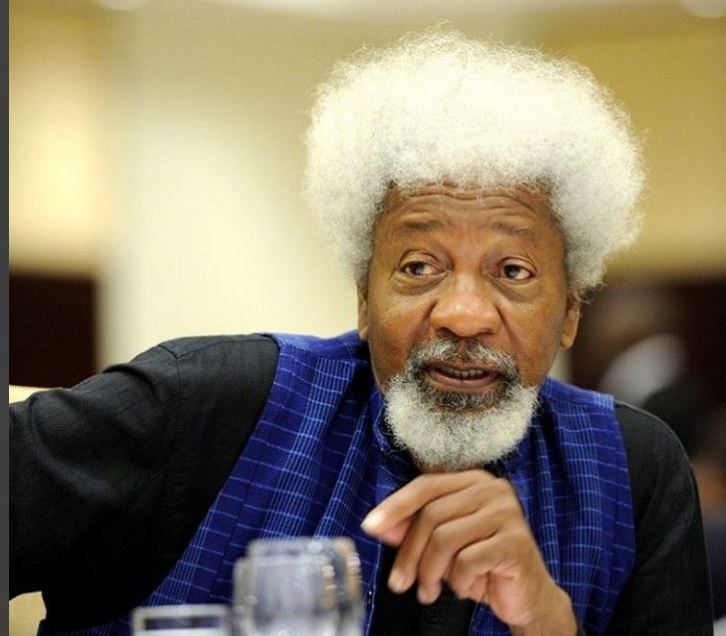
There comes a moment in every moral crusader’s journey when protest meets paradox, when the fire that once purifies begins to scorch its own altar. For Professor Wole Soyinka, Africa’s Nobel laureate and Nigeria’s unyielding literary conscience, that moment arrived the day he tore his American green card. It was not merely the act of an aging rebel disturbed by the election of Donald Trump. It was the culmination of a long intellectual pilgrimage, the transformation of a restless idealist into a global moralist who continues to test the boundaries of conscience and consequence.
To understand Soyinka is to grasp that he has always lived at the intersection of art, defiance, and principle. His life has been a continuous argument with power. From his early days confronting military dictatorships in Nigeria to his imprisonment during the civil war, Soyinka has carried rebellion in his bones. He has been the poet who refused silence, the dramatist who refused exile, and the intellectual who treated cowardice as a sin. Yet there is a point where rebellion, if unchecked by reflection, risks becoming its own theatre.
When Soyinka tore his green card in 2016, he was not just rejecting a political outcome; he was performing a moral ritual. It was his way of declaring that even the world’s greatest democracy could fall short of the ideals it preached to others. To him, the green card had ceased to symbolize belonging; it had become an emblem of disillusionment. But in that dramatic gesture, Soyinka also revealed the uneasy tension between personal protest and public responsibility. Every symbol has meaning, and every act carries consequence.
The green card was not just a piece of plastic. It represented an understanding between the bearer and the state that issued it. It was both privilege and promise, a silent acknowledgment of trust. By tearing it, Soyinka was not simply expressing anger; he was severing a bond. The gesture spoke loudly to the moralist within him, but it also spoke to the jurist within America. For in the language of sovereignty, to repudiate a nation’s symbol of belonging is to withdraw from its protection.
If indeed the United States has revoked his visa, as reports suggest, then that decision cannot be read as vindictive. It must be seen as consistent with the logic of justice and sovereignty. Every nation guards its dignity through symbols, and when those symbols are publicly rejected, the state must respond to preserve its meaning. To revoke Soyinka’s visa is not an act of spite but an assertion of coherence. A country cannot be mocked and still offer embrace.
Soyinka’s act of tearing the green card, though born of moral conviction, also exposes the contradictions of intellectual privilege. There is a subtle arrogance that creeps into the consciousness of global icons, a belief that fame is a form of immunity. The Nobel Prize, however luminous, does not confer exemption from consequence. A nation’s sovereignty is not a stage upon which celebrity may perform without repercussion. Freedom of expression remains sacred, but freedom from consequence is a myth.
In this sense, America’s response, if confirmed, is a moral echo of Soyinka’s own philosophy. It reminds the world that respect must be mutual. The nation’s decision to revoke his visa is not a rejection of dissent but a reaffirmation of dignity. It distinguishes between criticism, which enriches democracy, and contempt, which undermines it. You may disagree passionately with a country’s policies, but you cannot tear apart its symbols and still demand access to its privileges.
It is at this junction that Soyinka’s own words return with prophetic irony: “Justice is the first condition of humanity.” Justice demands that actions align with consequences. It is not sentiment that binds societies together, but a shared understanding of responsibility. When Soyinka invoked justice throughout his career, he spoke against dictators who weaponized power without accountability. Yet justice, in its purest form, is impartial. It does not recognize celebrity or moral reputation. It applies its scales to all, even to those who preach it most fervently.
America’s firmness, therefore, becomes a lesson in the moral arithmetic of consequence. It is justice rendered without emotion. It does not punish Soyinka; it completes his act. He tore a card as a declaration of independence; the state responded by withdrawing its embrace. Each side has remained faithful to its own principle. One exercised freedom; the other exercised sovereignty. Between them lies the enduring truth that both freedom and sovereignty are sacred only when tempered by respect.
Nigeria, too, must draw lessons from this episode. For decades, we have watched the slow erosion of our national dignity. Our symbols are mocked, our passports scorned, and our institutions desecrated. Yet we respond with silence, as though national pride were a luxury. We forget that respect, whether between nations or individuals, is never given; it is earned through the consistent defense of one’s own values. A self-respecting country must guard its honor with firmness, not with fear. America’s example is a reminder that power without principle is chaos, but principle without firmness is impotence.
This moment in Soyinka’s journey also invites reflection on the deeper nature of protest itself. True protest is not performative. It does not seek applause or validation. It endures even when misunderstood. To tear a card is easy; to live without its comfort is the harder testimony of conviction. If Soyinka’s act was indeed a moral protest, then he must live with the full weight of its logic. The moral life, after all, demands consistency.
There is, however, a nobility in his defiance. In an age where conformity masquerades as civility, Soyinka’s gesture remains a rare act of courage. It tells us that the conscience of a man cannot be caged by convenience. Yet the same conscience must also accept consequences. That, too, is justice. The measure of integrity is not in the noise of one’s protest but in the silence with which one bears its aftermath.
Soyinka’s metamorphosis, therefore, is not a fall from grace but an evolution of principle. It marks the moment when a lifetime of rebellion confronts the inescapable reality of consequence. It is the transformation of protest into reflection, of theatre into truth. He has taught generations that moral courage is not the absence of restraint but the endurance of principle in the face of discomfort.
In the end, this story is not about America’s pride or Soyinka’s defiance. It is about the fragile architecture of respect that binds humanity together. When a man rejects a symbol, he challenges more than law; he challenges meaning. And when a nation responds, it is not protecting pride alone but preserving coherence. Both acts are legitimate, and both are bound by the same moral law.
The torn green card was Soyinka’s message to America. The revoked visa, if true, is America’s reply. Between the two lies the eternal dialogue between freedom and consequence, between conscience and sovereignty, between the poet’s fire and the jurist’s law. The world should listen carefully, for in that dialogue echoes an ancient truth: justice, the first condition of humanity, is also the final measure of dignity.