Africa
Tinubu’s New Service Chiefs: A Fresh Strategy Or Another Round Of Military Musical Chairs? -By Maryam Berende
President Tinubu’s new service chiefs carry the burden of expectations from a weary nation yearning for peace. Their performance in the coming months will be crucial, not only for national security but also for the credibility of the administration’s promise to deliver a safer and more stable Nigeria. Whether this new team heralds a genuine turning point or merely another round of leadership rotation will depend on how quickly Nigerians begin to feel the difference—not in press releases, but in their daily lives.

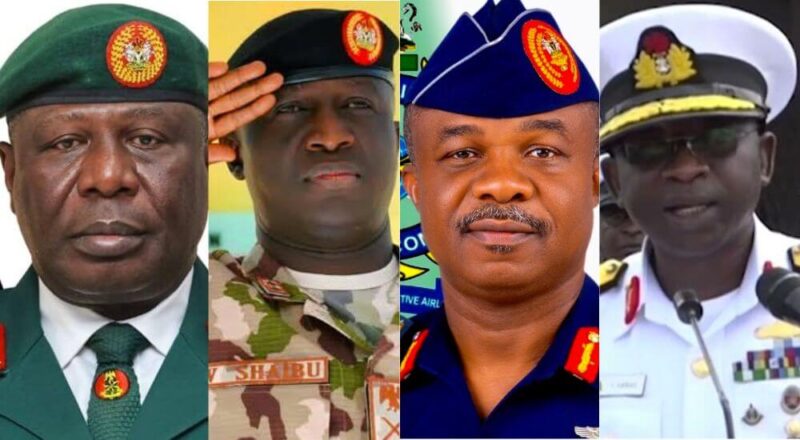
In a decisive move that has dominated Nigeria’s political and security landscape this week, President Bola Ahmed Tinubu announced the appointment of new service chiefs to head the nation’s armed forces. The announcement, which came on October 24, 2025, marks one of the president’s most significant efforts yet to reshape Nigeria’s national security architecture. Coming at a time of rising insecurity, the reshuffle is being hailed by some as a bold step towards reform, while others remain cautious, questioning whether new faces alone can solve deeply rooted problems.
Under the new appointments, General Olufemi Oluyede now serves as the Chief of Defence Staff, succeeding General Christopher Musa. Major General Waidi Shaibu takes over as the Chief of Army Staff, Air Vice Marshal S.K. Aneke assumes the position of Chief of Air Staff, while Rear Admiral Idi Abbas becomes the new Chief of Naval Staff. The only figure retained from the previous leadership is Major General E.A.P. Undiendeye, who continues as the Chief of Defence Intelligence. The appointments took immediate effect, signaling Tinubu’s sense of urgency and determination to reenergize Nigeria’s security apparatus.
For many observers, the shake-up represents an attempt to inject new vigor into the armed forces and restore public confidence in a system that has struggled to contain multiple crises. From the lingering insurgency in the North-East to the banditry and kidnappings in the North-West, and the growing militancy and oil theft in the Niger Delta, the challenges confronting the Nigerian military are vast and multifaceted. President Tinubu, in his statement, urged the new chiefs to “deepen professionalism, strengthen inter-agency cooperation, and deliver tangible security results for all Nigerians.”
General Oluyede, the new Chief of Defence Staff, comes with decades of field and administrative experience. A graduate of the 39th Regular Course of the Nigerian Defence Academy, he has served in key operational commands across the country. Analysts describe him as a disciplined and strategic officer with a reputation for prioritizing troop welfare and operational efficiency. His appointment is expected to bring a fresh perspective to joint military operations, particularly in the fight against insurgency and terrorism.
Major General Waidi Shaibu, the new Chief of Army Staff, is equally well regarded within military circles. Known for his no-nonsense leadership style, Shaibu previously commanded operations under Operation Hadin Kai in the North-East, where he led several counter-insurgency campaigns. His elevation comes at a time when the Nigerian Army faces mounting pressure to restore security in rural communities terrorized by bandits and kidnappers. For many Nigerians, his ability to motivate troops and deliver quick results will determine the success of the new military team.
Air Vice Marshal S.K. Aneke’s appointment as Chief of Air Staff underscores the administration’s intent to strengthen Nigeria’s aerial defence and surveillance capacity. The Air Force, which has played a critical role in counter-terrorism operations, has been accused of facing logistical and maintenance challenges in recent years. Aneke, a trained pilot and logistics expert, is expected to modernize fleet management and improve coordination between air and ground forces. Rear Admiral Idi Abbas, on the other hand, brings years of maritime experience to the Naval Command. His task is to curb the persistent issues of piracy, crude oil theft, and illegal maritime activities that have plagued Nigeria’s economic waters.
Security analysts have described the appointments as both symbolic and strategic. Symbolic, because they show Tinubu’s willingness to act decisively on national security; strategic, because each appointee has been carefully selected from operational backgrounds that mirror Nigeria’s most pressing security challenges. Yet, analysts caution that while leadership changes are important, they must be complemented by structural reforms, adequate funding, and better inter-agency collaboration.
Public reaction to the reshuffle has been mixed. Some Nigerians see it as a welcome development—a sign that the government is serious about tackling insecurity. Others remain skeptical, arguing that similar reshuffles in the past have failed to yield tangible improvements on the ground. Civil society organizations have urged the new service chiefs to embrace transparency, respect for human rights, and accountability, noting that military operations must be people-centered to gain the trust of affected communities.
For the new military leadership, the road ahead will not be easy. Beyond battling armed groups, they must contend with issues of morale, logistics, and intelligence-sharing. They also face the challenge of rebuilding public confidence in the military, which has been eroded by reports of corruption, poor welfare, and operational setbacks. As one analyst aptly put it, “The problem is not always who wears the uniform at the top, but whether the system beneath them can support real change.”
In the end, President Tinubu’s new service chiefs carry the burden of expectations from a weary nation yearning for peace. Their performance in the coming months will be crucial, not only for national security but also for the credibility of the administration’s promise to deliver a safer and more stable Nigeria. Whether this new team heralds a genuine turning point or merely another round of leadership rotation will depend on how quickly Nigerians begin to feel the difference—not in press releases, but in their daily lives.
Maryam Berende is a 300 Level Student From Mass Communication Department University Of Maiduguri.