Africa
UDUS Campus Radio: How Student Broadcasters Learn Through Struggles -By Issa Hamed Alhaji
Prof. Maishanu confirmed that the university fully funds the station and is committed to improving it. “We are already planning to recruit more professionals after the next accreditation exercise,” he said.

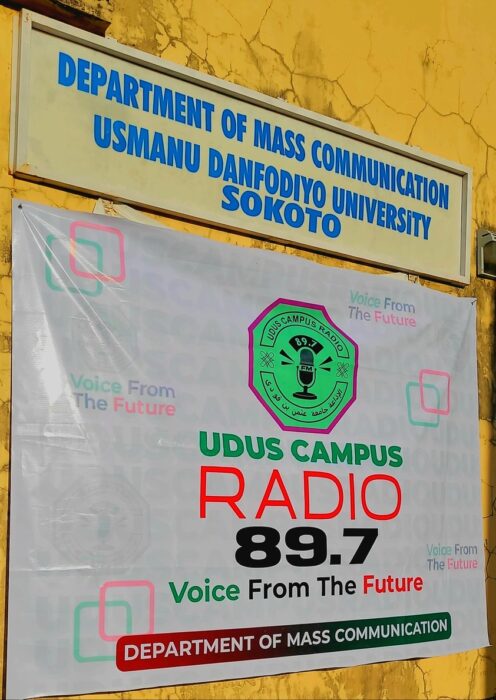
At exactly 8 a.m. on a Tuesday morning, while her classmates hurried into a lecture hall for a Mass Communication course, Adamu Nana sat behind the microphone in the small, echoing studio of UDUS 89.7 FM. Handling console as DCA, but so had her missed attendance sheet.
“I should be in class right now,” she whispered during a song break, eyes fixed on the blinking console lights. “But there’s no one else to take over.”
For Nana and many others at Usmanu Danfodiyo University, Sokoto, the dream of learning radio broadcasting has slowly blurred into a demanding routine of long hours, unpaid labour, and academic sacrifice.
At Usmanu Danfodiyo University, Sokoto (UDUS), the Department of Mass Communication launched its own campus radio station in April 2024 to enhance students’ practical learning. The initiative was widely praised as a step forward. But nearly two years later, what was meant to be a hands-on learning platform has become a source of concern for many students.
Students at the station manage most operations themselves, from presentation to production, often without professional supervision. Many say they work long hours, sometimes at the expense of their studies.
“I Had to Miss My Class” — Nana’s Story
For Adamu Nana, a 200-level student, joining the radio team was a dream come true, until it started interfering with her academics.
“There are times I stay in the studio during my lectures because there’s no one to take over my shift,” she said, her tone mixed with pride and exhaustion. “It’s affecting my studies, but I also love what I do here.”
Nana hopes the department will employ more supervisors and allow students to schedule their duties without clashing with lectures.
Between Passion and Pressure– Muslimah Says
Olamilekan Muslimah, a 300-level student, wears many hats at the station, Head of News, Program Producer, Presenter, and Duty Officer. While the experience has boosted her confidence, it has also tested her endurance.
“I sometimes produce and present multiple programs in a single day,” she said. “It’s helping me grow, but it can be really stressful. A little appreciation from the department would mean a lot.”
From Hope to Hopeless: “I Might Graduate With a 2.2”
Asiyah Sanusi, a final-year student and producer of two programs, also voiced her frustrations. Once hopeful of graduating with a first-class degree, she now fears slipping to a 2.2 due to the heavy workload
“Ideally, the department should hire professionals.The output is poor because we are still learners. I try to balance my academics, radio work, and extracurriculars, but it’s overwhelming,” she admitted.
Asiyah believes that while practical training is valuable, it should not come at the expense of academic success.
More Students Bemoaned of Workloads at Campus Radio station
For 200-level student Aliyu Babangida, who serves as both an engineer and newscaster, the lack of recognition is demoralizing.
“I open the studio before 8 a.m. almost every day,” he said. “Even small words of appreciation or a certificate would motivate us to do more.”
Across the department, student broadcasters are calling for recognition, rewards, and better welfare. They argue that they are primarily students, not unpaid staff.
“It’s Training, Not Exploitation”: Department’s Response
Responding to the complaints, Dr. Abubakar Musa Mijinyawa, Head of the Department of Mass Communication, said the radio station is part of students’ professional training, not exploitation.
“The station was established to bridge the gap between theory and practice,” he explained. “What the students are doing is part of their learning process. In journalism, you can’t learn everything from the classroom.”
Dr. Mijinyawa, however, acknowledged the need for more professionals at the station. “We plan to bring in more experienced broadcasters to the students,” he added. “They should see this experience as a foundation for their career growth.”
Management’s View: A Tool for Learning, Not Profit
Deputy Vice-Chancellor (Administration), Prof. Malami Muhammad Maishanu, described the campus radio as an essential training platform, not a commercial venture.
“It is like a teaching hospital for medical students,” he said. “A Mass Communication department cannot function effectively without practical facilities like a radio station.”
Prof. Maishanu confirmed that the university fully funds the station and is committed to improving it. “We are already planning to recruit more professionals after the next accreditation exercise,” he said.
He emphasized that the radio’s purpose is strictly academic: “The moment it becomes a profit-making platform, it loses its educational essence. The focus must remain on learning.”
Reporter’s Note: All students’ names used in this story are pseudonyms for safety reasons. Only the Head of Department and the Deputy Vice-Chancellor are identified by their real names.