Africa
What Qatar Cannot Do—Exists -By Prince Charles Dickson Ph.D
As a Nigerian, this comparison stings. It’s not about Qatar’s wealth but its will. Nigeria has no excuse: Our oil reserves surpass Qatar’s, our diaspora excels globally, and our creativity dominates music and film. Yet, we falter where focus and integrity are required.

Let me start by saying I am not shallow…
The easiest and most attractive national pastime is buck-passing, especially with the bunch of leaders that we have, who can hardly peel a banana or wash an already white handkerchief. Not many of us want to take responsibility for anything, from personal to family or national life.
The blame is on the system. We do not need to create demons out of our leaders because they are already specimens of demons, so we hang our sins on them appropriately and inappropriately, too. And unfortunately, their behavior has made it easy for the critics to descend on them.
We, at most, talk, write, and discuss the Nigerian myth with a sense of fatalism. If everyone thought as much as I did about justice and fairness, life would be better. I am a critic, but I am also the critics’ critic, the unrepentant believer that the best way to keep the government on its toes is to keep harping on their flaws so they can improve.
Often, I say I believe the things I write about are as important for our nation as they are for other nations, but when it appears to me, Nigerians, especially those in authority, do not react to these issues as people in other lands do, I repeat them in new essays to remind old readers and recruit new ones to participate in the continuing dialogue.
So today, I address the real nonsense people…citizens, apologists, and crooks called politicians in Nigeria where nothing works and no one cares, when it works, it is because someone’s interest is about to be served or being served, not the people’s interest.
We talk about our institutions despairingly. Our leaders do not watch network news any longer except when their faces are there on the occasion of their sons/daughters’ weddings or such. They do not need the newspapers anymore because it is full of their lies, paid adverts, and the critics’ truth, the bitter truth.
Government bashing is a national issue, and every drinking joint and any suya spot has a sitting parliament with an expert on every and any issue, but we forget that no matter the input, if the politicians and actors in our national scene have questionable lives both on a personal and domestic level, nothing will change, the best government policy cannot change the individual. It is because the policies are formulated on a bad foundation and by people with warped thinking.
We do not need the government to teach us to stop treating ourselves like animals. Do we need the government to teach us that we demand responsible leadership and representation? Certainly not, we should know that and act in a fashion that depicts that we demand more than what we are getting.
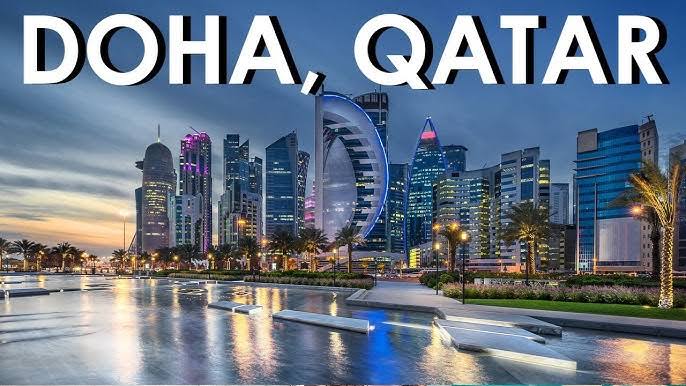
So I’ll tell us a short story of my recent trip to Doha—In the heart of the Arabian Peninsula lies Doha, a city that has defied the limits of imagination. Over the past decade, Qatar has transformed from a quiet Gulf state into a global powerhouse, a metamorphosis symbolized by its glittering skyline, world-class infrastructure, and audacious ambition. Yet, this progress exists alongside persistent human rights critiques, particularly regarding migrant labor conditions. How did Qatar achieve so much so quickly? And why does Nigeria, a nation brimming with potential, remain trapped in a cycle of unfulfilled promises?
When Qatar won the bid to host the 2022 FIFA World Cup, skeptics questioned its capacity. A decade later, the world watched in awe as Doha unveiled state-of-the-art stadiums, a seamless metro system, and the architectural marvel that is Hamad International Airport. This airport, with its futuristic design, indoor gardens, and 40,000-square-meter retail space, is more than a transit hub—it’s a statement. Qatar invested over $200 billion in infrastructure, diversifying its economy beyond oil and gas into tourism, finance, and education.
Yet, this progress came at a cost. Reports of exploited migrant workers, restrictive labor laws, and censorship cast shadows over Qatar’s triumphs. However, the nation’s leadership demonstrated an unwavering vision: a willingness to spend, plan, and execute projects that transcended short-term politics. Qatar’s success lies not in perfection but in its ability to align resources, ambition, and global branding—flaws notwithstanding.
Nigeria, Africa’s largest economy and most populous nation, mirrors Qatar in potential. With vast oil reserves, a youthful population, and cultural influence, it could be a continental beacon. Yet, decades of corruption, inept governance, and infrastructural decay tell a different story.
Consider airports: While Hamad Airport symbolizes Qatar’s ambition, Nigeria’s airports—like Lagos’ Murtala Muhammed International—remain stuck in the 1970s, plagued by power outages, leaking roofs, and bureaucratic inertia. Qatar’s leaders see infrastructure as nation-building; Nigeria’s political class views it as a piggy bank. The $461 million Abuja CCTV contract, the Ajaokuta Steel Mill, and the Lagos-Ibadan Expressway delays are monuments to graft and incompetence.
The divergence stems from leadership and vision. Qatar’s monarchy, though autocratic, prioritizes legacy projects that outlive individual rulers. Nigeria’s leaders, however, are consumed by short-term gains—embezzling oil wealth, politicizing development, and weaponizing ethnicity. Qatar invests in education (Education City hosts branches of Georgetown and Northwestern); Nigeria’s universities languish through endless strikes. Qatar leverages its small population (2.7 million) for cohesive growth; Nigeria’s 220 million people endure fractured governance, where state allocations vanish into personal pockets.
Cultural attitudes also differ. Qatar maintains its infrastructure meticulously; Nigeria’s “maintenance culture” is an oxymoron. Stadiums built for the 2003 All Africa Games lie in ruins. Refineries do not work, despite billions spent on repairs. We celebrate “potential” as an anesthetic for failure.
As a Nigerian, this comparison stings. It’s not about Qatar’s wealth but its will. Nigeria has no excuse: Our oil reserves surpass Qatar’s, our diaspora excels globally, and our creativity dominates music and film. Yet, we falter where focus and integrity are required.
The problem isn’t resources—it’s accountability. Qatar’s World Cup spotlight forced labor reforms; Nigeria’s leaders face no such pressure. Citizens endure hardships while elites stash billions abroad. Our institutions, from the judiciary to the police, prioritize patronage over service.
Qatar’s story proves that transformation is possible with vision and sacrifice. Nigeria’s redemption requires a leadership revolution—not just in government but in civic responsibility. We must demand transparency, punish corruption, and invest in human capital.
The Hamad Airport wasn’t built by magic but by intentionality. Nigeria can rise, but only when we confront our demons: greed, tribalism, and apathy. The world saw Qatar’s ambition; it’s time to show them ours. As hurt as I am, I still believe—because Nigeria’s greatest resource isn’t oil. It’s her people. And our story isn’t over yet.
The critic’s anthem would be my end to this essay; it has always inspired me by H.G. Wells: “We are going to write about it all. We are going to write about business and finance and politics and pretenses and pretentiousness, and decorum and indecorum until a thousand pretenses and ten thousand impostors shrivel in the cold, …we are going to write about wasted opportunities and latent beauties, until a thousand new ways of life open to men and women. We are going to appeal to the young, and the hopeful, and the curious against—the established, the dignified, and the defensive…”
I will write about the nonsense in my society, once in a while, when I see good things, I will write about them, but I will not let an opportunity pass to address the real nonsense people so that they know that people are not happy, so that they come down from their hypocritical high horses, so they have the scales in their eyes removed; par adventure they can change, if only that we can have a true people’s revolution to get rid of the nonsense in our society
Qatar has done loads of things right, but one thing it cannot do; is make Nigeria do right, if it will happen—Only time will tell.
—
Prince Charles Dickson PhD
Team Lead
The Tattaaunawa Roundtable Initiative (TRICentre)
Development & Media Practitioner|
Researcher|Policy Analyst|Public Intellect|Teacher
234 803 331 1301, 234 805 715 2301
Alternate Mail: pcdbooks@yahoo.com
Skype ID: princecharlesdickson