Africa
Who Will Wrestle Cameroon From The Collective Grip Of Gerontocrats? -By Isaac Asabor
Cameroon’s gerontocracy has done more than just outlive its usefulness; it has become a barrier to the nation’s future. The youth, who make up the country’s lifeblood, are treated as spectators rather than stakeholders. But as history shows, young people do not remain silent forever.

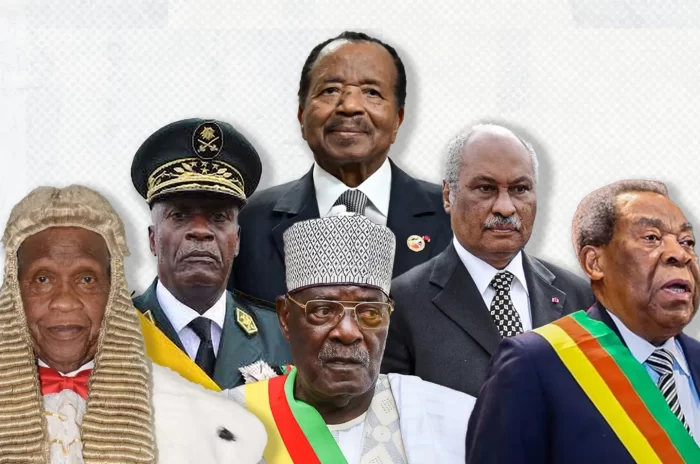
Power, they say, is sweet, but when it becomes the exclusive preserve of the old, it mutates into something else: stagnation. Cameroon today sits under the heavy, trembling hands of men whose combined ages could span the nation’s modern history. With its 92-year-old President Paul Biya securing an eighth term in office, extending his already 43-year rule, the country has once again made international headlines, not for progress or innovation, but for its stubborn allegiance to gerontocracy.
Cameroon is, by every definition, a gerontocracy; a state governed by the elderly. The term itself derives from the Greek “geron”, meaning “old man,” and “kratos”, meaning “rule.” In practice, a “gerontocrat” is a leader who wields power largely by virtue of age and seniority. Such systems, which existed in ancient Sparta where a council of elders governed the city-state, were once respected for their wisdom and stability. But in modern times, gerontocracy has become synonymous with stagnation, resistance to change, and disconnection from the lived realities of younger generations.
This is precisely the case in Cameroon, where political power, judicial authority, and even the military command are in the hands of men who have outlived entire generations of their citizens.
At 92, Paul Biya is the world’s oldest sitting head of state. His rule, which began in 1982, has outlasted most African leaders, multiple wars, and the rise and fall of global powers. In October 2025, Biya was declared the winner of Cameroon’s presidential election for an eighth term, a victory that could keep him in office until he is nearly 100. But Biya is not alone in this elderly elite club; he presides over a system where nearly every key power player is past 80, and some well into their 90s.
Let us start with the legislature. The President of the Senate, Marcel Niat Njifenji, is 91 years old, born in October 1934. With nearly six decades of political experience, Njifenji was elected President of the Senate in 2013, a position that carries enormous constitutional weight. Should the president die in office, it is the Senate President who becomes Acting President, though the constitution bars him from contesting the subsequent election. In other words, if Biya were to pass on, Cameroon’s temporary leader would be a man in his nineties, a scenario that raises valid concerns about physical fitness, mental sharpness, and continuity.
The President of the National Assembly, Cavayé Yéguié Djibril, is another example of this aging hierarchy. Born in February 1940, Djibril, now 85, has held his post since 1992, a tenure spanning more than three decades. Together, Biya, Njifenji, and Djibril form the triumvirate that dominates Cameroon’s political architecture, men born before World War II who still dictate the affairs of a nation whose median age is just 19.
But the pattern extends well beyond the political sphere. For instance, in the armed forces, the Chief of Staff, General René Claude Meka, was born in February 1939, making him 86 years old. He has been the head of Cameroon’s military since 2001, a tenure older than most of the soldiers under his command. When a nation’s defense system is led by someone nearing 90, questions about agility, strategy, and modernization become unavoidable.
The judiciary tells a similar story. The President of the Constitutional Council, Atangana Clement, is 84 years old. Appointed in 2018, Atangana presides over the institution that interprets the constitution, oversees elections, and validates presidential results. It was Atangana who officially declared Paul Biya the winner of the October 12, 2025 presidential election, sealing yet another chapter in Biya’s long reign.
Meanwhile, the Chief Justice of the Supreme Court, Daniel Mekobe Sone, is 79 years old. He has been in the role since 2014. The Minister of Justice, Laurent Esso, is 83, having taken office in 2011. Together, these figures form a judiciary that mirrors the executive and legislative arms, aged, insulated, and immovable.
Cameroon’s top leadership is thus a mirror of itself: old men leading an overwhelmingly young country. According to the United Nations, Cameroon’s population is roughly 30 million, with 41% aged 0–14, and another 56% between 15 and 65. This means that more than 97% of Cameroonians are younger than their rulers.
For many of these citizens, especially those under 30, there has been only one president in their lifetime. Their parents grew up under Biya. Their grandparents grew old under him. In the eyes of the young, the system is not merely outdated; it is suffocating.
Defenders of gerontocracy often argue that age brings experience, stability, and wisdom. And to be fair, those virtues can be true in some cases. Older leaders can indeed serve as custodians of institutional memory and mentors for the next generation. They may also embody a sense of continuity in societies still grappling with political instability. But Cameroon’s case reveals the darker side of gerontocracy, the point where longevity ceases to be an asset and becomes a liability.
The problem is not that Biya and his team is old. The problem is that they have allowed their age to become the justification for monopolizing power. For 43 years, Biya’s leadership has revolved around control rather than renewal. His government has perfected the art of survival, manipulating elections, repressing dissent, and rewarding loyalty over competence. The result is a state where young people are not encouraged to participate in governance but to wait, indefinitely.
Gerontocracy has crippled Cameroon’s political evolution. Instead of fostering generational transition, it has institutionalized geriatric governance. Instead of building resilient institutions, it has built a cult of personality. Instead of empowering the young, it has left them disillusioned, unemployed, and unheard.
The economic consequences are equally dire. Youth unemployment remains rampant, infrastructure is decaying, and corruption festers unchecked. Biya’s government, often described as remote and reactive , has failed to adapt to technological change or the demands of a modern economy. The result is a country where the young are fleeing in droves, seeking opportunities elsewhere.
In many ways, Cameroon today is a paradox: a young nation trapped in an old body. Its leaders represent the past, not the future. And the country’s institutions, from the military to the courts, have been frozen in time, mirroring the frailty of their custodians.
Yet, the danger is not just political. It is existential. The constitution gives the Senate President the right to assume power temporarily if the president dies, but with both Biya and Njifenji in their 90s, Cameroon risks a succession crisis that could destabilize the entire nation. In effect, Cameroon’s leadership structure has no future, only extensions of the past.
The question, then, is not whether Cameroon is a gerontocracy, it is. The real question is how long this gerontocracy can survive before collapsing under its own weight.
History offers a clue. No gerontocracy lasts forever. The Soviet Union in its final years was ruled by a succession of frail leaders, Brezhnev, Andropov, Chernenko, before finally imploding in the face of a younger reformer, Mikhail Gorbachev. Zimbabwe’s Robert Mugabe clung to power until age 93, only to be swept aside by the same system he built. The same fate, inevitably, awaits Cameroon’s old guard.
The danger, however, is that by the time generational change comes, it may be too late, too late for the economy, too late for national unity, and too late for the millions of young Cameroonians who have been left voiceless.
Paul Biya’s eighth term should therefore not be seen as another victory, but as a national tragedy, the triumph of inertia over renewal. Each time he “wins,” Cameroon loses another decade of potential progress. His latest victory, rubber-stamped by a judiciary led by octogenarians, exposes not the strength of his leadership but the fragility of a system built on fear and familiarity.
Cameroon’s gerontocracy has done more than just outlive its usefulness; it has become a barrier to the nation’s future. The youth, who make up the country’s lifeblood, are treated as spectators rather than stakeholders. But as history shows, young people do not remain silent forever.
Sooner or later, someone, or rather, a generation, will wrestle Cameroon from the grip of its gerontocrats. It will not be an easy struggle. Power never yields without resistance. But when it finally happens, it will mark not just a change of leadership, but a rebirth of possibility.
Until then, Cameroon remains what it has tragically become: a young nation trapped in an old man’s dream.