Africa
Wike and the Soldiers -By Ariwoola Samuel Akinwale
This shows the rot of regressive practices in our institutions. Nothing captures the way forward for us like the visceral advice of Wike at that gathering. Hear him: “You cannot use soldiers to intimidate government officials doing their job. This country cannot continue this way.” One question lingers after the recent incident: When will our military remain in barracks, as opposed to acting on orders that cause institutional disrespect and cross professional lines?

The late author Chinua Achebe penned the children’s story collection, “Chike and the River.” I draw an allegorical parallel for the title of this piece from that book. Unlike Chike the village boy from Umuofia who came to the city of Onitsha, faced with the barrier of crossing the River Niger to the other side of the city, in this case, the parallel is Wike and the impersonal rules that should characterize our public space but often don’t.
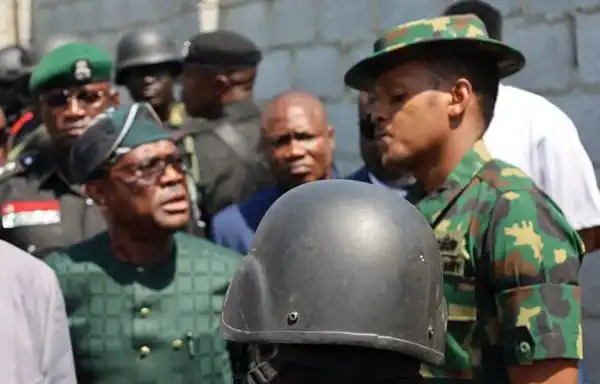
Last week, FCT Minister Nyesom Wike was in the news over a viral video where he was seen in an altercation with a young naval officer—Lt A. Y. Yerima. The officer with his men, acting on orders, barricaded a landed property somewhere in the Gaduwa district area in Abuja, preventing FCT officials from carrying out a demolition exercise on the said property, allegedly belonging to a retired military admiral.
In that video, which has since sparked mixed reactions from many quarters, it was evident that our society still struggles to enforce impersonal rules in governance. Power and authority are used as instruments of bargaining for both opportunities and privilege in public places. The thrust of authority is therefore often self-serving.
On this matter, most analyses have focused on the foul language used by Minister Wike during the confrontation and the unarguable illegality of the military presence at that venue. But the significance of such an event, and its consequences for governance and order, are examined here. Here are a few lessons from that incident.
First, Wike enjoys legitimate authority over Abuja territory, and he is duty-bound to carry out his responsibilities. Hence, we can give him the benefit of the doubt that he was in an official role in that capacity. But the military’s resistance, using its instrumental office to pursue purely personal interests, conflicts with the law and modern rules of public service. Today, people use their offices and authorities to exert their will on others, sometimes even against the state, as this incident revealed again.
Logos, caps, and insignia are displayed in conspicuous parts of vehicles to signify positions held by our authorities. Many Nigerians have witnessed military men dressed in official attire walking into banking halls and fuel stations, shunting queues. The military qualification is equated with impunity by some elements. In traffic, motorcades of our law enforcement agencies ignore lanes and cut lines while on sometimes non-official duties; a salient impression of being above the law envelops onlookers. Those who dare challenge such abuse come under “military discipline.”
But there is a public endorsement to this that can’t be overlooked. The public privileges the military and paramilitary personnel in violation of such etiquette almost without question. In that video, the resistance of the officer was a contestation for authority and a lack of demarcation between public service and self-service. One would ask this question: What is the plight of the average Nigerian without such authority in a society where people use their offices to bargain for both spaces and opportunities?
Second, another angle to this is the question of, “Who are you?” We hear this often when Nigerians are provoked. Parties express the implicit challenge of demonstrating powers rooted in identities: class, office, status, or mystical powers. Minister Wike was seen questioning the officer, “Who are you?” repeatedly. The officer was also seen reiterating his official status, wanting to be recognized as such: “…I am a commissioned officer.” Fundamentally, such a question applies in modern meritocratic societies to assess the authority and competence of a person for a given role. But in our own situation, its importance is about the level of power, affluence, or influence such persons wield; it is not for the enforcement of the rules required, but rather to question the audacity to usurp or violate them. That was the implicit meaning of the question Mr. Wike asked the officer: “Who are you?” The Minister knew he was a commissioned officer.
Sadly, we rarely get to know the identity of the superior military officers on whose orders such men acted. Thankfully, this time, we got to know the retired admiral in the Abuja case either.
Third, another form of indiscipline also evident in that clip is a practice in the military where superior officers use their juniors to engage in private ends. Aside from asking them to run errands, they are sometimes engaged in unprofessional and clearly demeaning tasks. This trend is peculiar to armed forces generally, where law enforcement agencies simply meddle in civilian affairs—a practice likely a legacy from our history of military dictatorship. Yet, it’s one thing to engage junior officers in unofficial roles; it’s another to task them for private and selfish ends.
Finally, there’s a caution line of demarcation that was almost crossed by the officers of the navy and the DSS. With both parties armed almost to the teeth with AK-47s, the lives of civilians in their midst were at risk in that event. Perhaps this was the only restraint for both sides—otherwise! One could ask where the spirit of esprit de corps is among the agencies. Wike’s mood aptly captured the averted adversity narrowly escaped at that scene: “If not for the Chief of Defence Staff who just spoke to me, you could have killed everybody here.”
An example suffice here to show instances where our law enforcement agencies could not draw the line between order and chaos in such situations: Ibrahim Wadume was arrested in his hometown in Taraba State by police officers for kidnapping-related matters sometime around August 2019. He was accosted in a vehicle by the officers. But suddenly the Nigerian army appeared and opened fire at the officers in the vehicle with Wadume. The officers later died. In the end, the military men were said to be acting on “orders from above.” Nothing significant has happened to those men since then, and the identity of the issuer of the order is still muted. This is Nigeria!
Again, this speaks to the level of professional training and conduct of our law enforcement agencies.
This shows the rot of regressive practices in our institutions. Nothing captures the way forward for us like the visceral advice of Wike at that gathering. Hear him: “You cannot use soldiers to intimidate government officials doing their job. This country cannot continue this way.” One question lingers after the recent incident: When will our military remain in barracks, as opposed to acting on orders that cause institutional disrespect and cross professional lines?
Ariwoola Samuel Akinwale wrote this piece from Lagos.
ariwoolaakinwale@gmail.com