
Africa
Lean Carbon, Just Power: Why a small, temporary rise in African carbon emissions is justified to reach the continent’s urgent electrification needs -By Louis Strydom
Africa does not seek permission to pollute. It seeks permission to end energy poverty quickly while peaking emissions early. That is the lean-carbon bargain: a small, declining hump instead of a long, dirty plateau, and a faster route to the sunny side of the Kuznets curve. The task for partners is to help keep the overdraft small, and to pay it back fast.

Africa holds 17% of the world’s people yet produces roughly 4% of global CO₂. On a per-capita basis it emits about one tonne a year, the lowest of any continent. Africa also contains the world’s largest pocket of energy poverty. The question that matters is not whether to cut carbon, but how much temporary pollution is tolerable on the way to energy prosperity, and under what constraints.
An old question, a sharper answer
Orthodoxy has split into two camps. One says “no fossils, ever”, a moral stance that collides with fragile grids and frequent blackouts. The other says “gas or nothing”, tidier for funders, but often impossible where gas infrastructure does not exist.
A better course is lean carbon: a minimal, time-limited overdraft of emissions to buy dependable power now, with covenants that force an early peak and a rapid decline. Think of it as carbon on credit, a capped facility, not a blank cheque.
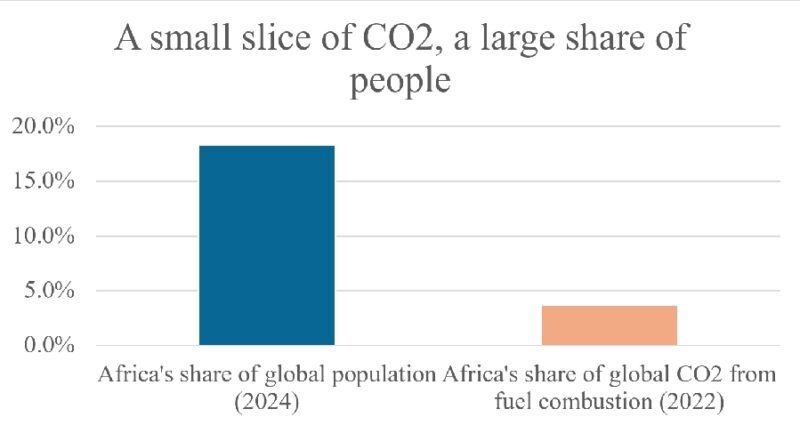
Africa’s cumulative energy-related CO₂ to date is <3%
Sources: United Nations (World Population Prospects 2024), IEA Africa (2022)
An old curve, a new context
The Environmental Kuznets Curve describes an upside-down U. Pollution rises at low incomes, then peaks and falls as countries grow richer and regulate more. Africa can peak lower and earlier than historic industrialisers because renewables are cheaper, technology has improved and coal can be avoided. The policy aim is to flatten the hump: accept a small bump now to reach the downhill sooner.
Reality, not dogma
Today’s counterfactual is not a continent powered neatly by wind and sun. It is millions of diesel generators humming in courtyards and factories because the grid is unreliable. Studies suggest self-generation already equals about 6% of installed capacity in sub-Saharan Africa, at a punishing 0.30 to 0.70 dollars per kWh, several times typical grid tariffs. When utilities falter, governments lease emergency diesel in bulk. In some cases these contracts have cost 3 to 4% of GDP. A clean sentence in a strategy does not change the physics of a failing system.
Intermittent renewables alone cannot yet stabilise a weak grid at scale. They need firm capacity, storage, or both. The sensible choice is planned, efficient firm power that complements solar and wind, rather than the messy reality of unplanned, dirtier backup.
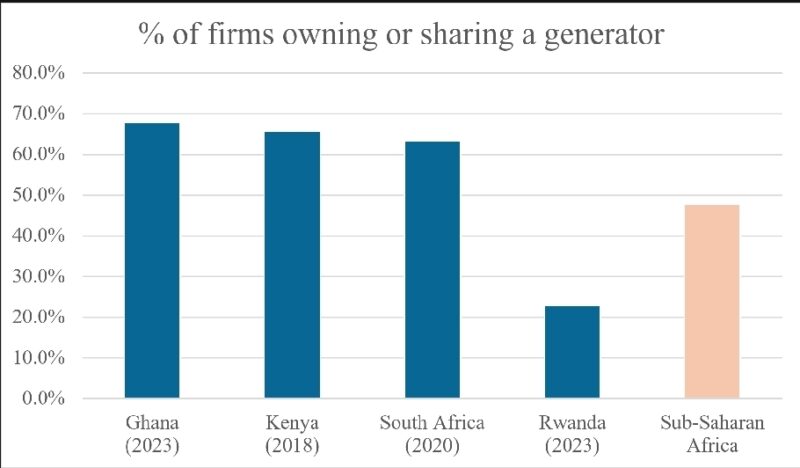
Sources: World Bank Enterprise Surveys (WBES), IFC The Dirty Footprint of the Broken Grid (2019), World Bank (Foster & Steinbuks 2009)
The gas-only headache
If fossil molecules must feature, natural gas is preferable to oil products: fewer local pollutants and roughly half the CO₂ of coal per kWh. But gas-only is a mirage in much of Africa because pipes and LNG are scarce and markets are small. Outside a few corridors there are only a handful of regional gas arteries, notably the West African Gas Pipeline from Nigeria to Ghana and the line from Mozambique to South Africa. Grand schemes to extend them have moved slowly. Most countries lack the demand density to finance pipelines or import terminals. Insisting on gas everywhere, now, often means no power at all.
Policymakers have improvised. Ghana plugged supply gaps with a floating powership that initially burned heavy fuel oil, then switched to domestic gas once supplies and connections were ready. Senegal has commissioned Heavy Fuel Oil-capable plants built to convert to gas when new fields and pipes arrive. These are bridges engineered to shorten the dirty phase, not invitations to lock-in.
What a workable plan looks like
A credible lean-carbon pathway is neither all-renewables tomorrow nor gas for ever. It has three moving parts.
1. Power plants that can switch fuels
New power stations should be able to start running right away—using heavy fuel oil or diesel if needed—but be built so they can easily switch to natural gas when supplies become available. This avoids blackouts today without locking countries into oil and gas for decades. Modern reciprocating engines can start and stop quickly, making them ideal substitutes for solar and wind power when the sun isn’t shining or the wind isn’t blowing.
2. Fossil fuel use that drops over time
Fossil fuels should be relied upon only when necessary, shifting focus to using them for system stability and renewable-scarce periods. If they are the only means of electricity generation, we should systematically seek to decarbonise them. That way, emissions per unit of GDP fall fast, even before absolute emissions peak. The first target is to displace diesel generators, the dirtiest and costliest kilowatt-hours on the continent.
3. Covenants that bind
To make sure the “carbon overdraft” stays small and temporary, it needs hard limits. These include deadlines for switching to cleaner fuels, limits on total emissions, and power purchase agreements that reduce payments to conventional plants as renewables and storage grow. The focus should be on financing the whole energy system – renewables, backup power, and better transmission lines – not just individual plants.
Funders are shifting, cautiously
Development financiers are moving from blanket bans to conditional support for transitional projects. A growing chorus argues that gas should form part of Africa’s just energy transition, provided it is integrated into national climate plans and structured to de-risk the shift to cleaner power. The most useful money crowds in private capital to systems, not stand-alone assets. The priority is hybrids that cut diesel use immediately and accelerate renewables later.
Why the bump is acceptable
Two points matter for the climate ledger. First, Africa’s historical contribution is tiny. Sub-Saharan Africa excluding South Africa has emitted well under 1% of cumulative CO₂ since the industrial revolution; including South Africa the region is still under 2%. Second, the opportunity cost of delay is enormous. Energy-starved economies grow slower, which makes the clean transition harder to finance. A modest, time-boxed rise to something like a 5% share of global CO₂ as grids stabilise would still leave Africa’s burden small by world standards, especially if the uptick displaces diesel and comes with a dated plan to fall.
Risks, spelled out and mitigated
The obvious risk is lock-in: today’s bridge becomes tomorrow’s motorway. That is why the contract matters. Write conversion deadlines and decommissioning triggers into PPAs. Require modular plants whose value survives a fuel switch. Publish transparent emissions dashboards. Include stop-loss clauses if milestones slip. Another risk is cheap-today myopia, choosing the lowest upfront tariff and ignoring reliability, ramping and integration costs. The remedy is to procure systems and judge bids on whole-system cost and carbon, not just cents per kWh.
One final objection is to wait for cheaper batteries. Storage costs are falling and Africa should adopt them early. But telling a low-income country to wait five years for round-the-clock electrons is not climate policy; it is development deferred. High costs of capital already hobble clean projects. Suppressing growth makes those costs worse. Better to grow with discipline, shrink diesel immediately, and use rising demand to make gas and storage bankable, then retire the fossils on schedule.
The ask
For energy ministries and regulators: publish peak-and-pivot plans that show when emissions will crest and what will force them down. Bake overdraft covenants into every firm-power tender. Allow dual-fuel where necessary, but mandate gas-ready design, switch-by dates and emissions-intensity floors.
For development financiers and multilaterals: fund hybrids and grids, not single-fuel bets. Reward early conversion and managed retirement. Deploy guarantees to cut the cost of capital for storage and transmission.
For developers and independent power producers: bid least-carbon firm power, not cheap today and stuck tomorrow.
Africa does not seek permission to pollute. It seeks permission to end energy poverty quickly while peaking emissions early. That is the lean-carbon bargain: a small, declining hump instead of a long, dirty plateau, and a faster route to the sunny side of the Kuznets curve. The task for partners is to help keep the overdraft small, and to pay it back fast.
ENDS
About the Author
Born in South Africa, Louis Strydom is Director of Growth and Development for Africa and Europe at Wärtsilä Energy, with over two decades of experience in infrastructure development across Africa, the Middle East, Europe, and Asia. He leads initiatives covering the full development cycle — from strategy and market definition to project development, sales effectiveness, and operational performance — with a focus on accelerating the energy transition and driving long-term value. Louis holds multiple master’s degrees from leading universities in business, finance, and strategy, and has a strong interest in digital transformation and artificial intelligence. He also serves on several boards, representing Wärtsilä’s strategic interests.

















You must be logged in to post a comment Login