
Politics
Gov Abba Yusuf: When Ruthless 2027 Respects No Matrimony, Friends -By Festus Adedayo
While Sir Ahmadu Bello, the Sardauna of Sokoto, was a blue-blooded descendant of dan Fodio, non-royals like Prime Minister Sir Abubakar Tafawa Balewa were brought into the establishment fold, and the broader Northern People’s Congress elite routinely cemented alliances between senior civil servants, ministers and traditional titleholders through marriage. Early Northern leaders institutionalized the gesture with an unspoken creed: “I trust you with my bloodline, so I can trust you with my political legacy.”


As if he had Kano State Governor Abba Kabir Yusuf and his estranged wife, Zainab, in mind, the retired American Air Force officer and poet, Stanley Victor Paskavich, once wrote: “Always remember when it comes to family arguments and disputes: blood is thicker than anger.”
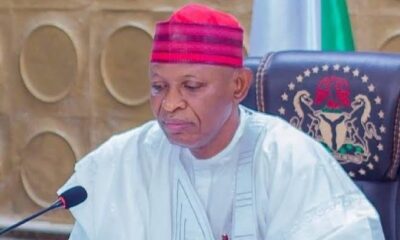
Neither Governor Yusuf nor Zainab yielded to that counsel. Paskavich, who once declared that poetry was where he hid his demons, could hardly have imagined his words playing out with such modern clarity in the ancient city of Kano last week. Apparently miffed that a woman had dragged the majesty of his office through the mud by initiating a divorce, Governor Yusuf stood before a Government House gathering to announce, with theatrical finality and self-deprecating banter, the dissolution of his 20-year marriage. Immediately afterward, he was quoted as saying: “If what our opponents want is a divorce letter, then we have provided it. Let everyone rest. We have also directed the Commissioner for Information to issue an announcement so that we can find decent and respectable women to remarry.”
With that statement, it became unmistakably clear that the demon of 2027 election politics was the sole incubus behind the couple’s matrimonial disharmony. Their conjugal union, which produced six children and celebrated its second decade a couple of months ago, had ceased to be merely a marriage vow, transforming into an oath of political abidance.
Zainab’s secret filing for Khul’i at an Upper Area Court in Abuja was the first salvo heard from her flank. A bedrock of northern Islamic family law, Khul’i is a divorce initiated by a wife in exchange for financial compensation, often involving the return of her mahr, dowry to her husband.
Yusuf’s public confirmation sealed their fates. In what appeared to be political rather than domestic retaliation, the governor tossed a pebble at the porcelain of his 20-year matrimony, shattering it with a public, husband-initiated divorce called talaq. Turning a family dispute into political theater at a Government House event, Yusuf joked that he had been demoted from a “corporal” to a “constable” – from two wives down to one – before inviting fresh applicants to jostle for his heart. It was a textbook display of how Nigerian politicians weaponize populist banter to neutralize personal embarrassment and project strength in the face of ridicule.
At the center of this drama stood Zainab, niece and adopted daughter of Yusuf’s estranged political godfather, Rabiu Musa Kwankwaso. Kwankwaso had given his late brother’s daughter, whom he raised as his own, to Yusuf, his longtime personal assistant, commissioner, and handpicked successor, as a seal on their political alliance and a totem of trust.
In this executive domestic saga, the Kano political class witnessed far more than a private separation. What Yusuf hoisted in public view was the fatal rupture of auren siyasa, the time-honoured Northern Nigerian tradition of dynastic marriage, where a political Malam gives his daughter to a protégé as an unspoken blood oath of loyalty.
Those privy to the turgid atmosphere inside Government House say the collapse was triggered by Yusuf’s daring decision to defect to the rival All Progressives Congress (APC), along with the bitter political brickbats that followed. The fallout underscores a timeless truism: wherever power and matrimony share the same roof, they breed a mutual discomfort the Yorùbá capture in the proverb of a hen perched on a taut rope. Neither is at ease – the rope strains under the hen’s weight, while the hen struggles to keep its balance. My people express this strain as “Adìyẹ bà l’ókùn, ara ò rọ okùn, ara ò rọ adìyẹ.” This typifies and exemplifies the Yusuf family. In a politically midwifed union like this, the couple is that hen and politics is the rope. Once Yusuf crossed party lines, the political tremor could not be kept outside the bedroom door.
Across Kano and the wider North, gifting a daughter to a key aide or anointed successor is a proven mechanism to ensure the protégé does not turn against his benefactor upon tasting power. When the protégé defects, however, the marriage ceases to be an alliance and becomes an active loyalty hazard. Zainab was apparently caught in a classic hostage dilemma, forced to choose between husband and father. Viewed with suspicion in her husband’s new camp, while her father’s political family expected unwavering fealty to the man who raised her, Zainab’s latter years trauma under a political captive was best imagined.
For two decades, Zainab served as the living axle binding Kwankwaso’s red-cap political empire to Yusuf. Indeed, Yusuf’s emergence as Kwankwaso’s successor rested squarely on that foundation; without the marriage, Kwankwaso would scarcely have hugged the porcupine by entrusting so vast a political destiny to an ordinary aide. Yet, the moment Yusuf crossed the Rubicon into his father-in-law’s rival party, playing Judas to his benefactor and apostate to a shared political dream, his home ceased to be a covenant of fealty and became a battleground until it caved in.
To the casual observer outside the North, the collapse of the Yusuf marriage might look like an isolated melodrama. In truth, across African history and statecraft, matrimony has rarely been matrimony simpliciter. From the diplomatic marriages of the 19th-century Sokoto Caliphate and the ọgọ in-law non-aggression pacts of pre-colonial Igboland, to the warlord alliances of the Old Oyo Empire and the 1962 Awolowo–Akintola fratricide that tore through Western Region parlours, marriage has long doubled as an instrument of statecraft.
In Northern Nigeria specifically, auren siyasa has functioned as a political glue across four distinct eras: pre-colonial, colonial, military, and the four Republics. Following the 1804 Jihad, Usman dan Fodio and his successor, Sultan Muhammad Bello, deliberately married their daughters and sisters to newly appointed emirs and flag-bearers in Kano, Katsina, Zazzau, Bauchi, and Adamawa, while taking wives from those ruling houses in return. Those unions forged a trans-emirate aristocracy that turned any rebellion against Sokoto into a violation of family bloodlines. Similarly, in emirates like Kano and Zazzau, where rival royal houses such as the Sullubawa, Dabo, and Mallawa competed for the throne, intermarriage softened succession bitterness and guaranteed losing factions continued proximity to the palace.
Centuries earlier, the Mais of the Kanem-Borno Empire routinely used marriages with the daughters of tributary chiefs like the Bulala and Mandara to secure frontier peace and trans-Saharan trade routes. Centuries later, during British Indirect Rule and into the First Republic, the Northern aristocracy used the same instrument to absorb the rising Western-educated commoner class – the talakawa intelligentsia – into their fold, bridging bureaucratic competence with aristocratic legitimacy.
While Sir Ahmadu Bello, the Sardauna of Sokoto, was a blue-blooded descendant of dan Fodio, non-royals like Prime Minister Sir Abubakar Tafawa Balewa were brought into the establishment fold, and the broader Northern People’s Congress elite routinely cemented alliances between senior civil servants, ministers and traditional titleholders through marriage. Early Northern leaders institutionalized the gesture with an unspoken creed: “I trust you with my bloodline, so I can trust you with my political legacy.”
This Malam–protégé dynamic borrows directly from traditional Qur’anic schooling called tsangaya, where a revered scholar rewards his most loyal, brilliant and trustworthy almajiri disciple with his daughter’s hand. The pattern persisted into the military era, when prominent political, military, and business dynasties, the Yar’Aduas, Babangidas, Abachas, Buharis, Sarakis, Dantatas, and Indimis, intermarried across generations.
What makes the Yusuf–Zainab split so troubling is its departure from that historical norm. In traditional Northern political culture, marriages were designed to absorb political shocks, not get shattered under them. Even during the fierce First and Second Republic rivalries between the conservative NPC/NPN establishment and Mallam Aminu Kano’s radical NEPU/PRP movement, families rarely dissolved because matrimony straddled both camps. The Kano matrimonial rupture of the Yusufs signals a stark erosion of that old aristocratic code. It reveals that modern electoral survival and party defections have become so ruthlessly zero-sum that even a sacred Malam–protégé marital covenant can no longer withstand the shock of political betrayal.
History beyond Nigeria’s borders offers sobering parallels. In South Africa, while personal strains existed, the 1996 divorce of Nelson and Winnie Madikizela-Mandela was fundamentally accelerated by irreconcilable political divergence: Nelson’s post-prison commitment to reconciliation clashed head-on with Winnie’s militant populism, turning their marriage into an unsustainable political liability.
In politics, “till death do us part” often carries an unspoken codicil: “unless party realignment comes first.” A similar dynamic played out in Zimbabwe during ZANU-PF’s succession wars, where spouses within the party’s inner circle, particularly among allies of Jonathan Moyo and former Vice President Joice Mujuru, queued on opposing sides of the Lacoste (Mnangagwa) and G40 (Mugabe) factions, forcing public denouncements and separations.
Even in the United States, Arnold Schwarzenegger and Maria Shriver walked a 25-year tightrope between a Republican governor and a Kennedy Democrat, where constant ideological friction exposed how political identity can strain a union. The crucial difference is that while Western political marriages tend to fracture over ideology, African political divorces are far more often driven by patrimonial and factional survival, where loyalty to a godfather or political bloc outweighs personal vows.
As Nigeria navigates the crater-filled road to the 2027 general elections, the Yusuf–Zainab rupture is merely the most dramatic symptom of a wider trend. Across the country, prominent political families are splitting publicly along party lines, echoing Shakespeare’s “Et tu, Brute?” In November alone, Auwal Lawal Daura, an APC chieftain, publicly endorsed President Bola Tinubu’s re-election bid even as his father, former DSS Director-General Lawal Daura, runs as the vice-presidential candidate on the APM ticket.
Similarly, while former President Olusegun Obasanjo remains a vocal critic of the APC administration, his son Olujonwo formally joined pro-Tinubu campaign ranks in November as Special Adviser on Political Affairs for the PBAT Door-to-Door Movement. And in Benue, House of Representatives member, Blessing Onuh sits on a different party platform from her father, former Senate President David Mark, who is now a central figure in the ADC, as she forges an alignment with APC and pro-Tinubu campaign efforts ahead of 2027.
Many commentators also suffer collateral damage from friends whose political parties they critique and those whose principals fall under the hammer of their commentaries. Friendships forged in the smithy when ambitions were mustard seeds, made realizable with the help of those friends, suddenly, on the cruel road to 2027, became leprosy and enmity of the Yusuf-Zainab kind.
Ultimately, the collapse of the Yusuf–Zainab union stands as a cautionary parable for Nigeria’s political class ahead of 2027. When matrimony is drafted as a foot soldier in partisan warfare, the home ceases to be a sanctuary. It becomes an extension of the campaign ground. It then becomes vulnerable to every shift in political wind. If the ancient covenant of auren siyasa can no longer shield bloodlines from the zero-sum ruthlessness of 2027 elections defections, then Nigerian politics has entered an era where no institution, not even the family altar, is sacred. Paskavich was right that blood ought to be thicker than anger. Yet in Kano’s executive theatre, among friends, raw political ambition proved thicker than blood and the sanctity of family altar.
Who decides Nigeria’s 2027 president: Ballot or bullet?
As Nigeria inches closer to the 2027 general elections, the familiar drums of political hostility are beating once again. Across the country, violent rhetoric, convoy attacks, and targeted intimidation, are casting a dark shadow over the democratic process. Since campaigns officially kicked off in August, at least eleven major incidents of electoral violence have been recorded. They range from the disruption of an NDC town hall in Lagos and attacks on party rallies in Enugu, to the obstruction of presidential candidate, Peter Obi’s convoy in Benue, as well as the October ambush on ADC senatorial candidate, Heberta Okonofua in Edo State.
While alarming, these incidents are neither isolated nor new. They are the latest symptoms of a violent political culture woven into the very fabric of Nigeria’s electoral history.
Nigeria has at best a legacy of elections written in blood. The rain of political thuggery began beating Nigeria long before the Fourth Republic and even before independence. In 1953, when the Action Group (AG) toured Northern Nigeria to campaign for independence, the move triggered large-scale riots in Kano. Supporters of the Northern Elements Progressive Union (NEPU) and Southerners living in Sabon Gari, particularly the Igbo, bore the brunt of a conflict they did not start. Around the same period, the Tiv faced brutal suppression for opposing the Northern People’s Congress (NPC) regional government and demanding Middle Belt autonomy.
By the First Republic, electoral contests had fully degenerated into warfare. Ahead of the 1964/65 general elections, both the Nigerian National Democratic Party (NNDP) and the AG, later allied under the United Progressive Grand Alliance, (UPGA) treated the ballot as a do-or-die affair.
Nigerian Tribune editions of the period read like war dispatches: On June 20, 1964, its lead story was, “Act of thuggery: NCNC fires Yoruba Obas.” It was a report which linked Chief S. L. Akintola’s government to political brigandage in the West. In its June 24 and 29, 1964 report, the newspaper’s banner headlines screamed: “NNDP thugs hit Ado, Ife.” It prompted a grim editorial comment in the newspaper on hooliganism. This forced a regional curfew and an emergency intervention in Lagos by ceremonial president, Nnamdi Azikiwe.
On October 2, 1965, following UPGA’s failed court injunction to restrain the Electoral Commission under Mr. T. Esua from declaring candidates unopposed, the Tribune reported mass displacements across Osun, Ife, and Ilesa. In Osogbo, it reported that a Mrs. Fatoki, wife of an UPGA candidate, was severely macheted and that, in Ilesa, thugs smashed the vehicle of an UPGA candidate, Bola Sadipe.
As Prof Eghosa Osaghae notes in his Crippled Giant, (1998) while both sides deployed violence, the NNDP weaponized state incumbency to devastating effect. There is near-unanimous consensus among historians that the 1964/65 electoral crisis, marked by widespread fraud, arson, and the killing of over 200 people in the Western Region, directly triggered the collapse of the First Republic.
Why does this cycle of blood persist? Beneath the surface of Nigeria’s political turbulence lies a fundamental philosophical failure: the triumph of monism over pluralism. Long before the 17th-century philosopher, René Descartes formulated his theory of Cartesian dualism, the idea that reality consists of distinct substances, rather than a single monolithic truth, Yoruba philosophy captured the necessity of multiple perspectives through its proverb, “A kì í dúró ojú kan wò’ran eégún.” It translates to read that, one does not stand in a single spot to watch a dancing masquerade. Because a masquerade’s performance is dynamic and multifaceted, an observer must constantly shift angles to appreciate its full form.
In contrast, Nigerian politics is trapped in a rigid, monist worldview. It is a mindset of “I and I alone.” When political actors believe there is only one legitimate path to power and no room for opposition, democracy ceases to be a contest of ideas and becomes a zero-sum war for survival. Violence becomes the way out.
This monist mindset is reinforced by structural and historical forces that turn elections into existential battles. First, as scholars, Kelechi Ani and Dominique Uwizeyimana observe, British colonialism, the type Nigeria went through, was established through “naked brutality” and military subjugation. Rather than dismantling this coercive apparatus at independence, Nigeria’s political class inherited it, institutionalizing violence and the militarization of the polity as standard tools of governance.
Political scientist, Billy Dudley, also famously noted that Nigerian politicians view public office as an investment for acquiring extraordinary wealth unavailable through legitimate enterprise, stating this to be where “politics means money and money means politics.” Legendary political scientist, Claude Ake, also pushed this further by saying that in Nigeria, those who win state power can accumulate limitless wealth without working, while those who lose have no security even for wealth earned through honest labour. Consequently, to capture the state becomes a matter of life and death.
As a 2007 United States Institute of Peace (USIP) report highlighted, political parties often operate like mafia syndicates controlled by “godfathers.” These power brokers exploit Nigeria’s mass youth unemployment to recruit idle young men as political mercenaries for the purpose of snatching ballot boxes, assassinate rivals, intimidate electoral officials and deploy state security forces to suppress voters.
While it is possible to hold elections without democracy, it is impossible to sustain democracy without credible elections. Credibility, however, cannot exist where voters are governed by fear.
As 2027 draws near, Nigeria stands at a familiar crossroads. If Nigeria will escape the ghost of 1964, its political class must shift their gaze from the destructive zero-sum logic of political monism. True democracy requires the wisdom of the masquerade’s audience: the willingness to accommodate shifting viewpoints, respect the opposition and allow the ballot, rather than the bullet, to decide who leads Nigeria in 2027.
Olanipekun: Here comes newest GCON
In a piece I wrote on April 3, 2022, on the occasion of Chief Wole Olanipekun’s appointment as Chairman of the Body of Benchers, I began by writing as follows:
“Since his death in March 2005, not minding the galaxy of topnotch legal colossi that Nigeria has sired ever since, many schools of thought hold that Nigeria has not been able to reincarnate Chief Frederick Rotimi Alade Williams, QC, SAN. I argue to the contrary, however, that in Chief Wole Olanipekun, Williams is very much alive at the Nigerian Bar. The late Queen’s Counsel bestrode the legal firmament, both literally and with his immense physical stature.”
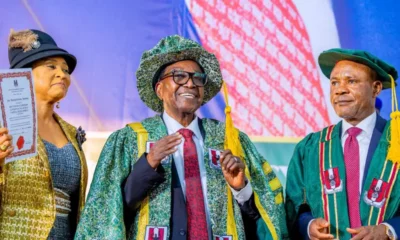
As President Bola Tinubu conferred on Olanipekun Nigeria’s second-highest national honour, the Grand Commander of the Order of the Niger (GCON) last week, I am forced to reproduce the piece thus:
“Like Williams, Olanipekun has also traversed the world of law. First Nigerian to become a Senior Advocate of Nigeria (SAN), a staunch member of the Action Group, Minister for Local Government, and Western Region’s first indigenous Attorney General—before becoming Minister of Justice in 1959, Williams also became President of the Nigerian Bar Association (NBA). When lawyers cite groundbreaking precedents like Lakanmi v. Attorney General (Western State) and the landmark case involving the Oba of Lagos, Adeniji Adele, against the Nigerian National Democratic Party (NNDP), Williams’s legal wizardry and imprimatur encompass them all.
Years after Williams’s departure, however, there is arguably no Nigerian lawyer who has traversed the firmament of law like the Ikere-Ekiti-born legal colossus, Olanipekun. Called to the Bar in July 1976 after graduating from the Nigerian Law School and becoming a SAN in July 1991, Olanipekun eventually became Ondo State’s Attorney General and Commissioner for Justice.
Perhaps the most talked-about period of his legal career, and his most profound engagement with the Bar, was in 2002 when he was elected President of the NBA. Legal pundits liken that period to the Alao Aka-Bashorun leadership of the Bar for its overarching impact on the profession and the lives of individual members. The year after, Olanipekun was appointed Vice President of the Pan African Lawyers Union (PALU) and, in January 2007, became a Life Bencher, one of the most prestigious heights of attainment in the legal profession.
The University of Ibadan still talks with nostalgia about his period as its Pro-Chancellor and Chairman of the Governing Council between 2004 and 2006. Apart from being a Fellow of the Chartered Institute of Arbitrators (FCIArb), Olanipekun was also bestowed with the national honour of Officer of the Order of the Federal Republic (OFR).”
Same last week, Olanipekun unveiled a six-volume publication he entitled, Wole Olanipekun Through the Cases to mark his 50 years at the Bar. Called in 1976, Olanipekun has also spent 35 years as a Senior Advocate of Nigeria, having been elevated to the Silk rank in July 1991.
While conferring him with the GCON last week, President Tinubu affirmed my earlier tribute to Olanipekun, touching a part of the great elephant when he said: “I proudly celebrate Chief Wole Olanipekun, Senior Advocate of Nigeria, a phenomenon in Nigeria and an outstanding advocate who has fittingly stepped into the shoes of the acclaimed legends of the legal profession. He did not merely fill those shoes, but is walking with them into new territory.”
Tinubu also acknowledged the years of friendship, loyalty, and hard work that hallmarked his relationship with Olanipekun by saying, “On a personal note, I celebrate decades of loyalty, friendship, commitment and reciprocity between Wole Olanipekun and me.”
In conferring the GCON on Chief Olanipekun, the Nigerian state has merely placed its formal seal on a historical verdict which the Bar delivered before now. More than four years after I first argued that the spirit of Timi the Law lives on in this Ikere-Ekiti titan, that thesis stands vindicated. Its vindication is not merely the towering precedents Olanipekun has helped make in Nigerian courts, but in the institutional panache with which he continues to steer the legal profession.
For Olanipekun, the GCON does not confer merely a valedictory medal. It is also not an oar – which steers boats through water – to be rested upon. It is for this legal icon a fitting national salute, a medal hung on the lapel of a colossus who straddles the firmament of Nigerian law with purpose.






















You must be logged in to post a comment Login