
Politics
Soludo’s Billboard Crackdown: Fear, Not Law, In Anambra -By Jeff Okoroafor
These actions constitute a fundamental betrayal of democratic principles. As the Coalition of South East Youth Leaders (COSEYL) rightly noted, a government cannot collect campaign fees, issue a permit, and then destroy the materials because it disapproves of the political personalities displayed on them. This is not governance; it is the weaponization of state institutions for political vindictiveness. The Anambra State Signage Act, which the government claims to be enforcing, was enacted during Peter Obi’s own tenure—a fact that only underscores the hypocrisy of using it as a tool to suppress his political allies.


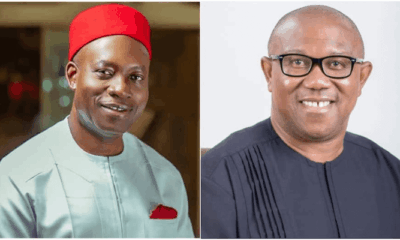
The heavy-handed removal of a campaign billboard featuring Senator Victor Umeh and Peter Obi is not an isolated act of regulatory enforcement. It is the latest, most brazen expression of a coordinated assault on democratic expression ahead of the 2027 elections. Under the guise of the Anambra State Signage Act, Governor Chukwuma Soludo’s administration has revealed its true motive: an obsessive, fear-driven campaign to erase Peter Obi from the political consciousness of his home state.
The government’s claim that the billboard was pulled down solely because the NDC presidential candidate had not paid a separate signage fee is a transparent pretext. Senator Umeh, the billboard’s owner, had fulfilled his financial obligations, paying the stipulated ₦20 million and obtaining the requisite Certificate of Permit. The state’s subsequent demand that Peter Obi pay an additional fee to have his image displayed alongside a compliant candidate is an absurd and targeted extortion. The Commissioner for Information’s assertion that “the billboard was not pulled down because of Peter Obi’s image” is rendered meaningless by the government’s own admission that the image was the specific reason for the additional, unfulfilled payment requirement.
The real motivation becomes undeniable when one surveys the visual landscape of Anambra State. As concerned citizens have publicly documented, the state is awash with banners bearing the image of President Bola Tinubu, yet not a single campaign banner for Peter Obi, a son of Anambra and a former governor, can be found. This is not a coincidence; it is a deliberate policy of political erasure. The governor’s fear is palpable—a fear that the sheer popularity of Peter Obi, the NDC presidential candidate, would further eclipse Soludo’s own political standing. By blocking Peter Obi’s visibility, the governor is not enforcing the law; he is attempting to manipulate the electoral marketplace and insult the intelligence of the Anambra electorate.
This abhorrent tactic is not confined to Anambra. It is part of a sinister, nationwide blueprint orchestrated by the ruling All Progressives Congress (APC) to stifle opposition visibility. The same directive has been enforced in the Federal Capital Territory, Abuja, where observers have confirmed that billboards from the city gate to the airport display only Tinubu’s image, with no sign of Peter Obi or any other opposition candidate. This pattern of suppression is replicated across APC-controlled states, from Plateau to Niger, where opposition parties accuse state governments of weaponizing regulatory agencies to frustrate their campaigns while allowing ruling party displays to dominate. The message is clear: in these territories, democracy is a privilege reserved for the ruling party.
These actions constitute a fundamental betrayal of democratic principles. As the Coalition of South East Youth Leaders (COSEYL) rightly noted, a government cannot collect campaign fees, issue a permit, and then destroy the materials because it disapproves of the political personalities displayed on them. This is not governance; it is the weaponization of state institutions for political vindictiveness. The Anambra State Signage Act, which the government claims to be enforcing, was enacted during Peter Obi’s own tenure—a fact that only underscores the hypocrisy of using it as a tool to suppress his political allies.
Governor Soludo must be reminded of a simple, immutable truth: he will not be governor forever. The instruments of state power he now wields to intimidate and silence are temporary. The democratic will of the people of Anambra and Nigeria is not. By choosing to prioritize the petty politics of fear and exclusion over the principles of fairness and freedom, he is not only tarnishing his legacy but also building a powerful backlash. Every billboard torn down, every banner suppressed, and every voice silenced only strengthens the resolve of those who believe in a truly democratic Nigeria. The governor should enjoy his fleeting authority while he can, for the judgment of the people—and of history—will be far more enduring and far less forgiving.
Jeff Okoroafor is a social accountability advocate and a political commentator focused on governance, accountability, and social justice in West Africa.


















You must be logged in to post a comment Login