Africa
A Psychologist Pleads with Kenneth Okonkwo: Please Don’t Distract from Obi—He’s Still Carrying the Nation’s Pain -By John Egbeazien Oshodi
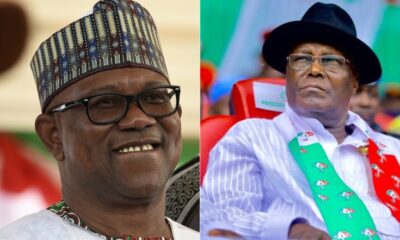
Julius Abure may be part of the rot. Labour Party may be compromised. But Peter Obi is not the rot. He is not the scandal. He is not your adversary. He is the signal—still reaching hearts across a suffering land. He is not in a contest with you. He is not seeking to silence you. But Nigerians—especially the forgotten—still see him as the only one listening. He speaks a language they still understand: quiet, consistent, and deeply human.

In a time when Nigerians are overwhelmed by daily hardship—soaring food prices, relentless insecurity, rising unemployment, and the silent grief of lives dimmed too soon—what the nation needs is not more political infighting, but clarity, compassion, and continuity in the few voices still echoing the public’s pain. Kenneth Okonkwo is respected for his courage and eloquence, but his recent public jabs at Peter Obi, however justified in his own view, risk redirecting national attention from the suffering of the people to the friction among the political class. This is a plea—not from a partisan or political loyalist—but from a psychologist who sees the emotional exhaustion gripping the country. Obi is not perfect. No one is. But he remains one of the few figures Nigerians still hear as their own. To distract from that, especially now, is to draw focus away from the deeper crisis at hand: the soul of a nation that is barely hanging on.
Kenneth, We Acknowledge You—But the People Are Watching
Kenneth Okonkwo’s legacy in Nigeria is not in question. He has stood out as a man of depth, bridging culture, intellect, and activism. From Nollywood screens to courtroom advocacy and campaign platforms, his voice has shaped public thought. During the 2023 elections, he emerged as one of the most passionate defenders of Peter Obi—articulate, fiery, and focused. It was more than politics; it was principle. People didn’t just hear him; they believed him. He reminded many that politics could still carry a moral edge.
But that credibility also carries consequence. When someone of Kenneth’s stature speaks against Obi, it reverberates beyond the headlines. It unsettles not just political observers but ordinary Nigerians who saw both men as part of the same moral struggle. Accusations or insinuations of betrayal do not happen in a vacuum. They send emotional signals to a weary public already drowning in distrust. Every word becomes a trigger. That is why the people are not just watching—they are listening closely, hoping this is not one more fracture in the last remaining alliance they still believe in. Because if this alliance collapses, it is not just about Obi and Okonkwo—it is about the people once again being left alone.
A Party at War with Itself—But Obi Did Not Create the Fire
The Labour Party’s internal crisis is real and visible. Since the end of the 2023 elections, the party has wrestled with damaging allegations: rigged primaries, financial opacity, and autocratic behavior under Julius Abure. Kenneth Okonkwo, to his credit, called it out early. He resisted the machinery when others fell in line. His voice was not just that of a critic—it was that of someone who had risked reputation to protect integrity, someone who hoped the party would reflect the movement it came to symbolize.
But Peter Obi did not architect that dysfunction. He joined a party in disarray and tried to use it as a platform to reawaken national consciousness. The party was flawed long before his arrival. Obi was not a founding insider but a reform-minded outsider. He was thrust into a house already on fire, and while he may not have shouted at the flames, he tried to steer the people through the smoke. If he remained silent at times, it may have been a strategy to preserve a fragile structure. If he appeared cautious, it was likely an attempt to avoid turning a public cause into a personal war. That may have disappointed some. But it is not betrayal—it is survival in a terrain where even clean hands get soiled, and sometimes silence is not complicity, but restraint.
The Public Has Spoken—Their Trust Still Lives in One Name
Away from party drama and media spin lies a deeper truth: the public still believes in Peter Obi. From Lagos to Aba, from Kano to Accra, in Whatsapp groups and market stalls, his name still triggers respect. Not because of perfection, but because of presence. He was there during fuel protests. He spoke up when silence was safer. He condemned injustice when others waited for instructions. He did not dismiss the pain of the people or recite rehearsed talking points. He engaged.
Poll after poll—informal or structured—places Obi far ahead in public trust. He is seen as the only figure among the political elite who still looks, sounds, and feels like the people. That symbolic power matters in a country where disillusionment is currency. In times of trauma, people lean toward the familiar, the stable, the emotionally credible. When Kenneth publicly distances himself, it is not merely a personal decision—it risks destabilizing the emotional trust people have in the only public figure they still call “ours.”
Obi does not need to be infallible to matter. He only needs to stay connected to the pain he has always acknowledged. And right now, that connection is what millions are holding onto.
When Trusted Voices Differ—How Do We Still Protect What Matters?
Peter Obi is currently facing pressures from multiple directions. While reports suggest tensions from Julius Abure’s camp, Kenneth Okonkwo has also voiced pointed critiques. Others in the public domain question Obi’s quiet approach. Yet despite these growing pressures, Obi continues to show up. He visits displaced communities. He speaks on inflation, insecurity, and injustice. He refrains from counterattacks and avoids theatrics. In a political landscape saturated with noise, he remains one of the few who still leads with presence, not performance.
This is not a defense of perfection. It is a defense of continuity in a voice many still find reassuring. Nigeria is hurting. And in a time of overwhelming suffering, the last thing the people need is for those who once stood together to now publicly fracture. When internal disagreements become public battles, the public pays the price.
So the question becomes: how do we protect what still serves the people emotionally and morally? Obi may not always speak as loudly or confrontationally as some might wish. But millions still interpret his tone as thoughtful, not weak; his caution as measured, not complicit. For them, his voice still carries the emotional rhythm of a country looking for balance.
That’s why, in moments like this, it’s not about choosing sides—it’s about protecting what matters. The message. The dignity. The hope. And that means resisting the urge to use platforms meant for healing as spaces for division. Nigerians deserve better than to watch those they once admired pull each other apart in public. Especially when so little trust remains.
Let us preserve what little is still working: the quiet voices that have not abandoned the people. Let us argue, yes—but let us not fracture what still holds meaning for the broken.
Nigerians Need Symbols—Even Imperfect Ones
In a traumatized society, symbols matter more than speeches. Obi is not a perfect man. But he is a necessary one. He stands as a moral reference point in a collapsing system. In psychology, we understand that people transfer their survival hopes onto those they trust emotionally. Obi became that vessel—not through propaganda, but through consistency. His calm, his presence, his quiet insistence on accountability—those are his real power.
His restraint in the face of abuse, his refusal to answer violence with noise, his ongoing calm amid chaos—these are not political tricks. They are signs of someone who understands the weight of national grief. They are the qualities of a figure carrying the emotional labor of a nation. When Kenneth attacks him, even indirectly, he attacks that emotional bridge. And in a country where bridges are burning every day—between people and government, between trust and truth—that is a costly blow.
Let Obi Stand, Even If You Must Walk Away
Kenneth, you are free to walk your own path. You are free to speak your truth. You owe no lifelong allegiance to any man. But in choosing to speak, choose wisely. The nation is not in a season where it can afford emotional fractures disguised as commentary. This is not the time for subtle feuds or wounded pride. This is a time of hunger, confusion, displacement, and despair. Millions are walking through this darkness not with maps, but with memory—and for many of them, Peter Obi remains the last symbol of leadership that didn’t insult their pain.
You may no longer have confidence in Obi. That is your right. But millions still do. And they do so not because Obi is flawless, but because he still speaks when others retreat. Because he listens when others lie. Because he still walks among the poor without fanfare or fury. Because even when silent, he does not mock the people with spectacle or indifference.
Julius Abure may be part of the rot. Labour Party may be compromised. But Peter Obi is not the rot. He is not the scandal. He is not your adversary. He is the signal—still reaching hearts across a suffering land. He is not in a contest with you. He is not seeking to silence you. But Nigerians—especially the forgotten—still see him as the only one listening. He speaks a language they still understand: quiet, consistent, and deeply human.
So once more—we hear you, Kenneth. We know your heart for Nigeria. We honor your previous courage. But in this hour of hardship and hunger, let the last steady voice keep speaking. Let him speak uninterrupted. Let him speak unprovoked. Let him speak without having to answer friendly fire.
Let Obi stand—not for power, not for perfection, but for the people.
Let him carry the weight—until the people can finally breathe.
And finally, we beg you: if you must continue speaking to the media, please speak to the real issues—poverty, hunger, insecurity, injustice. Let your voice serve the people. But kindly leave Obi’s name out of it. This is not about avoiding criticism; it is about protecting what little hope remains. In a time of national breakdown, we cannot afford to silence the voice still steady enough to comfort the broken.
And let it be clear: this writer, a psychologist, has no personal or official relationship with Peter Obi, with you, or with President Tinubu. This is not about alliances or grudges. It is about one thing—Nigeria must get better. And to get there, we must stop tearing down the voices still trying to lift us up.

John Egbeazien Oshodi
Professor John Egbeazien Oshodi is an American psychologist, educator, and author specializing in forensic, legal, and clinical psychology, cross-cultural psychology, police and prison sciences, and community justice. Born in Uromi, Edo State, Nigeria, he is the son of a 37-year veteran of the Nigeria Police Force—an experience that shaped his enduring commitment to justice, security, and psychological reform.
A pioneer in the field, he introduced state-of-the-art forensic psychology to Nigeria in 2011 through the National Universities Commission and Nasarawa State University, where he served as Associate Professor in the Department of Psychology. His contributions extend beyond academia through the Oshodi Foundation and the Center for Psychological and Forensic Services, advancing mental health, behavioral reform, and institutional transformation.
Professor Oshodi has held faculty positions at Florida Memorial University, Florida International University, Broward College, where he also served as Assistant Professor and Interim Associate Dean, Nova Southeastern University, and Lynn University. He is currently a contributing faculty member at Walden University and a virtual professor with Weldios University and ISCOM University.
In the United States, he serves as a government consultant in forensic-clinical psychology, offering expertise in mental health, behavioral analysis, and institutional evaluation. He is also the founder of Psychoafricalysis, a theoretical framework that integrates African sociocultural dynamics into modern psychology.
A proud Black Republican, Professor Oshodi advocates for individual empowerment, ethical leadership, and institutional integrity. His work focuses on promoting functional governance and sustainable development across Africa.