Politics
Gadaka, Renounce That 100 Years Curse Now, Nigerians Can’t Endure A Century Of This Pain -By Isaac Asabor
Nigerians are not asking for miracles. They are asking for relief. They are asking for leadership that understands their pain, not leadership that appears to overlook it. They distant future they may not even recognize. So Gadaka, this is a moment for reflection. A moment to step back from the applause of political allies and listen to the quieter, more urgent voices of ordinary Nigerians. A moment to recognize that power is not measured by how long you can hold it, but by how well you can use it while you have it.

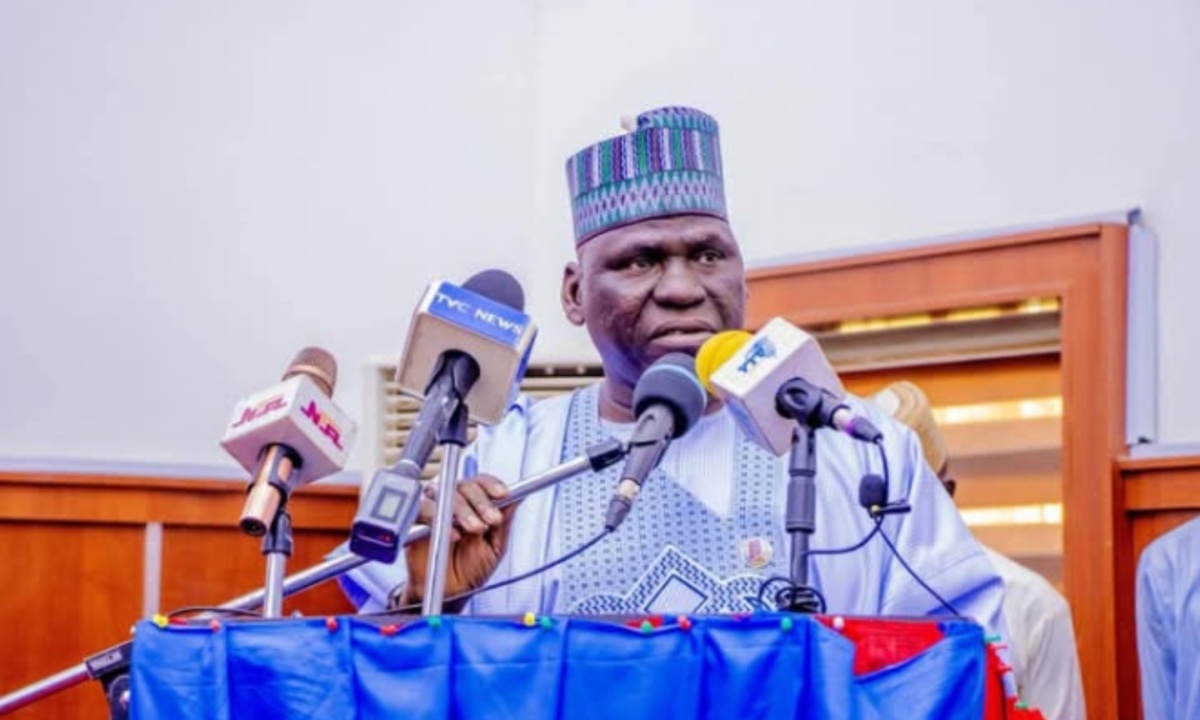
Muhammad Gadaka, this is not just another political statement to be waved off as rhetoric. Your declaration on April 10, 2026, in Damaturu, that the All Progressives Congress (APC) could rule Nigeria for more than 100 years, lands heavily in a country already buckling under the weight of economic hardship, insecurity, and eroding public trust. Words like these do not exist in a vacuum. In a nation as politically sensitive and historically burdened as Nigeria, they echo like prophecy. And if, by any chance, that prophecy carries the weight of a curse, then it is one you must urgently renounce.
Let us be honest: Nigerians are tired. Not the casual, everyday tiredness that sleep can fix, but a deep, bone-level exhaustion born from years of struggling to make ends meet. Since 2023, life has become markedly harder for millions. Food prices have skyrocketed, the naira has suffered devastating blows, fuel costs have surged, and the average Nigerian is now forced to stretch every naira beyond its limit. These are not abstract statistics; they are lived realities. They show up in empty kitchens, unpaid school fees, abandoned dreams, and rising frustration on the streets.
So, when you say the APC is poised to rule for a century, it doe not inspire hope. It triggers fear. It reminds Nigerians of a political culture that appears more focused on permanence in power than on performance in governance. It calls back memories of similar boasts made in the past, notably by the Peoples Democratic Party (PDP), which once claimed it would rule for 60 years. Nigerians remember how that ended. Not with applause, but with rejection. Not with admiration, but with a collective decision that no party, no matter how powerful, has a divine right to rule indefinitely.
Your statement risks placing the APC on that same slippery path of political arrogance. Let us break it down. You justified this bold claim by pointing to the party’s “vision to transform Nigeria” and its efforts to strengthen strategic direction. That sounds good on paper. Every ruling party, anywhere in the world, claims to have a vision. But vision without visible results is just talk, and Nigerians have heard enough talk to last several lifetimes.
What Nigerians are asking for is simple: “Where is the transformation that justifies even another 4-year term for the APC in power, let alone a hundred years?” “Where is the measurable improvement in the daily lives of citizens?” “Where is the sense of relief that should naturally follow bold economic reforms?
Instead, what many Nigerians feel is a tightening grip of hardship. Inflation is not just rising; it is suffocating. Jobs are not just scarce; they are disappearing. Security is not just shaky; it is unpredictable. These realities stand in stark contrast to the confidence your statement projects. And that is why it feels less like a promise, and more like a threat.
You must understand how statements like yours are received outside the walls of political gatherings. To the struggling trader in Lagos, the farmer in Benue, the teacher in Kano, or the unemployed graduate in Port Harcourt, “100 years of APC rule” does not sound like stability. It sounds like being trapped in a cycle with no escape route.
Democracy is built on choice, on the ability of the people to change their leaders when they are dissatisfied. It thrives on accountability, competition, and the constant reminder that power ultimately belongs to the people. But when a ruling party begins to speak in terms of centuries, it raises uncomfortable questions about its commitment to those democratic principles. Is this confidence in performance, or confidence in control? Because there is a difference.
If it is the former, then the focus should be on delivering results that naturally earn the trust and votes of Nigerians over time. But if it begins to sound like the latter, then it risks undermining the very democratic foundation that brought the APC to power in the first place. Gadaka, this is where the weight of your words becomes dangerous.
Nigeria is not a monarchy. It is not a one-party state. It is a complex, diverse democracy where power is meant to be contested, questioned, and, when necessary, changed. Any suggestion, intentional or not,that one party is destined to dominate for a century disrupts that delicate balance.
Even more concerning is the timing of your statement. It comes at a moment when public frustration is already high. When citizens are questioning policies, struggling with reforms, and demanding accountability. In such a climate, political leaders must tread carefully. They must speak with empathy, with awareness, and with a deep understanding of the emotional temperature of the nation.
Unfortunately, your statement did the opposite. Now, let us address the possibility, however symbolic, that your words could be seen as a curse. In many African societies, words carry power. They shape perception, influence reality, and sometimes take on a life of their own Without recourse to sounding sanctimonious in this context, it is germane to inform you that in the Bible, words are portrayed as having immense creative and destructive power, capable of bringing life or death (Proverbs 18:21). They reflect the heart’s condition, with the ability to heal, build up, or cause harm. Scripture emphasizes that words create reality and are tools to be used with wisdom, caution, and integrity.
When a leader declares something as bold and absolute as a century-long rule, it can begin to feel less like ambition and more like a sentence imposed on the people.And that is why you must reconsider.
If your intention was to inspire confidence, then it has missed the mark. If it was to project strength, it has instead exposed a disconnect. And if there is even the slightest chance that your words could be interpreted as a curse on a nation already enduring too much, then the responsible thing to do is to publicly walk them back. Renounce the statement, not out of weakness, but out of wisdom.
Replace it with something more grounded, more human, more in tune with the realities Nigerians face. Speak about the next four years, not the next hundred. Speak about reducing hardship, not extending dominance. Speak about listening to the people, not outlasting them.
Here is the truth: no political party, anywhere in the world, earns a century of rule through declarations. If It earns profit at all, it is through consistent, undeniable performance over time. And even then, it remains subject to the will of the people.
Nigerians are not asking for miracles. They are asking for relief. They are asking for leadership that understands their pain, not leadership that appears to overlook it. They distant future they may not even recognize. So Gadaka, this is a moment for reflection. A moment to step back from the applause of political allies and listen to the quieter, more urgent voices of ordinary Nigerians. A moment to recognize that power is not measured by how long you can hold it, but by how well you can use it while you have it.
And if your words have, even unintentionally, cast a shadow of prolonged suffering over this country, then it is within your power to lift that shadow.
Say it clearly. Say it publicly. Say it in a way that restores confidence rather than erodes it.
Because Nigerians have endured enough. They cannot, and should not, be asked to endure a hundred more years of uncertainty, hardship, and unfulfilled promises.
Not in the name of any party. Not under any banner. Not for any reason.









![Gaza has been under heavy Israeli bombardment for weeks [File: Ohad Zwigenberg/AP]](https://www.africansangle.com/wp-content/uploads/2023/10/Gaza-has-been-under-heavy-Israeli-bombardment-for-weeks.jpg)