Forgotten Dairies
Is This the Nigeria You Promised Us? —By Muhammad Bashir Abdulhafiz
Let us stop seeing them as a normal part of the landscape and start seeing them as the crisis they are. Let us be the generation that finally answered their cries. Let us give them back their childhood, their dignity, and their future. That is the only way we can truly call ourselves patriotic.

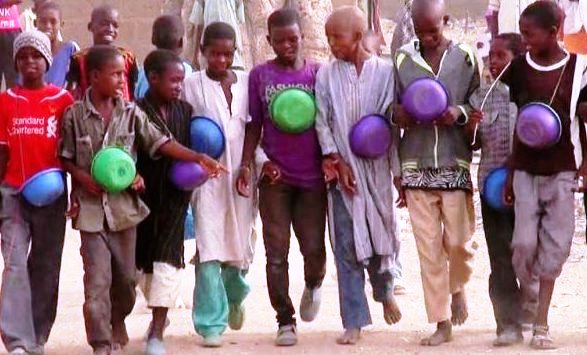
I am a young Nigerian. I am a human rights activist, but more importantly, I am a patriot who loves this country. To love Nigeria is to see her completely not just her bustling cities and vibrant culture, but also the corners of her heart that are bleeding. Right now, that bleeding heart can be seen in the Almajiri child.
When we speak of children’s rights, we often speak of a future generation. But for the millions of Almajiri boys scattered across northern Nigeria, the future is not a promise, it is a distant, and a blurry dream. Their present is a harsh reality that should shake us all to our core.
There is a deep rooted tradition of seeking spiritual knowledge, a noble pursuit that has shaped scholars for centuries. A family, hoping to give their son a path to God, sends him away to live with a Mallam. But in its current, neglected form, this pursuit of spiritual knowledge has come at a devastating cost: the children’s health, safety, and future.
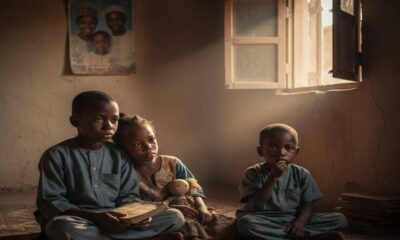
We see young boys, some barely five years old, walking for miles in tattered clothes, holding plastic bowls. They are not going to school, they are going to beg. They are not learning science or mathematics, they are learning to survive on the streets. The quest for religious education has been distorted into a system of child abandonment, where the right to a childhood is sacrificed for the hope of piety.
Imagine being so young and being told you must leave your home, your mother’s embrace, and travel to a distant town you have never seen. You are handed over to a Mallam, a man who may have dozens, sometimes hundreds, of other boys under his care. The Mallam is often overwhelmed and under resourced. He cannot feed them, clothe them, or house them properly.
So, the system depends on the child’s ability to fend for himself. The boy is sent out into the community with that plastic bowl. He must beg for his meals. He must compete with dogs for scraps. He must learn to navigate a world where adults look away, where his only value is the pity he can extract from passersby. This is not education. This is survival of the fittest, applied to children.
If you walk through the streets of our northern cities, you will see them. Their clothes are often torn and dirty, their bodies marked by the sun and the dust. Their eyes carry a weight that no child should bear. They face hardship with a disturbing acceptance. They sleep in makeshift shelters, under bridges, in overcrowded, and dilapidated rooms where ventilation is poor and clean water is a myth.
This brings us to the unspeakable truth of their living conditions. They survive in unhygienic environments. They sleep on bare floors, and they are exposed to the elements and diseases. They drink water that is not safe. They have no access to toilets, and no means to wash. This is a breeding ground for sickness, from malaria to cholera, and from skin infections to malnutrition. Their entire lives depend on the random kindness of a community that has become desensitized to their presence. They are, in effect, a community of invisible children, surviving on the margins, belonging to no one and everyone at the same time.
An Urgent Call to Those in Authority.
My heart is heavy, but my resolve is strong. This is not just a cultural issue, it is a failure of governance. It is a violation of the Nigerian Child’s Right Act and the very constitution we swear to uphold. To our leaders in the presidency, the governors of the north, the local government chairmen, and the traditional and religious institutions, I say this: The time for excuses is over. The time for action is now.
Here are my advice on how we can tackle these challenges:
1. Separate Education from Exploitation: We must work with respected Mallams and Islamic scholars to reform the Tsangaya system. Government must provide resources such as food, accommodation, and clean water to these schools. In return, the Mallams must agree to stop sending children to beg. If a school is a place of learning, the government must fund it. If it cannot be funded, the children must not be there.
2. Implement a Compulsory and Inclusive Education Policy: Every Almajiri child must have access to free, and compulsory basic education. This education must integrate Western knowledge (literacy, numeracy, science) with Islamic studies. A child who can only recite the Qur’an but cannot read a prescription or count his money is not educated, he is vulnerable. We need a curriculum that gives them skills for the 21st century.
3. Establish a Child Welfare and Tracking System: We cannot help children we cannot count. State governments must partner with local communities to create a database of all Almajiri children. They must be registered, dewormed, vaccinated, and provided with identity. We must know who they are and where they come from, so we can reunite them with their families or provide alternative care.
4. Invest in Infrastructure and Social Services: Local governments must enforce minimum standards of hygiene in these learning centers. Provide boreholes for clean water, build proper sanitation facilities, and ensure regular health check-ups. It is a basic duty of government to prevent a public health crisis, and these children are the first line of defense against disease outbreaks.
5. Engage and Sensitize Communities and Parents: We must speak to the parents who send their children away. We must use religious leaders to preach that true Islamic scholarship does not require a child to suffer. We must change the mindset that a child’s suffering is a necessary part of religious devotion. We must teach parents that their duty to their child does not end at sending them away.
Fellow Nigerians, the Almajiri child is our child. They are not a problem of the North alone, they are a Nigerian challenge. Their suffering diminishes us all. Their ignorance is a threat to our collective security. Their hopelessness is a time bomb for our future.
Let us stop seeing them as a normal part of the landscape and start seeing them as the crisis they are. Let us be the generation that finally answered their cries. Let us give them back their childhood, their dignity, and their future. That is the only way we can truly call ourselves patriotic.
God bless the Federal Republic of Nigeria.