Forgotten Dairies
Making Fertilizers Available And Affordable To Farmers -By Abachi Ungbo
The increase in fertilizer production and blending companies represents a significant advancement in domestic production capabilities. However, converting this development into tangible benefits for farmers and enhancing overall food security necessitates more than mere production capacity. The crux of the issue lies in ensuring that smallholder farmers have unhindered access to the input, thereby effectively augmenting yield and realizing the overarching goal of food security.

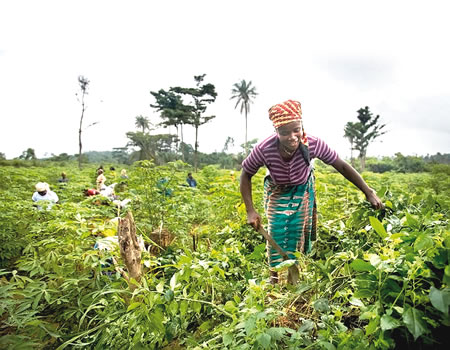
In the latter half of the 20th century, one of the innovations that has unequivocally augmented crop productivity is the production of inorganic fertilizers. This vital component of a comprehensive array of agricultural inputs is essential for enhancing yield.
It comprises macronutrients—nitrogen, phosphorus, and potassium—which are requisite for optimal plant growth in substantial quantities.
The degraded condition of the soil underscores the significance of fertilizer application as a critical agricultural practice. The Food and Agriculture Organization (FAO) has designated Nigeria as one of the nations grappling with severe soil degradation. It is evident that the predicament can be ascribed to a combination of factors, including poor management practices and adverse climatic and environmental conditions.
With a burgeoning population and the pressing need to ensure food security, making agriculture viable necessitates concerted efforts towards the provision of affordable fertilizers.
The role of fertilizers continues to challenge the ingenuity and resolve of governments, policymakers, and social enterprises in rendering this essential input accessible to end-users. Enhanced access to fertilizers is transformative, particularly for the multitude of smallholder farmers, as it breaks the cycle of poverty, boosts productivity and income, and improves the food system as a whole.
Current fertilizer application rates remain woefully insufficient to instigate a seismic shift in Nigeria’s food production paradigm. According to the Fertilizer Producers and Suppliers Association of Nigeria (FESAN), farmers are utilizing approximately 24 kg per hectare of fertilizer, starkly below the 50 kg per hectare target established in the 2006 Abuja Declaration on fertilizers, which aims to elevate average fertilizer usage in Africa and consequently enhance yield.
The same source indicates that the nation currently boasts an estimated annual production capacity of around 16 million metric tonnes of fertilizers, while domestic consumption hovers at approximately 2 million metric tonnes.
Since the 1960s, the government has maintained control over the fertilizer industry through tenders, contracts, and importation to supply this crucial input, supported by extensive subsidy programs aimed at advancing agricultural initiatives. However, these efforts have frequently been marred by corruption and inefficiencies, with products often failing to reach the intended beneficiaries. Moreover, attempts to stimulate domestic production led to the establishment of fertilizer companies by the government, which subsequently fell short of expectations due to a myriad of challenges.
The liberalization of the fertilizer sector in 1997 encountered an unprepared private sector, resulting in a sharp escalation in fertilizer prices, thereby placing it beyond the financial reach of farmers and precipitating a dramatic decline in fertilizer usage. The ramifications of this liberalization compelled the government to recalibrate its approach, culminating in the reintroduction of subsidies.
Subsequently, under the privatization agenda of the Obasanjo administration, the country’s principal fertilizer companies were privatized, with private investment catalyzing large-scale Urea production and effectively positioning Nigeria as a net exporter of Urea since 2014 (Urea, rich in nitrogen at approximately 46%). The availability of Urea incentivized the local production of NPK blending plants by the private sector.
In an effort to address the persistent issues of corruption, political patronage, exorbitant prices, and distribution challenges, the Jonathan administration instituted the Growth Enhancement Support Scheme (GES) to enhance the affordability and availability of fertilizers and facilitate access to subsidies through an e-wallet system. This initiative garnered both significant acclaim and considerable criticism due to various inadequacies.
The Presidential Fertilizer Initiative (PFI) was launched in 2016 following an agreement between the Buhari government and OCP, a Moroccan state-owned enterprise, to supply phosphorus at discounted rates. The objective was to facilitate farmers’ access to fertilizers and promote the proliferation of fertilizer blending companies. The government ensured it imported the critical component of mineral fertilizer, basically the phosphorus and potash, while Urea was locally sourced due to its abundance. The initiative led to an uptick in blending factories to about 90 from 2016 to 2025.
The program initially succeeded in driving prices down. However, following this brief respite, farmers found themselves compelled to purchase fertilizers and other inputs at exorbitant prices, which led to an escalation in production costs that subsequently affected food prices. Like its predecessors, the initiative faced a deluge of criticism despite attempts at restructuring.
In an effort to mitigate the surging food prices in 2025, the government launched a myriad of initiatives that, while effective in reducing food costs, inadvertently relegated farmers to significant debts and losses. As the country approaches the onset of the 2026 wet season, ensuring the availability of inputs at reasonable prices could invigorate production and alleviate the lethargy afflicting many farmers still reeling from the previous season’s losses.
The increase in fertilizer production and blending companies represents a significant advancement in domestic production capabilities. However, converting this development into tangible benefits for farmers and enhancing overall food security necessitates more than mere production capacity. The crux of the issue lies in ensuring that smallholder farmers have unhindered access to the input, thereby effectively augmenting yield and realizing the overarching goal of food security.
Essentially, governmental interventions in the fertilizer sector must prioritize availability, accessibility, timeliness, competitive pricing, and quality. Furthermore, the efforts must be smart enough to circumvent the debilitating effects of corruption, which has persistently plagued the sector.
Abachi Ungbo
abachi007@yahoo.com.