Africa
The Nightmarish State Of Federal Roads, by Pius Mordi

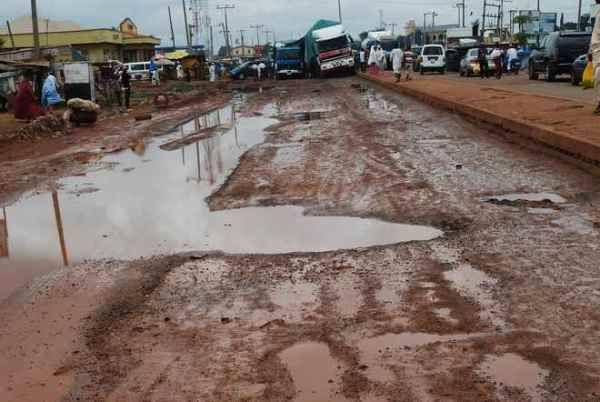
This is not about any administration, certainly not about Bola Ahmed Tinubu. It is about how the repair and maintenance of federal roads in Nigeria has seemingly become a tool for cartel-like transactions. For decades, federal roads have been on a programmed decline with simple potholes allowed to degenerate to gullies and ultimately disaster areas.
Most roads built and controlled by the federal government make up the artery for connecting the various states. Unfortunately, most of the roads are not just broken, but completely failed and impassable. Across the country, state governments have taken up the task of fixing collapsed sections of federal roads in their domain. The understanding is that on completion of the rehabilitation, applications are made to the federal government for refund of the cost incurred. The process of applying for the refund, its approval and actual disbursement by federal authorities has sprung an industry of its own. Top officials in the Federal Ministry of Works regale in the situation. With their recommendation, the cost quoted by a state may be deemed outrageous or reasonable. Previously, the federal government was known to routinely refund the amount quoted by states.
Muhammadu Buhari’s Information Minister, Lai Mohammed had in June 2022 said the Buhari administration had so far reimbursed about N447 billion for expenses incurred on construction and rehabilitation of federal roads and bridges to 24 states. By the end of April 2023, the figure hit N860 billion. But in a fact sheet highlighting achievements of the Buhari administration published by the Presidency in May 2023, then Minister of Works, Babatunde Fashola directed states to desist from such interventions as the federal government would no longer offset such expenses. For effect, Lai Mohammed stated that “Henceforth, if any state takes on federal government roads, it will not be paid. They will not get any refund. Even if you want to pay from your own pocket, you will still need the permission of the federal government and it will be supervised by the Federal Ministry of Works and Housing.” Tinubu’s current Works Minister, David Umahi, buttressed the stance when he visited Oyo’s Seyi Makinde in August 2023.
The fact that the prevailing arrangement where Abuja held the bulk of federal resources that should enable it repair federal roads was not working was not lost on both tiers of government. Federal roads were not being repaired and had become obstacles on the path to commerce and inter-state transportation. It no longer mattered if a state governor is in the good books of the president as Nyesom Wike found out when he hosted then President-Elect Tinubu for the inauguration of the N80 billion Rumuokwuta/Rumuola Flyover in Port Harcourt. Wike who was still Governor of Rivers State after successfully delivering the state to the coming president was roundly rebuffed. Abuja was not inclined to embark on comprehensive repair of its roads. And securing approval from federal officials to enable states restore such roads may have been weaponised.
Nowhere is the sorry state of federal roads in stark manifestation than in Delta State, home to most of the onshore oil infrastructure and a sizeable part of the maritime facilities.
Delta is the gateway to the southeastern part of the country from the south west; the major connecting point to the rest of South south from the north as well as the major link to the southwest from the southeast and south south. In a country where there is no viable rail network, road transportation remains the only way for movement of people and economic activities.
From the Benin-Asaba highway that links Onitsha and thencei the rest of the southeast; the roads from Agbor, Asaba and Onicha-Ugbo to connect the highway to Abuja as well as the Warri-Benin economic artery to Agbor-Eku Road, it is a tale of nightmare for road users and economic activities. They are all federal roads. The only clear exception is the Ughelli-Asaba highway which the Government of Delta State secured approval earlier to convert into a dual carriageway. The more than 112 kilometres road is almost completed and is the only bright light in the terrible state of federal roads in the state. Even this is now under serious threat from the failed sections in Asaba axis that link the Second Niger Bridge.
The tragedy of the crippling state of federal roads in Delta is that despite repeated attempts by Delta State Government to fix the roads, officials of the federal Ministry of Works go to great lengths to frustrate the rehabilitation of the failed sections that have virtually crippled human and economic activities. The failed sections of the Benin-Asaba highway aptly illustrate this alarming attitude of federal officials.
In the peak of the ongoing torrential rains, Governor Sheriff Oborevwori had directed his Commissioner for Works to effect immediate rehabilitation of the failed sections. As soon as the process began, officials from the federal Ministry of Works showed up to order the suspension of the exercise with the claim that contract has already been awarded for the rehabilitation. Sadly, no contractor has mobilised to site while the sections have turned into gullys and severed the ever-busy highway. Apparently, federal officials are more concerned that letting the Delta State Government to effect the repairs will deny them the perks that come with their handling of such contracts. The crippling of movement of goods and people under the asphyxiating economic challenges facing Nigerians is secondary to their peculiar interests in the contract process.
Months after, no contractor is yet to mobilise to site while the nightmare has worsened.
The brunt of the unusual and avoidable debacle is being borne mainly by residents and the business community in Delta State. This is unacceptable.
Given the fact that the federal government is too detached to be able to address the anomaly not just in Delta but also in other states nationwide, a viable option for keeping main artery roads linking states should be evolved.
The prevailing
Mr. Umahi should propose a viable strategy for effecting prompt rehabilitation of failed sections of federal roads in collaboration with the states in whose domain the collapsed sections are domiciled. The politics associated with the unilateral stance of federal officials is insensitive while commuters and businesses suffer.
While a comprehensive option is awaited, we urge the Works Minister to order his contractors to immediately mobilise to site in Delta State if truly the federal government awarded contract for the exercise. The sufferings of the masses is excruciating and avoidable.
All politicians and leaders in all arms of government know the federal government is the main cog in the wheel of keeping Nigerians connected through motorable roads. But just as my friend, Abraham Ogbodo, one-time editor of The Guardian noted, “Almost always, we deliberately settle for the wrong choices and hope to mitigate our collective guilt and outright stupidity.”