Africa
There Are Grains Of Truth In Traoré’s Comment—Democracy Alone Doesn’t Build Nations -By Isaac Asabor
Given the foregoing shortcomings of democracy, It’s time Africa wakes up to the reality that democracy, in its current form, is not working. The continent needs a governance model that prioritizes security, discipline, infrastructure, human capital, and national interest above blind imitation of Western systems. Call it benevolent dictatorship, developmental authoritarianism, or “popular progressive revolution” like Traoré says, what matters is results.

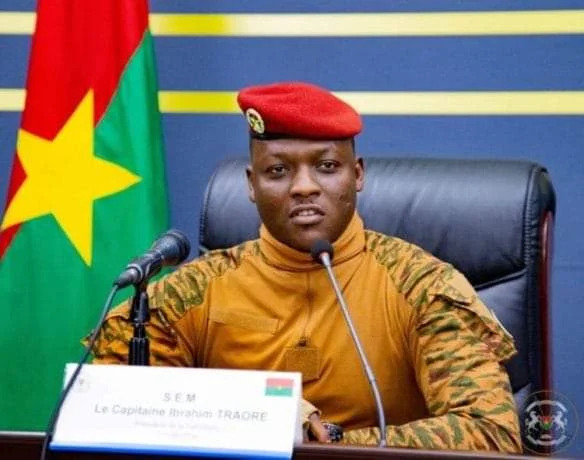
Captain Ibrahim Traoré, the 37-year-old military leader of Burkina Faso, recently declared that no country has developed under democracy, insisting instead that his country is undergoing a “popular, progressive revolution” and not bound by the dogmas of democratic governance. For many, especially in the West, such statements might sound like a rejection of modern civilization. But for those who choose not to be sentimental, his words ring true with a kind of clarity African nations desperately need.
Traoré’s assertion is not an attack on democracy itself; rather, it exposes the naivety and hypocrisy in believing that democracy, without foundational development, can bring prosperity to the people. The bitter truth? Democracy, as practiced in much of Africa today, is a grand illusion, more about appearances than results.
Since the wave of democratization that swept across Africa in the 1990s, most countries have transitioned from military or autocratic regimes to so-called democratic governments. Nigeria, Ghana, Kenya, South Africa, and others now hold regular elections, have multiple political parties, and tout themselves as democratic states.
Nigeria has been practising democracy uninterrupted since 1999, yet remains plagued by epileptic power supply, dilapidated infrastructure, mass poverty, and endemic corruption. Despite being Africa’s largest economy, over 133 million Nigerians are classified as multidimensionally poor (NBS, 2022), and the government still relies heavily on foreign loans and handouts to survive. The legislature, an institution that symbolizes democracy, is bloated, secretive, and consumes billions in allowances while ordinary citizens beg for palliatives.
South Africa, often lauded as Africa’s most sophisticated democracy, faces crippling inequality, rampant crime, rolling blackouts (load shedding), and mass unemployment. The very freedom that democracy guarantees has not translated into economic equity or social stability.
Kenya, Zambia, and Malawi have had multiple peaceful elections, but economic progress has remained slow, stunted by elite capture, donor dependence, and political instability. In fact, many democracies in Africa are caught in a vicious cycle where elections become more of a power struggle between elites than a pathway to progress for the people.
Without a doubt, the myth of democracy is that it is being seen as a prerequisite for development. Let’s examine how the world’s current powerhouses got to where they are.
For instance, China rose to become a global economic titan without embracing democracy. Under an authoritarian model, it lifted over 800 million people out of poverty (according to World Bank) in just 40 years through strict policies, industrialization, and disciplined state-led growth. The same country that the West criticizes for human rights abuses has built more infrastructure, educated more citizens, and expanded its economy faster than any democratic nation in history.
Singapore, under Lee Kuan Yew, was essentially a benevolent dictatorship. Lee famously said, “What a country needs to develop is discipline more than democracy.” He was right. Singapore rose from a third-world port city to a first-world financial hub, not through liberal elections, but through vision, planning, and meritocracy.
Rwanda, under President Paul Kagame, has one of the fastest-growing economies in Africa, with high scores in security, infrastructure, and public health. Yet Rwanda is not a full democracy by Western standards, Kagame’s rule has been accused of authoritarian tendencies. But Rwandans today enjoy cleaner cities, better roads, and functional governance compared to many of their “democratic” neighbours.
To not a few people, elections without development is political theatre. This is as in Nigeria, democracy has become more about elections than governance. Politicians focus on winning power, not on building nations. Voters are weaponized with bags of rice, cooking oil, and Naira notes. Once elected, leaders loot the treasury, empower their cronies, and disappear into air-conditioned offices until the next election cycle.
At this juncture, it is expedient to ask, “What then is the essence of democracy when it fails to uplift the poor, protect the vulnerable, or stimulate economic growth?”
Traoré’s comment strikes at the heart of this hypocrisy. Democracy has been elevated as the gold standard of governance, yet it has become a theatre of corruption and chaos in Africa. When he said, “Democracy is only the result,” he meant that genuine democracy is the byproduct of development, not the foundation of it.
Not only that, democracy offers “Free Speech” Illusion. One of the most touted features of democracy is free speech. But what use is freedom of speech when it’s only used to complain about bad governance year after year? What value does it have in a system where speaking the truth changes nothing? As Traoré rightly said, libertinism, unrestricted expression without structure, often leads to societal disorder, especially where education and civic awareness are low.
Given the foregoing shortcomings of democracy, It’s time Africa wakes up to the reality that democracy, in its current form, is not working. The continent needs a governance model that prioritizes security, discipline, infrastructure, human capital, and national interest above blind imitation of Western systems. Call it benevolent dictatorship, developmental authoritarianism, or “popular progressive revolution” like Traoré says, what matters is results.
African nations should not be ashamed to chart their own paths. The West had its revolutions. Asia had its one-party states. Why must Africa be chained to a democratic model that doesn’t serve its people?
Democracy, in its pure form, is beautiful. But beauty without substance is deception. Captain Ibrahim Traoré may have ruffled feathers, but his boldness is refreshing. His leadership is forcing Africans to ask hard questions we’ve been avoiding for decades.
We must build strong institutions, robust economies, and literate societies first. Only then can democracy take root and flourish. Until then, democracy, African style, will remain a glorified charade.