Africa
When Farmers Can’t Farm, A Nation Goes Hungry -By Hyeladi Yusuf Ibrahim
We like to say Nigeria has the potential to feed itself and even its neighbours. But potential without policy is a dream deferred. What is needed is leadership, not lip service. Strategy, not sermons. Action, not appeals to fate.

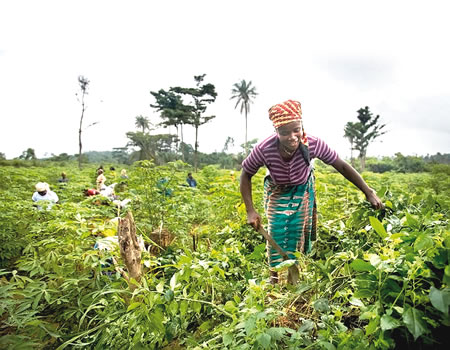
The people who feed Nigeria are now struggling to feed themselves. Farmers — the backbone of the nation’s food system — are being crushed by soaring production costs, insecurity, and policies that work against them. What should be the pride of the country has become a burden, leaving many who once tilled the land questioning whether farming is worth the sacrifice.
This year, cultivating a hectare of rice or maize costs no less than ₦1.2 million, up from about ₦665,000 just a season ago. The leap is staggering, but the consequences are even more alarming: abandoned fields, shrinking harvests, and broken livelihoods across rural Nigeria.
In farming communities across Kano, Taraba, Kaduna, Edo, and Gombe, despair is a recurring theme. A bag of NPK fertiliser now sells between ₦48,000 and ₦55,000, while urea reaches up to ₦52,000. Inputs that once sustained farming families have become luxury items. Many smallholders can no longer afford even half of what their crops demand.
The shift in cropping patterns tells the story. Farmers are abandoning rice and maize — staples of Nigeria’s food basket — and turning instead to cassava, sorghum, groundnut, and beans. These alternatives are not more profitable; they are simply less costly. In practice, the nation is retreating from commercial farming into survival-mode agriculture.
Even when farmers persevere and harvest, the market denies them fair reward. Imported maize and rice, made cheaper by government-licensed importers, flood local markets and undercut Nigerian producers. The policy contradiction is glaring: we call for food security, yet we weaken the very people tasked with securing it. Competing against nations that subsidise and protect their farmers is an impossible task for Nigeria’s struggling smallholders.
Credit and finance have done little to change the story. With interest rates hovering between 25–30%, bank loans are a mirage. Collateral requirements lock out smallholders, repayment timelines are unforgiving, and risks remain overwhelming. For most farmers, formal finance is a door permanently closed.
Then there is insecurity, the silent famine-maker. In Niger, Katsina, and Zamfara, vast farmlands lie abandoned under the shadow of banditry and kidnapping. In the North-East, insurgency and conflict continue to displace farmers from their ancestral lands. Farming under fear is not simply difficult — it is impossible.
Government responses have too often fallen short. Earlier this year, the Ministry of Agriculture provoked outrage when it called on Nigerians to fast and pray for food security. For many farmers, it felt like insult added to injury. “We don’t need prayers,” a farmer in Kaduna lamented. “We need fertiliser, tractors, and protection.”
Yet, not all responses have been tone-deaf. In Gombe, authorities distributed 200,000 bags of NPK at a subsidised rate of ₦27,000 — about 39% less than the market price. In Kaduna, 100,000 smallholder farmers received fertiliser and other inputs through structured clusters. These interventions highlight what is possible when leaders take agriculture seriously. But isolated gestures cannot address a national emergency. Nigeria needs a federal strategy that is bold, consistent, and urgent.
Such a strategy must begin with restoring direct fertiliser subsidies or designing voucher systems that reach only real farmers. Fertiliser cannot cost more than the produce it grows. Without this, the farming economy collapses under its own weight.
Import policies also demand reform. It makes no sense to encourage farmers to plant maize while opening borders to massive imports of the same crop at lower prices. If food sovereignty is truly a goal, then our policies must protect, not sabotage, local production.
Access to credit must be redesigned for agricultural realities: lower interest rates, extended repayment timelines, and flexible grace periods for crop failures. Without inclusive finance, smallholders will remain trapped in poverty and low productivity.
Security, too, cannot be ignored. Farmers should not need vigilantes to cultivate. Coordinated military support, early warning systems, and conflict-resolution mechanisms for land disputes are necessary if we are to restore confidence in rural communities.
Another missing link is storage and distribution. Too many farmers are forced to sell cheaply at harvest because they lack storage facilities or processing options. Rural storage and processing zones can reduce post-harvest losses and boost farmers’ earnings.
Mechanisation is also long overdue. Without tractors, harvesters, and irrigation systems, Nigeria’s agriculture remains locked in the past. If young people are to see farming as a profession instead of punishment, mechanisation must be scaled up, made affordable, and decentralised.
Lastly, education is crucial. Extension services that teach smarter practices, pest management, and improved yield strategies can transform rural farming communities. Knowledge, like inputs, is a vital ingredient in food security.
For now, Nigeria’s food system rests on the shoulders of farmers who are themselves going hungry. They are being driven into debt, despair, and displacement. A nation that treats its food producers this way cannot expect food security — only food panic.
We like to say Nigeria has the potential to feed itself and even its neighbours. But potential without policy is a dream deferred. What is needed is leadership, not lip service. Strategy, not sermons. Action, not appeals to fate.
Because when farmers cannot farm, it is not just their families who go hungry — it is the entire nation.
Hyeladi Yusuf Ibrahim Is A 300 Level Student From Mass Communication Department University Of Maiduguri.