Africa
When the Law Marches in Black: Tinubu, Wike, and the Dangerous War Against a Calm Governor -By John Egbeazien Oshodi
This is not a threat. It is not an insult. It is a cultural reminder—that no mortal, no matter how protected or powerful, can override the will of a people enshrined in their Constitution. It is ungodly to dismantle an entire state’s democratic structure. It is morally indefensible to silence a governor chosen by the people. And it is spiritually dangerous to presume the ancestors are asleep.

According to history, tradition, and Nigerian media narratives—when all else fails, when the presidency turns inward, the legislature nods along, the courts go silent, and police power overshadows the people—Nigerians have turned not to more politics, but to the gods, spirits, and ancestral forces for justice.
This pattern is not new. It is cultural. It is psychological. It is historical.
And in that spirit, this piece stands not as a provocation, but as a reflection—of what the people see, what the law is meant to protect, and what higher truths continue to whisper, even when institutions choose not to speak.
The Legal Eruption: A Cold Coup in the Language of Order
On the surface, it appears to be an “executive measure”—a declaration of emergency in Rivers State by President Bola Tinubu. But beneath that surface, legal minds across Nigeria and beyond are describing something more severe: a constitutional disturbance, bordering on what might be called a soft-state override.
With the removal—some say neutralization—of Governor Siminalayi Fubara and the state’s legislative structures, the act has left many legal practitioners, scholars, and ordinary Nigerians stunned. To many, it looks less like a democratic correction and more like a federal occupation masked in legality.
The Black March: Lawyers Choose Silence No More
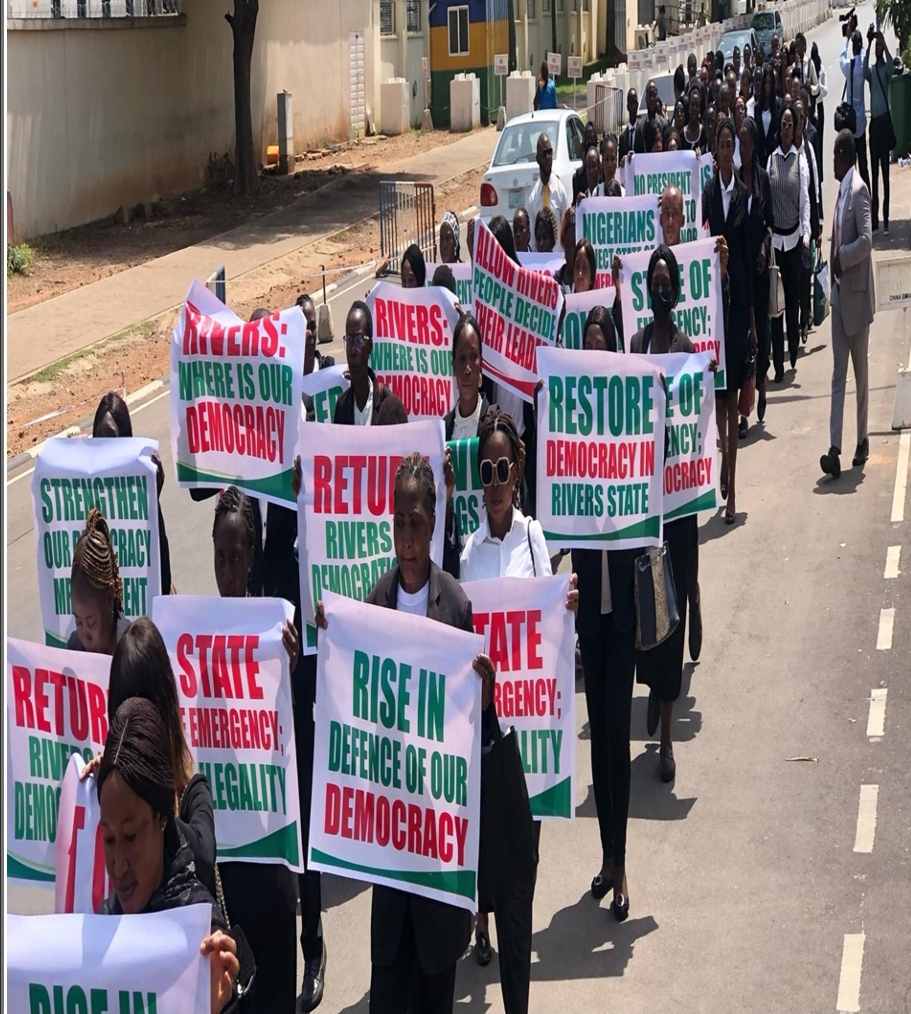
Then came the black robes. Young Nigerian lawyers—men and women—marched in mournful dignity to the United States Embassy. Their march was not chaotic, not riotous. It was orderly, composed, and resolute.
They came with law books, not slogans. They came not just to defend Fubara—but to defend the Constitution itself. And their message was unmistakable: Nigeria is drifting into dangerous constitutional territory. Not through gunfire. Not through military trucks. But through executive ink and parliamentary silence.
Their symbolism is powerful. The judiciary is trained to be quiet, but here they were—breaking their own cultural code of silence. And that, more than any protest chant, should give pause to any government truly committed to democratic balance.
Federal Overreach—or Strategic Calculus?
The Constitution of the Federal Republic of Nigeria is not vague about federalism. It does not permit a sitting president to singlehandedly dissolve or neutralize the governance structures of a state. Such power, as lawyers have reminded the nation, once belonged only to military heads of state—not democratic presidents.
And so, the question arises: Is this a lawful action, or a politically dressed intervention?
Most dangerously, a consensus is forming in the public domain that this move may be less about law and more about 2027. Nigerians are talking. Commentators are whispering. Observers are drawing lines: that this crisis may have less to do with Rivers’ “instability” and more to do with the strategic ambition of certain individuals ahead of the next election cycle.
Many believe that the influence of former Governor Nyesom Wike—once powerful in Rivers but now politically challenged—played a key role in persuading the presidency to act decisively. That Fubara’s calm defiance became a political embarrassment that had to be erased before 2027’s electoral map is drawn.
But Here Lies the Unspoken Question: How Do They Know They’ll Be Around in 2027?
This is not a death wish. It is not a threat. It is a question of political humility—of existential reality.
Politics is unpredictable. Power is never permanent. No officeholder, no matter how favored today, can claim tomorrow with certainty. Health changes. Public opinion shifts. Legal winds turn. Global optics reshape alliances.
So the people ask, quietly but sincerely:
What kind of certainty convinces some actors that they will still be key players in 2027?
What knowledge or assumption emboldens them to move the chess pieces so confidently—years before the board has even been set?
Such questions are not aimed at individuals. They are aimed at power itself, and the psychology that often blinds it to time, consequence, and the human spirit.
Echoes of Military Rule in Civilian Clothing
The deeper fear is not just about Rivers. It’s about precedent. Because if the President, with legislative affirmation, can dissolve the governance of one state today—under “emergency”—what stops it from happening again? Where is the boundary? Who watches the watchers?
Elders remember a time when such moves were reserved for military regimes. When federal power descended like a hammer without process. And the lawyers marching this week are warning: We may be drifting back to that era—only this time, in suits and agbadas instead of khakis and berets.
The Calm Governor: Why Fubara’s Silence Is Louder Than Their Noise
Siminalayi Fubara has not shouted. He has not threatened. But perhaps that is the very problem for those who seek total control.
His restraint is uncomfortable. His composure disarms chaos. And in a political climate addicted to confrontation, his calm is its own rebellion.
It is not that he has rebelled—it is that he has refused to be owned. And for some, that is more intolerable than open defiance.
So they push him aside.
But in doing so, they elevate him.
Because now, Fubara is no longer just a governor. He is a national metaphor—for quiet dignity, for stolen mandate, and for democratic betrayal.
A Judiciary under Watch, a People Under Strain
The silence from Nigeria’s judicial bodies—aside from the protesting lawyers—has been deafening. Whether it is fear, fatigue, or alignment, we cannot say. But one thing is clear: the people are watching.
More dangerously, the international community is beginning to take notice.
Images of black-clad lawyers, walking in legal dignity, are far more powerful in diplomatic corridors than tweets or protest chants. Those images raise questions in foreign capitals. They trigger quiet reports in foreign ministries. They shift how global actors view Nigeria’s internal affairs.
No administration—no matter how domestically secure—wants to become “that government” in the eyes of the world.
Final Word: They Can Influence Men, But Not the Spirits
Yes, President Tinubu may command the levers of federal authority. Yes, Minister Wike may still wield influence across the South-South’s political terrain. But there are forces—older, deeper, and beyond human manipulation—that neither of them can control:
The eyes of the international community
The judgment etched into legal history
The conscience of a betrayed populace
And the ever-watchful spirits of Nigeria’s ancestral realm
When governance begins to resemble conquest, when constitutional rights are treated as inconveniences, and when duly elected leaders are removed as though they are political appointments, the people do not merely protest—they invoke.
They call upon enduring values passed from generation to generation—not out of fear, but as expressions of cultural strength and psychological defense. These are not superstitions. They are symbols of moral resistance—reminders that power, no matter how entrenched, is never exempt from accountability or higher justice.
And so it should surprise no one that across platforms—social media timelines, radio call-ins, newspaper columns—a single refrain has risen with unmistakable clarity:
“Tinubu, you are not God.”
This is not a threat. It is not an insult. It is a cultural reminder—that no mortal, no matter how protected or powerful, can override the will of a people enshrined in their Constitution. It is ungodly to dismantle an entire state’s democratic structure. It is morally indefensible to silence a governor chosen by the people. And it is spiritually dangerous to presume the ancestors are asleep.
History Has Already Recorded Their Defiance
To President Tinubu, to Minister Wike, and to all those behind this unfolding constitutional rupture—history has already taken note.
What the young lawyers in black did was not ordinary. It was not angry. It was sacred. They did not shout. They did not burn. They walked—with law in their hands, and justice on their backs.
They did not mourn a man.
They mourned a system.
They marched not for noise, but for memory.
They carried no slogans—only the Constitution.
They carried no weapons—only truth.
And in doing so, they wrote your names—Tinubu, Wike, and all enablers of this moment—into the pages of Nigerian history. Not as reformers. But as those who stood against the very system they swore to protect.
Some among you may attempt the usual responses—subtle punishment, withdrawn appointments, whispered blacklists, legal smoke screens. But nothing can undo what has been seen:
The world saw it.
The Nigerian people felt it.
The ancestors have recorded it.
You may dominate budgets. You may direct institutions. You may maneuver the media. But you do not control truth. And truth, once revealed, does not go quietly. It outlives every regime. It survives every title. It becomes legacy.
Return Fubara—Before the Ground Shifts
So, I speak now not as a protester, but as a psychologist. Not to incite—but to reflect. Not to challenge authority—but to warn power of its illusions.
Return Fubara.
Not to please the crowd.
Not to ease global scrutiny.
But to preserve the last threads of your own moral legacy.
Return him—not as a sign of surrender—but as a mark of wisdom.
Return him—not for the optics—but for the order.
Return him—not for headlines—but for history.
Because if Nigeria’s journey has taught us anything, it is this:
Power passes. Memory remains.
While men may try to erase the past, the people remember. And the gods—those spiritual witnesses that hover over this land—they never forget.
You may shift courtrooms. You may suspend lawmakers. You may redraw the political map.
But you cannot erase what is already spiritually recorded:
That one calm governor was unlawfully removed.
That a silent march in black cried out without words.
And that those who held the reins of power broke the law in the presence of the world, and under the gaze of eternity.
So again, I say this not in anger—but in clarity:
Return Fubara. Now.
Before time does what it always does—exposes the truth, humbles the proud, and immortalizes those who stood for justice when others sought control.
This writer does not know any of the individuals involved; the focus is solely on upholding democracy, truth, and justice.
John Egbeazien Oshodi
Oshodi Open Door Public Training (OOPDT), also known as Oshodi Open Door, is a public awareness initiative dedicated to promoting transparency, accountability, and integrity in Africa. Through educational articles and resources, OOPDT fosters informed discourse on governance, institutional reform, and psychological well-being. It also provides specialized Timely Response Solutions (TRS) training at minimal or no cost, ensuring swift and effective interventions for critical institutional and societal challenges. For more information, contact: jos5930458@aol.com.
Professor John Egbeazien Oshodi is an American psychologist, educator, and author specializing in forensic, legal, and clinical psychology, cross-cultural psychology, police and prison sciences, and community justice. Born in Uromi, Edo State, Nigeria, he is the son of a 37-year veteran of the Nigeria Police Force—an experience that shaped his enduring commitment to justice, security, and psychological reform.
A pioneer in the field, he introduced state-of-the-art forensic psychology to Nigeria in 2011 through the National Universities Commission and Nasarawa State University, where he served as Associate Professor in the Department of Psychology. His contributions extend beyond academia through the Oshodi Foundation and the Center for Psychological and Forensic Services, advancing mental health, behavioral reform, and institutional transformation.
Professor Oshodi has held faculty positions at Florida Memorial University, Florida International University, Broward College, where he also served as Assistant Professor and Interim Associate Dean, Nova Southeastern University, and Lynn University. He is currently a contributing faculty member at Walden University and a virtual professor with Weldios University and ISCOM University.
In the United States, he serves as a government consultant in forensic-clinical psychology, offering expertise in mental health, behavioral analysis, and institutional evaluation. He is also the founder of Psychoafricalysis, a theoretical framework that integrates African sociocultural dynamics into modern psychology.
A proud Black Republican, Professor Oshodi advocates for individual empowerment, ethical leadership, and institutional integrity. His work focuses on promoting functional governance and sustainable development across Africa.