Forgotten Dairies
Dangote Refinery IPO: The ₦5,250 Question -By Usman Abdullahi Koli
They deserve more than a sales pitch. They deserve to know what they are buying, what they are risking and what assumptions must hold for the investment to work. Dangote has built something extraordinary and has opened the door for Nigerians to own a piece of it. That deserves recognition. But the ₦5,250 question is not simply whether Nigerians can afford to enter. It is whether, at ₦525 a share, the opportunity is worth the risk. That is the question every serious investor should answer before pressing the subscribe button.

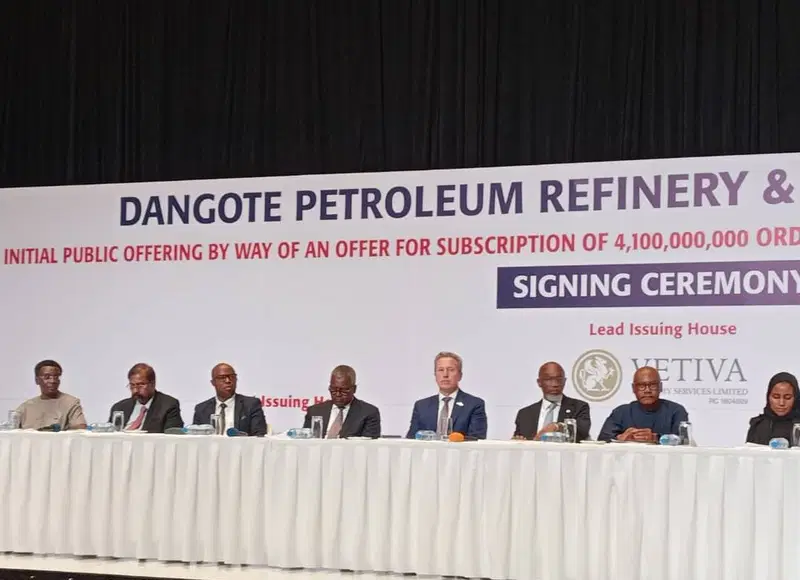
Something extraordinary is unfolding on the Nigerian Exchange. A refinery that accumulated nearly two billion dollars in losses during its first two years of commercial operation is now inviting Nigerians to own a piece of the largest single-train industrial complex on the African continent for the price of a modest family grocery run. That is not charity. It is one of the most ambitious attempts to broaden ownership of a strategic Nigerian industrial asset.
Consider what is on the table. Dangote Petroleum Refinery and Petrochemicals FZE is offering 4.1 billion ordinary shares at ₦525 each, with a minimum subscription of ten shares, or ₦5,250. If fully subscribed, the offer raises about ₦2.15 trillion, or $1.63 billion. The company is targeting up to ten million retail investors. Aliko Dangote, who currently controls 87.27 per cent of the company, would retain about 84.34 per cent after a fully subscribed offer. This is not simply a founder cashing out. The refinery is issuing new shares, with proceeds earmarked for growth capital, including the first tranche of a $14.27 billion programme to double refining capacity from 700,000 barrels per day to 1.4 million by 2029.
The financial turnaround behind the offer is striking. The refinery lost about $1.51 billion in 2024 and another $475.8 million in 2025. In the first half of 2026, however, it reported profit after tax of $1.82 billion on revenue of $13.91 billion. Utilisation rose to an average of 83.6 per cent, reaching 700,000 barrels per day in June. Gross refining margins also rose sharply. This is a genuine operational turnaround, not something that should be dismissed simply because the company is now seeking public money. The refinery is also creating strategic value beyond its balance sheet. It is processing Nigerian crude that was previously exported while Nigeria imported refined products at a premium. It has exported jet fuel to international markets and now supplies more than 80 per cent of Nigeria’s domestic petrol demand. Its emergence has altered the country’s position in the regional fuel market and given Nigeria an industrial asset with global relevance.
But the arithmetic demands clear eyes. At ₦525 per share, the offer implies a valuation of roughly ₦65.22 trillion, or about $47.8 billion at the prospectus exchange rate. Some analysts have argued that the valuation is difficult to defend against global refining peers, with one analysis placing fair value considerably below the offer price. That does not make the IPO a bad investment. It means investors are being asked to pay for substantial future performance, not merely today’s earnings. The private placement immediately before the public offer deserves similar scrutiny. Between late June and late July 2026, the refinery sold about three billion ordinary shares to institutional investors at $0.35 per share, raising $2.5 billion. The placement was reportedly oversubscribed. The public offer price of roughly $0.40 per share is higher. There can be legitimate reasons for differences between private and public pricing, including market access, structure and timing. Still, the gap is material enough for a retail investor to ask why institutions with greater negotiating power and access to due diligence paid less.
Debt adds another layer. Total indebtedness stood at $5.67 billion as of June 30, 2026, although net debt to EBITDA was a relatively modest 0.27 times. More important is the expansion bill. The IPO covers only a fraction of the $14.27 billion required to double capacity. The balance will have to come from internal cash flows, debt and potentially additional equity. For an investor buying today, future capital raises therefore matter because they could dilute existing holdings. Taxation is another under-discussed risk. The refinery currently benefits from its free-zone status, although its effective tax rate in the first half was 13.6 per cent. The prospectus indicates that domestic-market profits may become fully taxable from January 2028. If the business moves towards a higher blended tax burden, earnings could fall and the already demanding valuation would become harder to justify.
There is also the question of whether the exceptional refining environment of 2026 can last. Geopolitical conflicts have disrupted refining capacity and lifted margins, creating unusually favourable conditions for producers with available capacity. The refinery itself acknowledges that some of its recent performance has benefited from these market disruptions. Investors should therefore distinguish between current profitability and sustainable profitability. A business can be excellent while its current earnings are temporarily exceptional. Yet the most consequential feature of this transaction may not be its valuation. It is its potential effect on the Nigerian capital market. Nigeria now has a much larger population of digitally connected retail investors, and the Dangote offer is deliberately designed to reach them through banks, fintech platforms, mobile money operators and other approved channels. The minimum entry point of ₦5,250 makes ownership accessible to people who could never contemplate buying into a strategic industrial asset through a conventional private placement. The offer opens on September 14 and closes on October 13, with listing expected later in the year.
If it succeeds, the implications could extend far beyond Dangote. It would demonstrate that Nigerian capital markets can mobilise substantial domestic savings for industrial expansion while giving ordinary citizens a stake in productive assets. Other African industrialists would notice. A successful transaction could encourage more companies to consider public ownership rather than keeping strategic assets concentrated among a few investors. But public participation must not be confused with informed investment. The communication around the offer has been powerful, but storytelling is not the same as financial education. The official IPO platform itself warns investors that shares can fall as well as rise and urges them to read the prospectus and seek professional advice where necessary. That warning matters because a ₦5,250 minimum does not make the underlying investment risk-free.
The Saudi Aramco IPO offers a useful comparison. Saudi Arabia successfully mobilised millions of retail investors when it listed a portion of its national oil company in 2019. But the comparison has limits. Aramco entered the market with a long-established earnings record and extraordinary profitability. Dangote Refinery’s transformation is impressive, but its current profitability has a much shorter history. Investors should therefore admire the industrial achievement without allowing admiration to substitute for valuation analysis. There is also a broader lesson for corporate communication. Every campaign for a transaction of this magnitude should explain not only what investors might gain but what they could lose. The prospectus contains the losses, debt, tax changes, expansion requirements and other risks. The challenge is ensuring that the millions of people being targeted actually understand them. A 25-year-old fintech user in Lagos and a 60-year-old retiree in Kaduna do not necessarily need the same message or the same educational channel.
None of this diminishes the significance of the offer. Dangote deserves credit for attempting to place public ownership at the centre of an African industrial story of this scale. Nigeria has spent decades watching natural resources generate wealth without creating enough broad-based ownership of productive assets. Giving citizens an opportunity to own part of the infrastructure processing the country’s crude is economically meaningful and potentially transformative. But participation is not the same as investment. The person who buys ten shares with money he cannot afford to lose is not making a sound investment simply because the entry price is low. The young professional who borrows to subscribe because he expects the shares to double immediately after listing is not investing on analysis. He is speculating on a narrative.
There is another question that deserves attention: what happens if the offer is not fully subscribed? The answer should not be treated as a referendum on Dangote’s industrial achievement. Retail investors may simply conclude that the price is too high or that the risks are not adequately compensated. A partial subscription could alter the pace or financing mix of the expansion, but it could also demonstrate something healthy about the market: investors are capable of saying no when the numbers do not convince them. A capital market should reward good businesses without suspending price discipline. Dangote has also spoken about eventually listing the refinery in the United States after expansion. If that happens, the Nigerian retail investor could ultimately own a stake in a company with much wider international visibility. That possibility adds to the long-term attraction, but it should remain a future prospect rather than part of today’s investment case. Investors should buy the business that exists and the prospects reasonably supported by evidence, not a future valuation that may or may not materialise.
The real significance of this IPO is therefore bigger than whether Dangote’s share price rises after listing. It is a test of whether Nigerians can move from being consumers of large industrial businesses to becoming owners of them. That transition requires more than access. It requires confidence in institutions, credible disclosure, investor education and a market willing to reward both ambition and prudence. If those conditions hold, the Dangote offer could become a landmark in Nigeria’s financial history. If they do not, the country will learn an equally important lesson about the difference between popular participation and responsible ownership. What Nigeria needs now is disciplined participation. The Securities and Exchange Commission must supervise the market after approval, enforce disclosure rules and guard against manipulation. The Nigerian Exchange must ensure that retail investors receive timely information. The government should resist turning the offer into a political slogan. And investors themselves must accept the responsibility that comes with ownership: read the prospectus, understand the business, assess the price and invest only what they can afford to leave exposed to market risk.
The subscription window opens on September 14 and closes on October 13. Millions of Nigerians will decide whether to buy a stake in one of the country’s most consequential industrial projects. They deserve more than a sales pitch. They deserve to know what they are buying, what they are risking and what assumptions must hold for the investment to work. Dangote has built something extraordinary and has opened the door for Nigerians to own a piece of it. That deserves recognition. But the ₦5,250 question is not simply whether Nigerians can afford to enter. It is whether, at ₦525 a share, the opportunity is worth the risk. That is the question every serious investor should answer before pressing the subscribe button.
Usman Abdullahi Koli,
mernoukoli@gmail.com.