Africa
Demolition Of Police Duplexes In Apo Dutse: A Mismanaged Situation That Demands Transparency -By Kelvin Adegbenga
This is not just about the buildings lost; it is about accountability, institutional respect, and the need for better coordination among government agencies. The Nigeria Police Force deserves that courtesy, and the Nigerian public deserves that transparency.

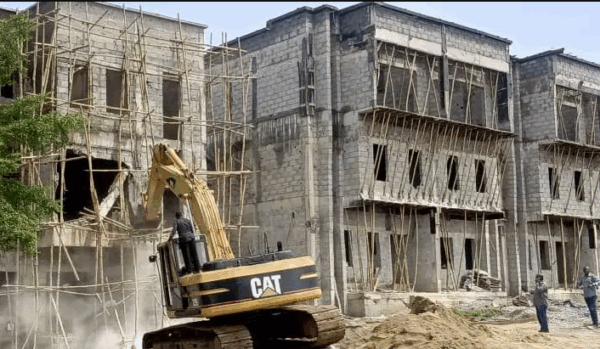
The recent demolition of duplexes belonging to the Nigeria Police Force (NPF) at Apo Dutse District, Abuja, by the staff of the Federal Capital Territory (FCT) Department of Development Control, has once again brought to light the recurring issues of poor communication, administrative inconsistency, and disregard for institutional integrity within the Federal Capital Territory Administration (FCTA).
It was reported that on Thursday, officials of the Department of Development Control carried out the demolition of no fewer than eleven residential flats, comprising three- and four-bedroom units, said to have been built under a high-tension power line. The incident, which led to the arrest of some staff of the Department by the Police, has generated widespread public debate and concern.
While it is true that no structure should be erected under high-tension lines for safety reasons, this particular situation raises pertinent questions about due process, inter-agency communication, and administrative accountability.
The FCT Minister reportedly stated that the land in question was duly allocated to the Nigeria Police Force. If that is indeed the case, then the critical question becomes: What was the purpose of the land allocated to the Nigeria Police Force? Was it meant for residential development, institutional use, or operational infrastructure? If it was allocated for residential purposes, then why was approval withheld by the Development Control Department on account of the high-tension risk?
More importantly, if the Department of Development Control had indeed refused building approval, was there any written communication or official correspondence to the Nigeria Police authorities clearly notifying them of the refusal and the reasons behind it? It is difficult to believe that the Inspector-General of Police, IGP Kayode Egbetokun, a man known for his strict adherence to the rule of law, discipline, and institutional responsibility, would have sanctioned or overlooked any act of illegality.
IGP Egbetokun’s leadership of the Nigeria Police Force has been marked by a visible commitment to transparency, professionalism, and respect for due process. He cannot, under any circumstances, allow his officers or any police personnel to contravene existing laws or violate development regulations.
That is precisely why I am convinced that the IGP may not even be aware of the arrest of the Development Control officers by the Police, as such actions, if confirmed, would contradict the principles of his administration.
This unfortunate episode could have been avoided through proper coordination and mutual respect between the FCTA and the NPF. Instead of resorting to a forceful demolition that could be interpreted as an attack on a sister federal institution, the FCTA should have engaged in constructive dialogue with the police leadership to resolve any misunderstanding regarding the land and its approved usage.
Beyond the immediate controversy, this incident exposes a deeper systemic issue — the lack of coherent inter-agency synergy within the federal system. It is unacceptable for one government agency to claim ignorance of another’s allocation or approval status, only to later destroy multi-million-naira structures funded by public resources.
In conclusion, while the safety concerns related to building under high-tension lines are valid, the manner in which this demolition was executed reflects poor administrative handling. The FCTA owes Nigerians, and the Police Force in particular, a transparent explanation of how land duly allocated to a federal security institution could be demolished without clear notice or inter-agency resolution.
This is not just about the buildings lost; it is about accountability, institutional respect, and the need for better coordination among government agencies. The Nigeria Police Force deserves that courtesy, and the Nigerian public deserves that transparency.
Kelvin Adegbenga writes from the Central Area, Abuja. kelvinadegbenga@yahoo.com @kelvinadegbenga