Forgotten Dairies
Gowon’s Last Lie: How the Aburi Accord Was Betrayed and a Genocide Erased from History -By Jeff Okoroafor
No amount of autobiography-writing can alter these facts. Gowon may find comfort in the pulpits of his prayer meetings. He may surround himself with sycophants who praise his “statesmanship.” He may bank on a Nigerian political class too compromised and too indifferent to demand accountability. But history keeps its own ledgers.

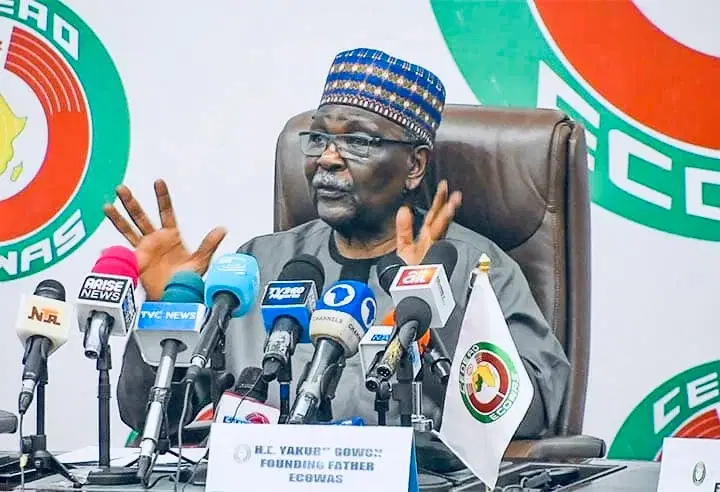
There is a particular cruelty in outliving not only your adversaries but the truth itself. At 91, General Yakubu Gowon has chosen to weaponize longevity, gambling correctly that most Nigerians old enough to remember the cataclysm of 1966-1970 are too exhausted, too traumatized, or simply too dead to contradict him. His autobiography, My Life of Service and Allegiance, is not a memoir. It is a sanitization project—a desperate attempt to bleach the blood from his hands before he meets his Maker. And his latest claim, that the late Chukwuemeka Odumegwu Ojukwu “deliberately and effectively thwarted every effort we made to amicably resolve our national issues,” is not merely a lie. It is an obscenity.
Let us state plainly what Gowon’s defenders will not: the Aburi Accord did not fail because of Ojukwu’s intransigence. It failed because Yakubu Gowon, acting on the advice of British imperial interests and a coterie of northern Nigerian civil servants, returned to Lagos and tore up an agreement he had signed just days earlier. The historical record is unambiguous on this point, and it is a record that Gowon himself has inadvertently corroborated across decades of contradictory public statements.
The Truth Ojukwu Told Before He Died
Before his death in 2011, Ojukwu anticipated precisely this revisionist assault. He understood that Gowon, having lost the argument in real time, would wait half a century and attempt to win it in the history books. Ojukwu’s account of Aburi—delivered in interviews, writings, and the broadcast he made upon returning from Ghana—was consistent and precise.
The Aburi meeting was held on January 4-5, 1967, in Ghana, because Ojukwu could not guarantee his safety anywhere in western or northern Nigeria following the massacres of Igbos. Let that sink in: a regional governor within a sovereign nation required foreign soil to negotiate with his own head of state because his government had either orchestrated or allowed the slaughter of his people.
At Aburi, a comprehensive agreement was reached. The Supreme Military Council collectively agreed that all powers of the Federal Military Government would be vested in the Council itself, with decisions requiring unanimous concurrence. The regions were to exercise substantial autonomy, controlling their resources and taxation while contributing to a common federal pool. Appointments to senior positions in the police, diplomatic services, and civil service required Supreme Military Council approval. The head of the federal government was to assume the title of Commander-in-Chief of the Armed Forces.
This was a confederal arrangement designed to hold a fractured nation together. Ojukwu, armed with detailed proposals and a master’s degree in history from Oxford—a credential that stood in stark contrast to Gowon’s limited formal education beyond military training—came prepared. Gowon, by his own later admission, did not. He confessed that Ojukwu “was the only one who came with set papers and a list of demands”. The federal delegation went to Aburi unprepared and got outmaneuvered—not by deception, but by superior preparation.
The Betrayal That Followed
What happened after Aburi is the crux of Gowon’s culpability. According to Gowon himself, he fell ill with “a serious attack of a kind of fever” upon returning to Nigeria and was therefore unable to address the nation. This is the excuse he has peddled for decades: the leader of Africa’s most populous nation was incapacitated by a fever at the precise moment his country required leadership, leaving Ojukwu to “seize” the narrative by broadcasting the Aburi agreements.
The absurdity of this claim has been noted by many, including the Indigenous People of Biafra (IPOB), which pointedly asked: “Was his information minister also ill? Were all government spokesmen in Lagos also down with illness at the same time that made it difficult for Lagos to make a pronouncement on Aburi Agreement several weeks after the meeting?”. The silence was not medical; it was political.
What Gowon conveniently omits from his autobiography is what occurred during that strategic silence. According to multiple sources and historical accounts, British permanent secretaries and civil servants, acting at the behest of the Harold Wilson government, worked systematically to dissuade Gowon from implementing Aburi. Their calculus was crude and venal: a decentralized Nigeria threatened British Petroleum and Shell’s unfettered access to oil in the Eastern Region. As IPOB later charged, “Shell and BP acting through Harold Wilson the then British Prime Minister did not want Aburi Accord implemented. It was the Labour Party government of Britain that cleverly convinced the Arewa North to put pressure on Gowon to feign illness”.
Gowon has previously acknowledged—in multiple published works—that “super permanent secretaries and two foreign powers persuaded him to reject and renege on the Aburi Accord”. He has admitted that implementing the accord as agreed would have diminished his powers as head of state. These are not the words of a man whose peace efforts were “thwarted” by an unreasonable adversary. These are the confessions of a man who chose power over peace, British oil interests over Nigerian lives, and who has spent the subsequent five decades constructing an elaborate fiction to obscure that choice.
The Ohanaeze Ndigbo, the apex Igbo socio-cultural organization, has explicitly rejected Gowon’s account, accusing him of “rewriting history and reneging on a deal meant to avert war”. In their words, “it was Gowon’s refusal to honour the terms of the accord, documented and archived, that directly triggered the conflict that claimed millions of lives”.
The Genocide That Preceded the War
But to understand Aburi fully, one must understand the context in which it took place—a context Gowon’s autobiography treats with the delicacy of a man stepping around a landmine of his own making.
The 1966 anti-Igbo pogrom was not a spontaneous outburst of ethnic tension. It was a systematic, organized campaign of ethnic cleansing directed against Igbos living in northern Nigeria, carried out in waves in May, July, and September of 1966, with September 29 remembered as “Black Thursday”. Historians estimate that between 8,000 and 30,000 Igbos were murdered in these massacres. Approximately one million Igbos were forced to flee the Northern Region, creating one of the largest internal displacement crises in African history.
These killings occurred on Gowon’s watch. He was the Head of State. He was the Commander-in-Chief. The security apparatus of the Nigerian state—the army, the police—either participated in these massacres or stood by as northern mobs, with what eyewitnesses described as “tacit support” from the military, slaughtered civilians. Gowon’s promise to secure the safety of Igbos in northern Nigeria was, in the words of General Ibrahim Babangida himself, “unfulfilled”. The Ohanaeze Ndigbo has been even more direct, describing Gowon as a leader who “failed in his responsibilities as Commander-in-Chief to safeguard the lives of Nigerians, particularly the Igbo populace”.
This was the atmosphere in which Aburi took place. Ojukwu did not arrive in Ghana as an unreasonable separatist demanding special treatment. He arrived as the leader of a people who had just witnessed—on Gowon’s watch—the mass murder of his kinsmen. The negotiations were not, as Gowon now pretends, about regional ambition. They were about survival.
A Lifetime of Lies, a Legacy of Blood
What is most galling about Gowon’s autobiography is not its dishonesty—that is to be expected from a man who has spent his post-war life burnishing a hagiographic self-image. What is galling is the contempt it shows for the millions of Nigerians, predominantly but not exclusively Igbo, who perished in a war he helped make inevitable.
Gowon now claims that he “tried to preserve Nigeria without resorting to war” and that the federal government “exhausted every peaceful avenue.” This is the language of a man who has convinced himself of his own innocence, even as the corpses of his decisions litter the historical landscape. He speaks of his “No Victor, No Vanquished” policy as evidence of magnanimity, conveniently forgetting that he presided over a blockade that weaponized starvation against civilians, killing an estimated one to three million people—mostly children. The Ohanaeze Youth Council has described this as nothing less than genocide, characterizing Gowon as a “ruthless leader that perpetuated genocide against the Igbo”.
Gowon insists that the war “was not against the Igbo as such, it was to stop the breaking up of Nigeria”. He speaks of a “code of conduct” issued to troops to protect civilians. Yet we know—from survivors, from journalists, from the testimonies of relief workers—that federal forces committed widespread atrocities against civilian populations. The leaflets he claims were dropped to reassure civilians did not stop the bullets, the bombs, or the blockade-induced famine that produced the photographs of stick-limbed, pot-bellied Biafran children that haunt the global conscience to this day.
Gowon’s strategy for decades has been transparent: wait until key witnesses die, then rewrite the narrative for a generation with no living memory of the events. Ojukwu died in 2011. Most of the other principals at Aburi are gone. The refugees who fled the North in 1966 are in their twilight years. The survivors of the Biafran famine are aging. Gowon, at 91, is using his remaining years not to seek reconciliation through truth, but to seal a false legacy in print.
The Unfinished Reckoning
A nation that cannot honestly confront its past cannot build an honest future. The Nigerian Civil War was not an act of God, nor was it the inevitable consequence of Ojukwu’s intransigence. It was the direct result of choices made by Yakubu Gowon and his government—choices to renege on solemn agreements, choices to allow massacres to proceed unchecked, choices to prioritize the extraction of oil over the preservation of human life.
No amount of autobiography-writing can alter these facts. Gowon may find comfort in the pulpits of his prayer meetings. He may surround himself with sycophants who praise his “statesmanship.” He may bank on a Nigerian political class too compromised and too indifferent to demand accountability. But history keeps its own ledgers.
The verdict is already rendered: Yakubu Gowon supervised the genocide of Igbos, sabotaged the last real chance for peace, and has spent his old age lying about it. His autobiography is not a testament of service. It is a confession disguised as a memoir—and the Nigerian people deserve better than to be gaslit by the architect of their national trauma.

Jeff Okoroafor
Jeff Okoroafor is a social accountability advocate and a political commentator focused on governance, accountability, and social justice in West Africa.