
Economy
Nigeria’s Economy May Not Survive on Statistical Manipulation -By Blaise Udunze
Because no economy can thrive sustainably and more importantly, Nigeria cannot build its $1 trllion economy on invisible budgets, missing labour data, manufactured statistics and selective transparency. And no nation survives for long when truth itself becomes negotiable.

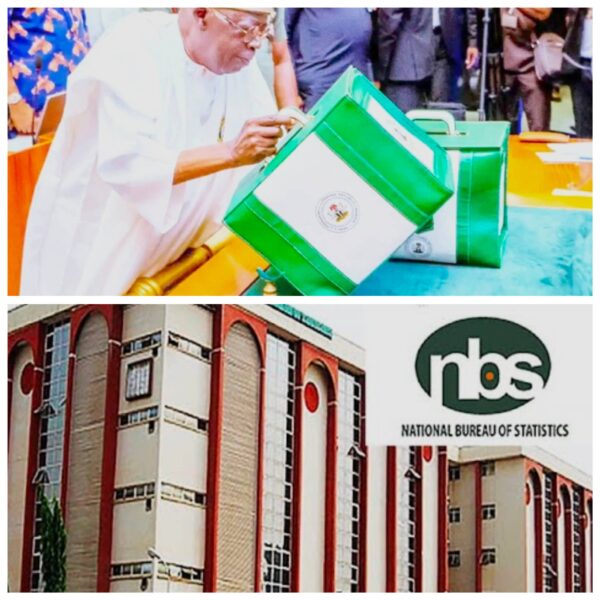
Nigerians should gear up to start seeking accountability from those in power because the country is gradually entering one of the most dangerous phases in its economic history, not merely because inflation is high, unemployment is worsening, or public debt is rising, but because the institutions responsible for telling them the truth about the economy are either failing, compromised, silent or increasingly non-transparent.
At the centre of this deepening crisis are two disturbing realities. First is the National Bureau of Statistics’ failure to publish credible and updated labour force data for more than 14 months despite unemployment being identified globally as Nigeria’s biggest economic threat. Second is the Budget Office of the Federation’s refusal or inability to publish statutory budget implementation reports for three consecutive quarters in violation of the Fiscal Responsibility Act.
Together, these failures represent something far more dangerous than administrative delay. They expose a governance culture increasingly defined by selective transparency, institutional opacity and economic manipulation. Nigeria is now dangerously close to governing itself without verifiable facts.
A nation cannot plan effectively when it cannot measure unemployment honestly. Neither can it fight corruption or fiscal leakages when it refuses to disclose how public funds are being spent. This is not merely an economic problem. It is a crisis of national credibility.
The irony is painful. While the World Economic Forum’s Global Risks Report identified unemployment and lack of economic opportunity as Nigeria’s leading economic threat for 2026, Nigeria itself has failed to publish official labour statistics capable of accurately measuring that threat since the second quarter of 2024.
That silence speaks volumes and could keep everyone wondering what the problem might be. At a period when millions of Nigerian youths are trapped between hopelessness, with an inflation rate currently 15.69 percent, collapsing purchasing power and shrinking job opportunities, while the absence of current labour data creates an economic blind spot of dangerous proportions. Policymakers are formulating reforms without clear visibility into labour realities.
Investors are assessing risks using outdated or disputed figures. With the apparent lack of clear direction, citizens are left with no choice but to wonder whether economic statistics are now instruments of propaganda rather than reflections of reality.
The controversy surrounding the infamous 4.3 percent unemployment figure released by the NBS in 2024 only deepened this distrust. It is both laughable and amazing for millions of Nigerians struggling daily to survive, the claim that unemployment had magically crashed from over 33 percent in 2020 to about 3.06 percent rate for 2025 felt detached from reality, which is based on March 2026 reports. Factories were shutting down. Multinationals were exiting Nigeria. Manufacturing firms were downsizing. Informal labour was exploding. Youth migration was accelerating. Yet official statistics suggested Nigeria was suddenly approaching near-full employment.
The explanation lay in the controversial redesign of the unemployment methodology. Under the revised framework, anybody who worked even minimal hours weekly could be classified as employed. While the NBS argued that the changes aligned with international best practices, critics insisted that the methodology ignored Nigeria’s peculiar economic conditions dominated by underemployment, survival jobs, disguised unemployment and casual labour.
The backlash was immediate and fierce. The Nigeria Labour Congress described the report as “fraudulent” and a “voodoo document”. Labour leaders warned that rebasing employment definitions merely to produce lower unemployment figures would destroy public trust in national statistics. Trade unions, manufacturers and employers’ associations openly rejected the figures.
The reality confronting businesses contradicted the official optimism. Textile factories were closing. Manufacturers were rationalising staff due to unbearable energy costs, foreign exchange instability and multiple taxation. Labour unions lamented rising casualisation as permanent jobs disappeared. The National Union of Chemical, Footwear, Rubber, Leather and Non-Metallic Products Employees revealed it had lost over 20,000 workers within one year because companies could no longer survive Nigeria’s harsh operating environment.
Yet official figures suggested unemployment was falling. This contradiction is dangerous because economic data is not supposed to comfort governments; it is supposed to guide policy.
When data becomes politically convenient rather than economically truthful, governance itself becomes distorted.
The problem is not merely methodological. It is institutional credibility. Why did the unemployment rate collapse statistically while poverty, inflation and hunger worsened visibly? Why has the NBS failed to publish updated labour force statistics for over 14 months if confidence in the methodology remains intact? Why are citizens increasingly suspicious of official numbers?
Unarguably, these questions matter because trust in national statistics is foundational to economic governance, but it appears that policymakers place less importance on this fact.
One thing that is missing is that they have yet to take into cognizance that countries cannot attract sustainable investments when investors doubt the credibility of official data. This is to say that international lenders, development institutions, and private investors depend on reliable statistics to evaluate risks, forecast growth and allocate resources. Once statistical integrity becomes questionable, economic credibility suffers.
Unfortunately, the non-transparency surrounding labour data is now being mirrored in Nigeria’s fiscal management architecture. The Budget Office of the Federation has failed to publish statutory budget implementation reports for three consecutive quarters despite explicit provisions of the Fiscal Responsibility Act requiring quarterly disclosure.
This failure is profound. Budget implementation reports are not ceremonial publications. But they have failed to acknowledge that these are among the few mechanisms citizens possess to independently evaluate whether public funds are being used responsibly. The simple fact is that these reports reveal actual revenue generated, expenditures incurred, projects executed and budget performance levels. Without them, public finance enters dangerous darkness.
According to findings, reports for the third and fourth quarters of 2025 and the first quarter of 2026 remain unpublished. This marks the first time in 15 years that Nigeria’s Budget Office has failed to release quarterly budget performance reports.
More concerning is that this comes at a time when Nigeria is implementing one of the largest budgets in its history. The National Assembly recently approved a staggering N68.3 trillion 2026 budget, significantly higher than the original N58.4 trillion proposal. While government officials describe it as a “legacy budget” aimed at infrastructure development and capital investment, Nigerians still do not know how previous budgets were substantially implemented.
This creates a dangerous accountability vacuum. How can citizens assess whether previous allocations achieved measurable outcomes when implementation reports are hidden? How can lawmakers exercise oversight without timely disclosures? How can anti-corruption agencies track leakages effectively? How can development partners verify fiscal discipline?
The truth is simple because unpublished budgets create fertile grounds for corruption, waste and fiscal manipulation.
More troubling are recent revelations from the World Bank exposing structural leakages within Nigeria’s fiscal system. According to the institution, over N34.53 trillion was diverted through pre-distribution deductions between 2023 and 2025 before revenues reached the Federation Account.
That figure is staggering. The World Bank warned that approximately 41 percent of government revenues never reached distributable pools because they were deducted as “first-line charges” by agencies operating outside conventional budgetary scrutiny.
Reports indicating that over $214 billion in public funds may have been lost, diverted, or trapped in non-transparent fiscal systems over the last decade capture the scale of Nigeria’s accountability crisis. More recently, it’s the shenanigans on the FAAC allocations of N800billion funds from States’ statutory shares meant to pay civil servants and improve on social amenities were channeled into private accounts linked to the Governor of Imo State, Hope Uzodinma, Chairman of the Progressive Governors Forum, to fund Tinubu’s 2027 re-election campaign.
With these intolerable developments, it becomes glaring that this is precisely why transparency without secrecy matters. The challenge is that when billions and trillions of funds move through non-transparent structures without rigorous disclosure, accountability collapses, whilst the citizens lose visibility over public finances and institutions responsible for oversight become weakened or compromised, which remains a litmus test for trust.
ActionAid Nigeria rightly described the development as “institutionalised revenue erosion” and warned that continued impenetrability undermines fiscal stability, public trust and development.
Truly and without an iota of doubt, its warning deserves more serious attention at this time. At a period when Nigerians are enduring painful economic reforms, rising transport costs, collapsing purchasing power, worsening insecurity and deepening hunger, every missing naira has human consequences. Every hidden expenditure weakens healthcare delivery, education, infrastructure and social protection.
One painful and unbearable approach is that instead of increasing transparency to reassure citizens, government institutions appear increasingly hard to understand, just to continue in their criminal and wasteful acts.
The consequences extend beyond economics into democratic legitimacy itself. Public trust erodes when citizens believe governments manipulate data, conceal budget performance and evade accountability. Eventually, institutions lose moral authority. Official figures become objects of suspicion rather than instruments of governance.
This is the larger danger confronting Nigeria today. Economic suffocation rarely begins with recession alone. It begins when institutions stop telling the truth.
It begins when governments prioritise narrative management over measurable realities. It deepens when citizens can no longer independently verify claims about unemployment, inflation, debt, revenue or budget performance.
Nigeria now risks entering that dangerous territory. Even more concerning is the growing culture of overlapping budgets, delayed implementation cycles and weak fiscal discipline. The government is reportedly still implementing components of previous budgets while simultaneously introducing new appropriations worth tens of trillions of naira.
This raises serious questions about planning efficiency, execution capacity and fiscal sustainability. If only about a quarter of approved capital expenditure is being effectively implemented, as recent reports suggest, then Nigeria’s challenge is not merely budget size but governance quality. Large budgets without transparency become monuments of waste.
The Fiscal Responsibility Commission, established to enforce compliance, has also appeared largely ineffective. Although the Fiscal Responsibility Act outlines numerous offences, enforcement remains weak while violations attract little or no consequences.
This culture of impunity emboldens institutional noncompliance. The implications for Nigeria’s economy are severe.
In every functional business atmosphere, foreign investors seek predictable and transparent environments. Credit rating agencies evaluate governance credibility alongside macroeconomic indicators. Development institutions increasingly emphasise fiscal accountability and data reliability but this does not apply to Nigeria.
An economy governed through disputed statistics and unpublished fiscal reports cannot inspire long-term confidence. The Tinubu administration must take cognizance of the fact that credibility itself is now an economic asset.
Understandably, reforms may initially be painful, but the irresistible fact is that citizens tolerate sacrifice better when governance appears transparent, honest and accountable. What destroys confidence is the perception that institutions are concealing realities while citizens bear the burden of economic hardship.
Nigeria does not merely need economic reforms. It needs truth-based governance. The National Bureau of Statistics must urgently restore credibility by publishing updated labour force statistics transparently and consistently. Methodological frameworks should be openly explained while stakeholder engagement must be strengthened to rebuild public confidence.
Similarly, the Budget Office must immediately release all outstanding budget implementation reports as required by law. Judging from the trend of events, it is a well-known fact that fiscal transparency cannot remain optional in a struggling economy already burdened by debt, inflation and widespread distrust.
Beyond publication, enforcement mechanisms must become stronger. Institutions that violate statutory disclosure obligations should face consequences. Accountability cannot survive where compliance is selective.
Nigeria’s future depends not only on how much revenue it generates or how large its budgets become, but on whether institutions remain credible enough to manage public trust.
Because no economy can thrive sustainably and more importantly, Nigeria cannot build its $1 trllion economy on invisible budgets, missing labour data, manufactured statistics and selective transparency. And no nation survives for long when truth itself becomes negotiable.
Blaise, a journalist and PR professional, writes from Lagos and can be reached via: blaise.udunze@gmail.com
























You must be logged in to post a comment Login