Africa
How Doctored Images and Viral Falsehoods Are Undermining Trust in Nigeria’s Politics -By Isaac Asabor
In a world awash with “pixels of deceit,” we must reclaim the bedrock principle that trust and expertise matter. We must champion truth over tactics, ethics over expedience. Otherwise, we risk becoming a nation guided by the loudest liars rather than the most reliable sources, and in such a nation, democracy, development, and dignity will be the first casualties.

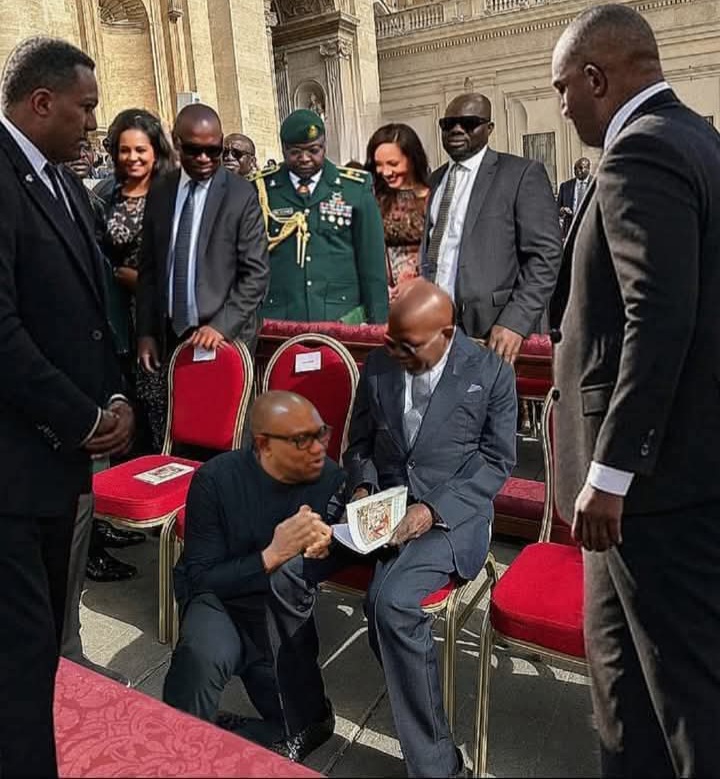
In an era when a single manipulated image can ricochet around the globe in seconds, our collective grasp on reality teeters dangerously on the brink. The media office of former Anambra State governor and Labour Party presidential candidate, Mr. Peter Obi, this week dismissed as “clearly photoshopped” the photographs circulating on social media that purported to show him kneeling before President Bola Ahmed Tinubu at a Vatican ceremony graced by the Pope’s moral authority.
According to Mr. Obi’s Media Adviser, Mr. Valentine Obienyem, these doctored images are “not reflective of the actual proceedings at the solemn occasion attended by global dignitaries” and would have “made the front pages of major newspapers” had they been real. That no credible outlet reported such a spectacle, Obienyem noted, speaks volumes about the lengths to which political mischief–makers will go to bend public perception to their will.
This latest affront is but the tip of a swelling iceberg: Nigeria today is drowning in a tsunami of fake news, filter-bubbled rants, and recycled rumors masquerading as fact. From the bogus “death” of Nollywood icons to fraudulent videos designed to inflame ethnic tensions, we’ve grown jaded, and dangerously complacent, about verifying what we consume. Yet beneath the surface of this chaos lies a simple truth elucidated by Source Credibility Theory: if the messenger is suspect, so too is the message. And in our Twitter-obsessed, like-driven world, we have surrendered our right to question not just the content of a story, but the very credentials of its originator.
To clearly understand the foregoing situation, it is germane I recount that years ago, long before I fully grasped the media industry’s nuances, I found myself in the corporate trenches delivering “news” of a prominent Nigerian politician’s death. My boss, the very picture of seasoned detachment, leaned back, arched a single eyebrow, and crooned, “Which newspaper reported it?” When I named the outlet, he snorted and waved the rumor away. “Forget it. It is fake.”
At the time, his flippancy stung. Was I so naïve as to believe every headline? Yet as I transitioned into journalism, I realized his skepticism was not borne of cynicism but of wisdom: information is only as valuable as its source. His instinctive application of what scholars call the Source Credibility Theory in Mass Communication would have made him a star pupil in any journalism school.
At its core, Source Credibility Theory argues that a message’s persuasive power is directly proportional to how trustworthy and expert its originator appears. Trustworthiness gauges perceived honesty and integrity; expertise measures knowledge and competence. Together, these twin pillars dictate whether an audience will accept, or reject, a claim.
Mainstream Nigerian dailies such as The Guardian, Punch, and ThisDay once, or still, command high scores on both counts. They painstakingly buttress each report with multiple sources, fact-checkers, and editorial oversight. Their hard-won reputations lend weight to every headline, strengthening democracy through informed debate. But today, the rise of digital influencers, amateur gossip blogs, and hyper-partisan WhatsApp chains has turned that paradigm on its head. Reach has eclipsed reliability; virality trumps veracity.
Every smartphone is now a de facto newsroom. Every social media user a self-declared journalist. The only qualification needed to break “news” is a large follower count, and a flair for the dramatic. Fact-checking? Optional. Attribution? Overrated.
This shift has unleashed a maelstrom of fake death announcements (remember Ngozi Ezeonu? Olu Jacobs?), conspiracy videos, and clickbait meant to enrage, not enlighten. Ned Nwoko, the politician-businessman, has had to publicly debunk false reports of his demise, twice.
Back to Peter Obi, an image claiming to show him meeting the Pope might as well have had a watermark from the “Emperor’s New Clothes” for all the truth it bore. Yet such doctored visuals spread faster than any correction could catch up.
Meanwhile, audiences judge credibility not by scrutinizing sources but by how an item makes them feel. Emotional resonance, confirmation bias, and the illusory-truth effect ensure that the more we see a lie repeated, the more we believe it, even if it originated from an anonymous handle with zero track record.
The Vatican incident crystallizes this crisis. A solemn gathering, featuring the spiritual leader of 1.3 billion Catholics, is reduced to a political stunt by opportunists wielding Photoshop as their paintbrush. Mr. Obienyem’s statement underscores three sobering realities:
1. “Silence Speaks”: “If such an event had occurred, it would doubtless have made the front pages of major newspapers.” The absence of mainstream coverage is, in itself, evidence.
2. “Procedural Protocol”: Pope Francis “extended personal greetings only to Heads of State, their official representatives, and members of the diplomatic corps”, a category not inclusive of Mr. Obi.
3. “Selective Targeting”: Of all Nigerian attendees, only Mr. Obi was slapped into the political crosshairs, a sign of malice, not accident.
This is not a mere prank. It is a calculated effort to redirect attention from the Pope’s real message, justice, peace, and care for the poor, and ethical leadership, toward specious clickbait that serves no purpose but to inflame partisan passions.
We are complicit in our own deception. We no longer pause before retweeting a fiery headline; we do not pause to check if the handle belongs to a reputable journalist or a newly-created sock puppet. The default assumption is: social media = truth. This blind faith undermines both the Source Credibility Theory and the very function of a democratic press.
Confirmation bias only deepens the wound, as we gravitate toward stories that validate our worldviews, regardless of their factual footing. In a country as ethnically and politically polarized as Nigeria, such bias becomes a weapon of mass distraction, one that drowns out serious discourse and corrodes civic trust.
If Nigeria is to stem the tide of fake news, we must re-embed Source Credibility Theory at the heart of our information ecosystem:
In fact, from primary schools to churches, it should be expedient to teach Nigerians to interrogate sources like they would inspect medicine labels. Who is speaking? What are their credentials? Have they cited evidence?
In a similar vein, legacy media must beef up their verification teams and publicly shame purveyors of fake content. Organizations like Dubawa and Africa Check need more funding, and higher profiles.
Also in a similar vein, social networks must be compelled to filter out manipulated media and penalize repeat offenders. Algorithms optimized for engagement should be recalibrated for accuracy.
In fact, the state can play a role without trampling press freedom. Legislation against malicious misinformation should target intent and patterns of deception, not stifle legitimate critique.
Again, brands and NGOs must vet the platforms they sponsor. If money stops fueling fake-news mills, their incentives evaporate.
On our own parts, we should always bear it in mind that each of us bears a responsibility. Before forwarding “breaking news” on WhatsApp, ask: “Who originated this? Have I seen it elsewhere? Could it be manipulated?”
My former boss never read Hovland and Weiss, yet he instinctively applied the lessons of Source Credibility Theory. He knew that the merit of any claim flows from the integrity of its messenger. Today, as a journalist, I stand alarmed at how easily our collective guard has been lowered. If we continue to elevate sensationalism over substance, amplify Photoshopped stooges over seasoned reporters, and reward clicks over credibility, then Nigeria’s democratic prospects will be undone by our own blindness.
In a world awash with “pixels of deceit,” we must reclaim the bedrock principle that trust and expertise matter. We must champion truth over tactics, ethics over expedience. Otherwise, we risk becoming a nation guided by the loudest liars rather than the most reliable sources, and in such a nation, democracy, development, and dignity will be the first casualties.