Africa
How Inflammatory Speech Can Backfire, And Trigger Suspicion -By Isaac Asabor
For Nigeria to mature politically, leaders must internalize the power of words, exercise restraint, and prioritize responsibility over rhetoric. Electoral violence, ethnic tension, and insecurity are not accidents, they are the inevitable offspring of careless speech amplified by influence. Words, once spoken, cannot be retracted. In politics, the stakes are often life and death.

In a quiet village, two friends once argued. In a flare of anger, one said, “I go show you pepper.” Hours later, the other collapsed and died. Villagers rushed to assign blame, accusing the speaker of murder, witchcraft, and every imaginable wrongdoing. The words were never meant to harm, yet the statement triggered real-world consequences.
This anecdote mirrors Nigeria’s political reality, where words, especially from politicians, carry far more weight than many appreciate. Just as the villager’s careless threat escalated into tragedy, inflammatory political speech in Nigeria has historically sparked atmosphere of suspicion and speculation, electoral violence, ethnic tension, and national insecurity. From the 2011 to 2023 elections, political rhetoric has repeatedly lit tinderboxes across the country.
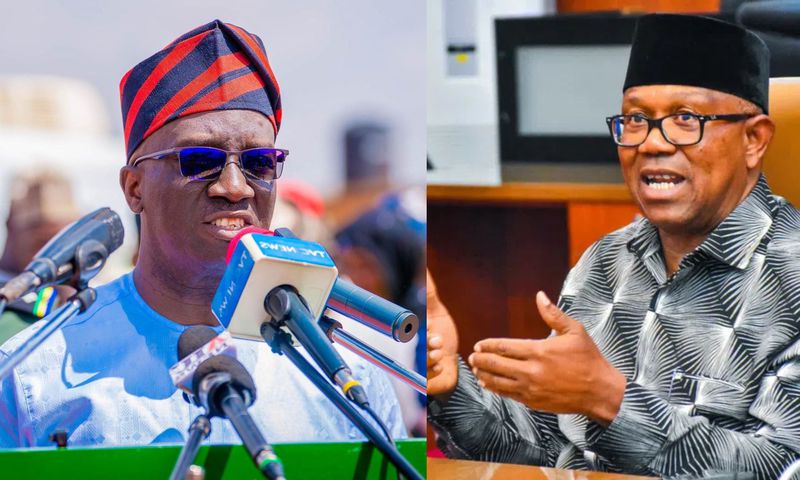
The dangers of careless speech were evident in Edo State in July 2025. Governor Okphebholo reportedly warned former presidential candidate Peter Obi to “take permission” before entering Edo state, particularly in Benin. Obi ignored the warning and narrowly escaped an assassination attempt recently. While it cannot be said that Okphebholo orchestrated the assassination attempt or not, his overbearing statements stoked suspicion, fear, and hostility, illustrating how words alone can influence perception and behavior.
In fact, politicians often weaponize language, using it to intimidate, coerce, or delegitimize rivals rather than to inform or persuade. Like the proverbial “pepper” in the village story, seemingly harmless rhetoric can have real consequences. Historical examples in Nigeria are sobering. In 2015, former President Muhammadu Buhari now of blessed memory warned that election rigging would lead to a country “soaked in blood.” Asari Dokubo threatened unrest in the Niger Delta if Goodluck Jonathan lost. In 2011, Lawan Kaita warned the North would make the country ungovernable if Jonathan prevailed. In the 2023 elections, threats and do-or-die rhetoric dominated, with figures like Alhassan Ado Doguwa, Abdullahi Abbas, and Okey Ezea framing the contest in violent, ethnicized terms. Even Lagos’ gubernatorial race inflamed tensions, portraying the election as a struggle between indigenous residents and Igbo communities.
This phenomenon is not limited to national politics. At the local level, careless statements have sparked violence. In 2026, a community chairman in Barkin Ladi, Plateau State, reportedly declared that Fulani pastoralists “should not be seen in the community” following a local death, effectively sanctioning discrimination and potential aggression through words alone.
The consequences are clear: political speech can mobilize supporters, stoke fear, and escalate tensions into violence. Words, in the hands of influential figures, transform from communication tools into weapons. The stakes are high.
First, there is an immediate threat to life. Careless statements, especially those targeting ethnic or religious groups, can prompt violent reactions before facts are verified. Communities often act on rhetoric rather than evidence, just as the villagers in this context presumed the first friend guilty of murder.
Second, reckless speech undermines democracy. Elections should be contests of ideas and policies, not fear and intimidation. When leaders engage in “linguistic rascality”, personal attacks, ethnic profiling, and violent metaphors, public discourse collapses, and civic participation suffers.
Third, the economic and social costs are profound. Violence and insecurity disrupt markets, scare investors, displace communities, and deepen poverty. Careless political speech amplifies these risks, creating ripple effects that extend far beyond the immediate audience.
Fourth, public words reflect leadership integrity. A politician’s statements are a litmus test for judgment. Those prone to reckless rhetoric signal poor decision-making, a dangerous trait for governance. Words that incite violence, even unintentionally, reveal a lack of prudence no nation can afford in its leaders.
The Okphebholo episode and past examples underscore the urgent need for circumspection in political speech. Warnings or declarations meant as protection or deterrence can trigger fear, speculation, and retaliatory acts. Leaders’ words must therefore be deliberate, measured, and mindful of their potential for harm. Their media team that usually cut across ministers, commissioners and Special Assistants or Advisers should take it as a point of responsibility by always advising them to be circumspect and intentional in the choice of words, particularly when making speeches.
Existing measures, peace accords mediated by the National Peace Committee (NPC), ethical calls for accountability, and civic education, are insufficient if political actors continue to exploit digital platforms irresponsibly or make unchecked inflammatory statements. Nigeria needs enforceable accountability structures and proactive strategies to counter misinformation and hate speech.
The lesson is unmistakable: words matter. They shape perception, influence behavior, and can catalyze outcomes far beyond the speaker’s intention. A casual threat, boastful warning, or ethnic slur may seem minor, but history and recent events show they are rarely harmless.
Political leaders bear responsibility beyond votes. Their statements can unite or divide, calm or inflame, protect or endanger lives. In a diverse, sensitive nation like Nigeria, the cost of linguistic carelessness is measured not only in lost votes but in disrupted lives, strained economies, and weakened national cohesion.
The Okphebholo warnings to Obi and Obaseki, though perhaps intended as cautionary, illustrate the danger of overreach. They are a stark reminder that political words are not mere expressions, they are instruments that can cut deeper than any sword. Just as the villagers witnessed tragedy from a single careless utterance, Nigeria continues to live under the shadow of words that kill, not by themselves, but by the reactions they provoke.
For Nigeria to mature politically, leaders must internalize the power of words, exercise restraint, and prioritize responsibility over rhetoric. Electoral violence, ethnic tension, and insecurity are not accidents, they are the inevitable offspring of careless speech amplified by influence. Words, once spoken, cannot be retracted. In politics, the stakes are often life and death.
In Nigeria, saying “I go show you pepper” may be metaphorical, but the consequences are painfully real. It is time for politicians to speak with care. The nation can no longer afford the casualties of reckless words.



![Gaza has been under heavy Israeli bombardment for weeks [File: Ohad Zwigenberg/AP]](https://www.africansangle.com/wp-content/uploads/2023/10/Gaza-has-been-under-heavy-Israeli-bombardment-for-weeks.jpg)