Africa
I Was So Interested In The Success Of President Goodluck Jonathan I Wrote A Book To Publicly Criticize Him -By Joe Dauda
Jonathan was accused of being clueless, being corrupt, being a drunk, and being incapable of defeating Boko Haram. Only after he left were Nigerians able to understand that the man wasn’t as bad as his detractors claimed he was. He built 14 federal universities, grew the economy, made Nigeria the largest economy in Africa, brought in mercenaries to help checkmate Boko Haram, and was almost succeeding in that endeavour before globalist Barack Obama got involved. But that is a story for another day.

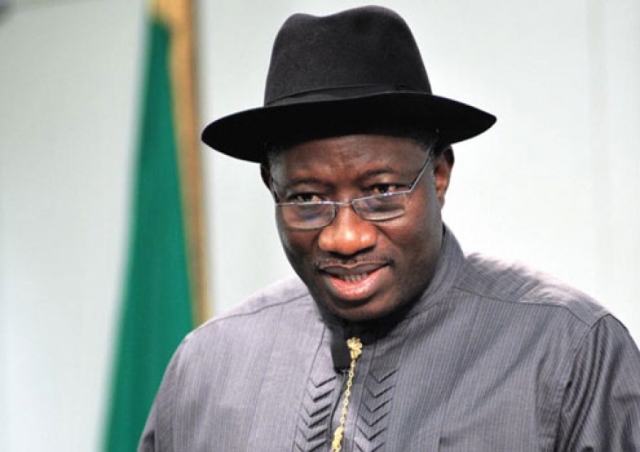
I liked President Goodluck Ebele Jonathan. And because I liked him, I wanted him to succeed; and because I wanted him to succeed, I did not want him making mistakes. And because I did not want him making mistakes, I appointed myself as his critic. No pay, no appointment letter—nothing: but I followed virtually every move of his administration and formed an opinion in support or in disagreement.
My love affair with Goodluck Jonathan started in 2010 and it was largely because I was involved in a project initiated by my boss at IMR, Victor Oluwafemi Walsh. The project had the objective of igniting national consciousness and excitement about the approaching golden jubilee celebrations on the 1st of October of that year. In a brainstorming session, we got to realize that 2010 was a GJ year. And while writing the script for the advert jingle we ran for weeks on AIT, I highlighted that point. The concept was christened GJ squared, meaning GJ multiplied by GJ, and it meant that Goodluck Jonathan, GJ, became President of Nigeria during our Golden Jubilee, which can also be abbreviated as GJ.
Although our 2010 Golden Jubilee Project recorded much less success in financial terms, it enabled me gain some experience. I was able to organize a high profile event at the Banquet Hall of the Aso Rock Presidential Villa, during which we donated a digital countdown clock to the federal government that had already been set to count down to the 1st of October. Not just Jonathan but Namadi Sambo (his VP) and all Ministers were at that event. Late Professor Dora Akunyili was still alive then and she was at the event as a cabinet Minister. Even SGF Mahmud Yayale was there, as well as Jonathan’s Chief of Staff, Mr Ogiadome.
I began to wish Goodluck Jonathan well from that time, seeing him as a child of destiny. We all remember how he came to power. Bearing in mind the powerful forces that were arrayed against him, it was nothing short of a miracle that the man not only survived but ascended to power. I still have video footage of our countdown clock event, and it proves that Dr Goodluck Jonathan was too gentle to be President of Nigeria when he was sworn-in. He was just too humble.
Believe it or not, we were later told that Jonathan and his entourage waited for sometime in one of the adjoining rooms inside the banquet hall while we were still putting finishing touches. What happened was that I did not know that the banquet hall did not have its own sound infrastructure. This was what caused the delay. A British sound engineer we got from Dare Art Alade’s wife, Deola, was helping to fix the sound when someone whispered in my ear that the event had to start immediately. I literally screamed at the sound engineer (Mr Steve) to give me sound and he looked at me in bewilderment, came to his senses, touched a button, and boom, there was sound all over. I couldn’t help thinking that Steve had been deliberately slow-walking his work just so he could charge us more money. Only later was I told that Jonathan had been waiting for us. I was only approached to begin the event immediately when the wait began to get too long. Incredible! That was how humble a man President Goodluck Jonathan was.
We had a successful event (that day was exactly 50 days to our golden jubilee on the 1st of October, 2010) and Jonathan was kind enough to instruct that our digital countdown clock be mounted in strategic places all over Nigeria. We smelt money. Lots of money. In the hundreds of millions and even in the multiple billions. Victor and I were set to become young millionaires. However, our strategic partnership with Daar Communications (operators of AIT) was going to cause a problem nobody could have imagined.
To cut the long story short, the first sign of trouble was during the unveiling ceremony itself. High Chief Raymond Dokpesi (owner of Daar Communications) was not around and was rather represented by Mr Tony Akiotu, who was the GMD of Daar Communications.
There was no easy way to explain Chief Dokpesi’s absence, especially because President Jonathan was there in person and knew that the countdown clock project was a joint effort by IMR and Daar Communications, who served as our media partners. In fact, Jonathan had stated that fact during his speech. There was no excuse for the Chairman of Daar Communications not to have been in that event—except if he was not in the country. We later learnt that he had suddenly travelled to Ghana. But subsequent events were going to prove that there was a real problem.
As everybody knows, General Ibrahim Babangida attempted to run for president in the 2011 general elections. Which was why he tried to participate in the PDP primaries that took place in 2010. It was when it became clear that High Chief Raymond Dokpesi had agreed to serve as IBB’s campaign manager that the whole matter began to make sense.
Jonathan’s people apparently added two and two together and came out in full force against our golden jubilee project. Even a fool knew that we were not the target. There was nothing to be gained in sabotaging the opportunity for Victor Walsh and I to make hundreds of millions legitimately. IBB was the target. And Dokpesi had come out in support of IBB as his campaign manager. There was no way Jonathan’s people were going to allow Dokpesi make so much money with the blessing of the Jonathan administration. So they tried to scuttle the project, hardly assessing that Victor and I were going to be the primary victims.
The spokesperson of the Jonathan administration, one Mr Ima Niboro, came on television and started badmouthing our golden jubilee project, which was made up of the countdown clock segment and the world’s largest cake segment. Even though by this time we had already been invited to the Presidential Villa to discuss the security arrangements that would allow President Jonathan taste our the cake on the 1st of October without any risk to his life or to his health, Ima Niboro was able to make the project seem foolish and crazy. Things began to go haywire. Before the move to basically destroy the project by these angry Jonathan appointees, we were getting calls from many agencies of government who wanted to obey his directive and place the digital countdown clocks in their respective offices. Even the Nigerian military had called us. But when things began to go awry, the calls dried up.
Painfully, General IBB eventually withdrew from the PDP primary. He did not contest against Jonathan but his attempt to contest destroyed our project and robbed us of an opportunity for some humongous financial boost based on the execution of a patriotic national project. I don’t believe Jonathan was personally aware of these happenings. Thus, my interest is his success did not wane. I simply accepted the very amazing mixup that caused the collapse of our golden jubilee project as an act of God and moved on.
Note that my interest in the success of Goodluck Jonathan was what made me his critic. My criticism was not out of hate but out of love. I saw in him a diffident leader whom destiny had pushed to the fore without a keen desire on his part and without the cunning the game required. I wanted him to succeed in spite of the disadvantages of his genial nature. In some ways, I felt sorry for him. He seemed too innocent to be a Nigerian President.
I remember the day I lost my temper with GEJ and decided to publish a book that was critical of him, even though it contained some encouraging statements. That book was titled My Phlegmatic President: A Thesis For Interacting With President Goodluck Ebele Jonathan From The Perspective Of Human Psychology.
Those of us who have attempted it know that publishing is a tough cookie to chew in Nigeria, but the handful of people who read My Phlegmatic President found it not only interesting but educative, especially because of the part that contained an outline of the four human temperaments and my analysis of Jonathan as a predominately phlegmatic personality. By the way, I have the phlegmatic temperament too. I think I’m choleric/phlegmatic or phlegmatic/choleric. Anyway, on the basis of publishing that book, I was invited for a chat on a talk show on AIT when President Nelson Mandela of South Africa died. The death of Mandela (aka Madiba) dominated global news for days and the presenter of that AIT programme, Obiora Iloh, wanted me to do an analysis of Mandela’s temperament for AIT viewers.
Through My Phlegmatic President, I plainly told President Jonathan that it was not everything said about him or his government by Alhaji Lai Mohammed that was a lie. At that time, Alhaji Lai Mohammed was the attack dog of the newly formed APC and even though current Senate President Godswill Akpabio nicknamed him Lier Mohammed, I warned Jonathan not to dismiss everything said by that man. The man and his party were trying to get many Nigerians to see them as good leaders and Jonathan and his party as bad leaders. Common sense dictated that they will busy themselves with research and investigation to find out all the possible bad things they could about the Jonathan administration so they can present them to Nigerians. Even if they supplemented these facts with lies, the wise course was to listen to them and find out how to adjust so as to resolve the issues they were raising. It required emotional discipline but I urged Jonathan to take advantage of the feedback from his critics so as to improve and even eventually neutralize their criticisms. In essence, I challenged Jonathan to see Alhaji Lai Mohammed as an asset rather than a liability. Not easy: but doable.
Four years after Nigeria’s golden jubilee, I implemented another project to support the Goodluck Jonathan administration. I don’t have the latest statistics but during that administration, Nigeria was the largest producer of cassava in the world. And Jonathan wanted Nigerians to begin to use cassava flour in bread making. This presidential initiative was going to put billions of naira into the pockets of Nigerian farmers. To support it, I came up with a project to demonstrate the suitability of cassava flour in baking. Since cake was a more complex food product than bread, I reasoned that making a Guinness-World-Record-size cassava cake would convince the world and Nigerians that cassava was good enough for bread. If it was good for cake, then it was very good for bread. The title of my project was thus The World’s Largest Cassava Cake and I secured a collaboration with the Federal Institute of Industrial Research, Oshodi (FIIRO). I challenged FIIRO to develop a recipe for cassava cake but that assignment was later fulfilled by one Dr Austin Okoruwa, a nutritionist who had worked with GlaxoSmithKline. At that time, the largest cassava cake in the world was the one that had been done years earlier in the Philippines: it was about 1.5 tones. This was why we set a target of 2-tons for ourselves so as to have the World’s Largest Cassava Cake for 2014. This massive cake was baked by bakers from FIIRO who were joined by some Lagos-based independent bakers. It took them three days and my eyes turned red within those three days because I was supervising them and sleeping like a chicken—with eyes ready to open at the slightest sound.
Unfortunately, Goodluck Jonathan did not come to FIIRO to see the cake I had made to support his administration’s cassava initiative. But he sent a worthy representative. The World’s Largest Cassava Cake was unveiled at the 2014 FIIRO Technology Week by then Vice President Namadi Sambo, on behalf of President Goodluck Jonathan. He was joined by Olusegun Aganga, then Minister of Trade and Investment, and the Minister of Science and Technology. Others were the Chairman of the Board of FIIRO, the Director General of FIIRO, and my humble self. NTA was still strong in 2014 and a report on the unveiling of the world’s largest cassava cake was the first item in their 9pm news lineup for that evening. I never got to meet Dr Goodluck Jonathan in person until several years later. Incidentally, the very day I met Jonathan in his Maitama residence, his Vice President, Architect Namadi Sambo, had also come to visit him. So I was able to see the two men in one setting.
What’s my point?
I liked a man and I became his critic. Since I did not have access to him but wanted to let him know of his blunders, I decided to publish a book. Jonathan’s special assistant on media and publicity, Reuben Abati, collected a copy of My Phlegmatic President. Of course I cannot tell if he ever shared its contents with Jonathan or if he even bothered to read it. But I remember that one of the advises I gave Jonathan in that book was to bow out without resistance if he lost the 2015 election. We all know his bowing out without resistance saved Nigeria from the precipice. I’m not taking credit for that but just saying I virtually saw into the future of his political journey and stated my recommendation in a permanent document. History will remember.
When you want a man to succeed, you cannot afford the luxury of flattering that man with lies. What provoked me to publish My Phlegmatic President was a news report I had seen on Channels TV. In retrospect, I now believe Jonathan may have been set up. What happened was that Channels TV showed the deplorable condition of the Police College Ikeja. My memory of the incident is fading but I think he was cornered by the media after visiting that college. The way he spoke was so unpresidential. He felt attacked; he was angry; he did not handle the matter well, even though, like I said, I felt he was set up, perhaps by secret enemies in his administration. He was set up to look bad and the sorry state of Ikeja Police College was what was used.
After a painstaking analysis of his temperament, with their strengths and weaknesses, my recommendation was for Jonathan to take the issue of appointments seriously. Phlegmatic people hate stressing themselves and stressing others; remember that I also have the phlegmatic temperament. So I knew that if Jonathan made any wrong appointment, that appointee was going to cheat him. How? Because phlegmatic people are not good at supervising others since they don’t like hurting people’s feelings. So, to succeed, the winning strategy for Jonathan was to focus all his presidential powers in ensuring that he got the best, the most honest, and the most patriotic Nigerians who can function and deliver for Nigeria without requiring supervision and without requiring encouragement or even praise. To his credit, one can recall that a good number of Jonathan’s appointees were stellar individuals who have since gone on to burnish the image of Nigeria around the globe. Dr Ngozi Okonjo-Iweala; Dr Akinwumi Adesina; Mrs Arunma Oteh; Mrs Omobola Johnson; Mohammed Ali Pate, etc. etc.
I have nothing against Vice President Namadi Sambo but when it became clear that Jonathan was going to participate in the 2015 presidential election, I conceptualized an article arguing for current NSA Nuhu Ribadu as Jonathan’s Vice President. I did not mind the fact that Nuhu Ribadu had dumped the PDP at that time and was in the APC. I just felt that if Jonathan had a Ribadu as Vice President, his government was going to have the required teeth to get appointees on their toes. Shockingly, Ribadu returned to the PDP not long after I conceived that article. For Jonathan’s sake, I was so excited with the return of Ribadu to the PDP I quickly published that article I had conceived. I still believe that a Ribadu as VP would not only have helped Jonathan politically but would have proven complementary to his phlegmatic nature. Ribadu, in my view, is predominantly choleric. A Buhari on steroids. It is people like him that need a good conscience most because they are fearless, decisive, and can do virtually anything without considering the consequences. All they need is to believe that something needs to be done and they would move, not minding the opinion of others.
So if you love a leader, pray that they will be blessed by honest critics. There is a huge difference between insulting a leader and criticizing a leader. In all my criticism of President Jonathan, I never insulted him, even though one APC Member of the House of Representatives at the time (who was and still is a personal friend) felt that the title of my book was somewhat audacious. Apart from the restraint of my home training, I won’t insult a leader in the name of criticism because the Bible clearly states that you shall not curse the ruler of your people (Deuteronomy 22:28). However, it cannot be overemphasized that, without honest criticism, a leader/ruler who intends to do well deserves to be pitied because the sycophants around him will ensure that he fails. Why? Because sycophants become sycophants due to selfishness. So everything they tell the leader will be what is calculated to preserve their advantage. And they do this by telling the leader what they think he wants to hear; never what they believe he needs to hear.
Jonathan was accused of being clueless, being corrupt, being a drunk, and being incapable of defeating Boko Haram. Only after he left were Nigerians able to understand that the man wasn’t as bad as his detractors claimed he was. He built 14 federal universities, grew the economy, made Nigeria the largest economy in Africa, brought in mercenaries to help checkmate Boko Haram, and was almost succeeding in that endeavour before globalist Barack Obama got involved. But that is a story for another day.
A serious leader must be sophisticated enough to expect criticism and must not be too sensitive even when criticism seems to come from sheer malice or from recklessness and the abuse of the freedom of expression.
For reasons best known to me, I don’t ever want to be President of Nigeria. But if I’m ever forced into such an unpalatable and undesirable situation, I will likely appoint my old-time friend and namesake, Joe Ukpong, as Critic-in-Chief to the President. I’m not the wisest man alive but I have come to value criticism so much I am willing to pay someone like Joe Ukpong to do nothing but criticize me. And I think Joe will enjoy such a job. He has a big head and a big brain and is naturally inclined to pessimism, which combines with his highly analytical mind to make him one of the most detailed human beings I have ever known. Joe sees problems when there are apparent problems and also sees problems when no one else does. He will be a great asset to any President any time, any day. But that President or leader has to be secure enough in himself to welcome honest and brutal criticism.
May we be blessed with honest, humble, and wise critics so our leaders can unleash their full potential and benefit us with the vast resources we have freely received by divine providence. The real enemies of the people are those who do everything to becloud the discretion of leaders and who do this for their selfish interests, not minding what the people will suffer as a result. Personal survival is their true religion and they are ready to sell anyone if they believe it will favour them. If you need to fear any set of Nigerians, fear these ones. And pray that our leaders will discern that they are not their friends but their enemies, desperate only to preserve themselves and afraid of getting out of the goodwill of whoever is currently in power.
Pray for our leaders.
You don’t have to imitate me (it’s ok if you do) but I include the words below whenever I pray for our leaders:
“Save them from evil advice, evil advisers, and evil spiritual influences.”
I consider the above prayer important because behind a good leader are good advisers and behind a bad leader are bad and mostly selfish advisers.
Note that a sycophant falls under the category of evil advisers because the sycophant, desperate to secure the favour of the leader, will give positive feedback when, indeed, there is positive feedback. He is likely to exaggerate this feedback but that’s ok. The problem is that, lacking courage to tell the leader the truth, the sycophant will also give positive feedback when there is negative feedback and even when there is no feedback.
How boring it is to have a sycophant around the corridors of power!
The ironic thing is that, due to the weakness of human nature, a leader may love the sycophants around him and hate or fear his honest critics. This is unfortunate and this is why a wise leader would try to listen to all so as to make the best judgment—sycophants, honest critics, and even malicious and insulting critics. Leaders need wisdom and courage plus humility to listen to honest criticism. Which is why I said we should pray for our leaders.