Forgotten Dairies
Inadvisability Of Urging Tinubu To ‘Carry-Go’ Beyond 2027 -By Isaac Asabor
If history is any guide, such calls will not stand. Nigerians have rejected tenure elongation before, and they will reject it again. The message remains clear and consistent: leadership in Nigeria is temporary, the constitution is supreme, and the will of the people cannot be overridden. Anything to the contrary is not just inadvisable, it is unacceptable.

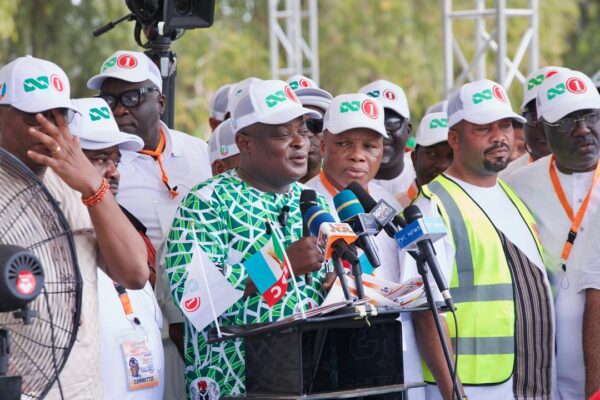
The recent calls by political loyalists, including Mudashiru Obasa, urging President Bola Ahmed Tinubu to “continue beyond 2027” may sound, at first glance, like routine political endorsement. In Nigeria’s political culture, it is not unusual for allies to publicly express confidence in an incumbent’s leadership or even advocate for re-election. However, when such calls are framed in a manner that suggests tenure extension beyond constitutionally permissible limits, they cease to be harmless expressions of support. Instead, they become deeply problematic signals that challenge the foundations of Nigeria’s democracy.
Obasa made the remarks on Saturday during an interfaith prayer session held in Ikeja to commemorate President Tinubu’s 74th birthday. The event was organized by the Mandate Movement (TMM).
Nigeria operates under a constitutional democracy, not a system of personal rule. The 1999 Constitution (as amended) clearly stipulates a maximum of two four-year terms for any president. This provision is not decorative; it is a safeguard, designed to prevent the concentration of power, discourage authoritarian tendencies, and ensure leadership renewal. Any rhetoric, however subtle, that hints at “continuity beyond 2027” must therefore be treated with the seriousness it deserves.
The recent endorsement by Obasa, alongside similar sentiments expressed by figures such as Sunday Igboho, raises an uncomfortable question: are these merely political statements, or are they part of a broader attempt to test public tolerance for tenure elongation? Nigerians cannot afford to be complacent in the face of such rhetoric. History offers sobering lessons.
During the era of Sani Abacha, Nigeria witnessed one of the most brazen attempts at self-perpetuation in power. What began as a military regime gradually morphed into a calculated effort to transform into a civilian presidency through orchestrated endorsements. Political parties, widely seen as extensions of the regime, adopted Abacha as their sole candidate, creating the infamous “five fingers of a leprous hand” scenario. The intention was clear: to perpetuate power under the guise of legitimacy.
Yet, despite the regime’s heavy-handed tactics, many Nigerians resisted. Civil society groups, pro-democracy activists, and ordinary citizens pushed back against what they rightly perceived as an affront to democratic principles. The eventual collapse of that project, though influenced by unforeseen circumstances, remains a powerful reminder that Nigerians do not easily surrender their democratic rights.
A decade later, under the civilian administration of Olusegun Obasanjo, the country faced another test. The proposed third-term agenda sought to amend the constitution to allow the president to remain in office beyond the two-term limit. Unlike the Abacha era, this attempt was cloaked in democratic processes, with arguments centered on continuity and stability. Proponents claimed that the reforms initiated by the administration required more time to mature.
However, Nigerians saw through the argument. The resistance was swift and decisive. Legislators, civil society organizations, the media, and the general public rallied against the proposal. Ultimately, the National Assembly rejected the constitutional amendment, reaffirming the sanctity of term limits. That episode remains one of the defining moments in Nigeria’s democratic journey, a clear statement that tenure elongation, no matter how well packaged, is unacceptable.
It is against this historical backdrop that current calls for Tinubu to “carry-go” beyond 2027 must be evaluated. Nigerians have been here before, and they understand the dangers. The language may differ, the context may have evolved, but the underlying implication is the same: an attempt, however tentative, to stretch the boundaries of constitutional governance.
Supporters of the current administration often point to policy decisions such as subsidy removal, student loan schemes, and infrastructure projects as evidence of progress that must not be interrupted. While it is legitimate to debate the merits or shortcomings of these policies, it is dangerous to suggest that their continuation depends solely on the indefinite stay of one individual in power.
Democracy is built on institutions, not personalities. If policies are sound and beneficial, they should be able to outlive the administration that introduced them. That is the essence of governance continuity in a democratic setting, not the indefinite retention of power by a single leader.
Moreover, the argument that the administration’s achievements justify extended tenure ignores a critical reality: governance outcomes are not universally experienced. In a country of over 200 million people, the impact of policies is uneven at best. While a small segment, often those within political and economic elite circles, may perceive improvements, whereas millions of Nigerians continue to grapple with economic hardship, inflation, unemployment, and declining living standards.
To suggest that the perceived benefits enjoyed by a few justify a deviation from constitutional norms is both elitist and undemocratic. Nigeria is not designed to serve the interests of a select group, nor is it the property of any political party, including the ruling All Progressives Congress (APC). It is a pluralistic society where power ultimately resides with the people.
Another danger in the “carry-go” narrative is its potential to erode democratic culture. Elections are meant to be competitive processes through which citizens evaluate leadership and make informed choices. When political discourse begins to lean toward inevitability or permanence, it undermines the spirit of electoral competition. It sends the message that leadership is a foregone conclusion rather than a mandate to be earned.
Equally important is the moral responsibility of political leaders and their supporters. Respect for the rule of law is not selective. It must be upheld even when it is inconvenient or when there is a temptation to extend influence. True leadership is demonstrated not by clinging to power but by strengthening the systems that ensure its orderly transfer.
Nigerians, by experience and instinct, are deeply sensitive to any attempt at undermining democratic norms. The resistance against Abacha’s self-succession project and the rejection of Obasanjo’s third-term bid are not isolated events; they are expressions of a collective commitment to constitutional governance. That commitment remains as strong today as it was then.
Those who advocate for tenure elongation, whether directly or indirectly, underestimate this resolve. Nigerians may be divided along political, ethnic, or religious lines, but on the issue of democratic integrity, there is a shared understanding: power must have limits.
If President Tinubu chooses to seek re-election in 2027, he is well within his constitutional rights to do so. That is the legitimate path available to any incumbent. Beyond that, however, there is no legal or moral justification for extending tenure. Any attempt to do so, whether through constitutional manipulation, political pressure, or rhetorical conditioning, will inevitably face resistance.
Nigeria’s democratic journey has not been perfect, but it has made significant progress. One of its most important achievements is the institutionalization of term limits and the peaceful transfer of power. These gains must be protected, not undermined.
Ultimately, the issue is not about any individual leader, no matter how influential or accomplished. It is about the integrity of the system. Democracies do not collapse overnight; they erode gradually when norms are weakened and boundaries are tested.
Calls for Tinubu to “carry-go” beyond 2027, therefore, are not just politically misguided, they are a step in the wrong direction. They ignore constitutional provisions, dismiss historical lessons, and underestimate the democratic consciousness of Nigerians.
If history is any guide, such calls will not stand. Nigerians have rejected tenure elongation before, and they will reject it again. The message remains clear and consistent: leadership in Nigeria is temporary, the constitution is supreme, and the will of the people cannot be overridden. Anything to the contrary is not just inadvisable, it is unacceptable.