Africa
Journalists from Leading African Media Visit PhosAgro’s Volkhov Plant -By Kestér Kenn Klomegâh
During their visit, the journalists toured the Fifteenth Element corporate museum and exhibition centre, visited classes of PhosAgro’s key social project — DROZD (Educated and Healthy Children of Russia) — which is aimed at providing children with free access to additional education, sports activities, spiritual and patriotic upbringing, learned about the plant’s history, and explored St Andrew’s Cathedral, which the Company built as part of its Spiritual Revival programme to promote cultural and spiritual values. The journalists thanked senior executives of PhosAgro and its Volkhov plant for inviting them.

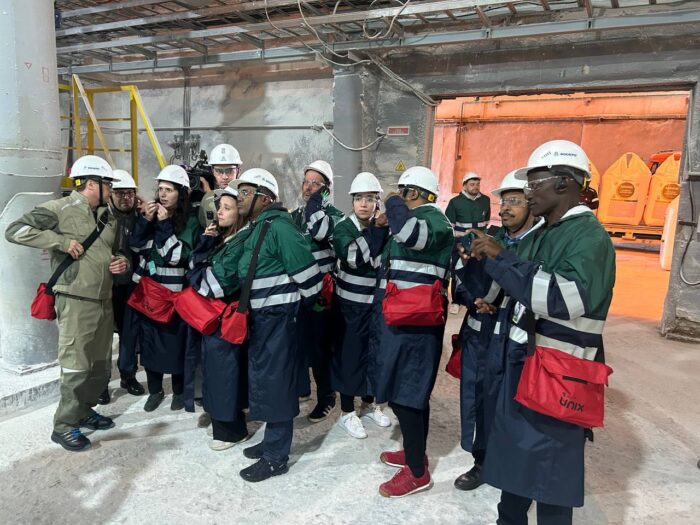
Volkhov (Leningrad Region) – Journalists from leading African media visited PhosAgro’s Volkhov production complex. They took part in an extensive tour of the production and infrastructure facilities, including the plant’s upgraded phosphoric acid and mineral fertilizer production facilities, as well as the new SK-800 sulphuric acid plant and new energy facilities, which recycle process steam into electricity for the plant. During their meeting with Phosagro’s executives, the journalists learned more about the significant role that the Company plays in ensuring global food security and supporting humanitarian projects in Africa.
As PhosAgro’s First Deputy CEO, Siroj Loikov, noted during the briefing, PhosAgro not only continues to strengthen its position as the leader in terms of total supply of all mineral fertilizers to the priority Russian market, but also remains a key supplier of phosphate-based fertilizers to the countries of the Global South, including African countries. Over the past decade, PhosAgro’s exports have nearly doubled and achieved 8.6 million tonnes in 2024. Today, Africa is a key focus for the Company’s international growth strategy. PhosAgro supplies its products to 21 African countries. The top five African importers of the Company’s agrochemical products include South Africa, Côte d’Ivoire, Ethiopia, Morocco, and Mozambique. With its extensive product line, PhosAgro is well positioned to address the specific needs of African regions, offering customers the best solutions while also making a significant contribution to the continent’s food security.
“Over the past year, PhosAgro has increased its supplies to Africa by a third to a total of 740 thousand tonnes. Since 2018, there has been a more than sixfold increase. I am also pleased to inform you that the exports to Africa have continued to expand in the first half of 2025 and have increased by a third compared to the first half of 2024. Over the next five years, we expect to double our deliveries to the continent. The launch of our state-of-the-art production facilities in Volkhov enhances the Company’s capacity to export our products to Africa. The plant, with a production capacity of one million tonnes, is located near Baltic ports, which are focused on exporting products to friendly countries,” Siroj Loikov said.
PhosAgro’s partnership with Africa is not restricted to the supply of agrochemical products. PhosAgro is working closely with international organizations to implement humanitarian initiatives in Africa. As part of the Green Chemistry for Life programme, in partnership with UNESCO and the International Union of Pure and Applied Chemistry (IUPAC), the Company provides grants to young scientists studying the application of advanced chemical technologies in areas such as environmental protection, natural resource management and waste recycling. Over eight rounds of the programme, the international jury has reviewed over 1000 applications and awarded grants to 55 young researchers, including 15 talented African scientists from South Africa, Egypt, Kenya, Tunisia, Nigeria, Sudan and Zimbabwe. Furthermore, over 200 young African scientists have received stipends as part of the PhosAgro–IUPAC Summer Schools on Green Chemistry.
PhosAgro also became an official partner for the launch of the African Soil Laboratory Network (AFRILAB) as part of a joint project in collaboration with the United Nations Food and Agriculture Organization (FAO). AFRILAB currently has 220 laboratories across 54 countries, assessing the quality and safety of fertilizers and monitoring soil conditions. To date, more than 11,000 farmers from developing countries have already taken part in the project, including approximately 4,500 farmers from over 20 African countries. This year, the programme will be expanded.
Last year, PhosAgro also launched Pro Agro Lectorium, an international educational platform with learning resources available in English and Portuguese. Nearly 170 leading academicians and practitioners from around the world, including 9 speakers from African countries, have recorded more than 420 lectures on agricultural science and agrochemistry, crop production and livestock farming, innovation and digitalization in agriculture, economics and responsible agriculture. In collaboration with its African partners, PhosAgro is integrating its online platform into the educational process for African students. The platform is constantly expanding: nine cooperation agreements have already been signed with African universities. Nowadays, thousands of African farmers and students access new knowledge and information on this platform.
“We will continue working in close cooperation with scientists, businesses, government authorities, and international organizations, to create a strong foundation for Africa’s food and technological sovereignty,” Siroj Loikov concluded.
During their visit, the journalists toured the Fifteenth Element corporate museum and exhibition centre, visited classes of PhosAgro’s key social project — DROZD (Educated and Healthy Children of Russia) — which is aimed at providing children with free access to additional education, sports activities, spiritual and patriotic upbringing, learned about the plant’s history, and explored St Andrew’s Cathedral, which the Company built as part of its Spiritual Revival programme to promote cultural and spiritual values. The journalists thanked senior executives of PhosAgro and its Volkhov plant for inviting them.
===