Forgotten Dairies
Lere–Rufai: When Spokesman Confronts Adversarial Journalism -By Onyejaka Alexander Arinzechukwu
The best government spokesperson should therefore welcome scrutiny—not because scrutiny is comfortable, but because it provides an opportunity to explain government policy directly to the public.

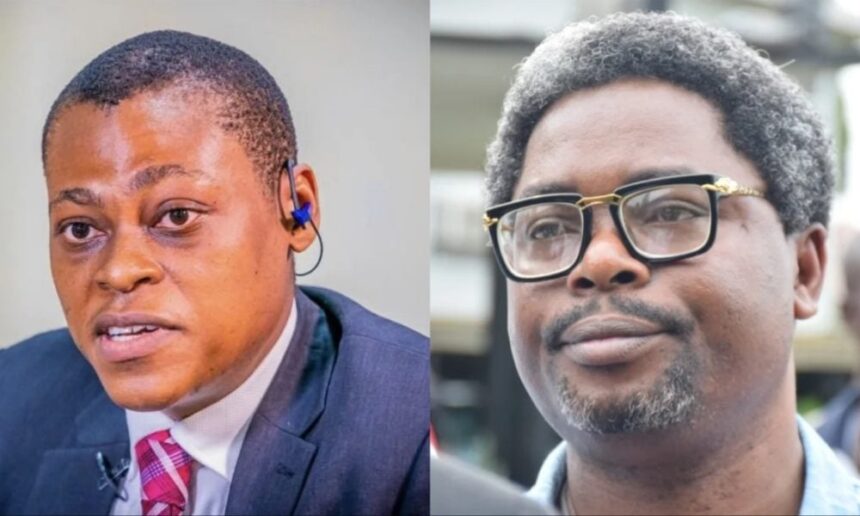
The recent confrontation between Lere Olayinka, media aide to the Minister of the Federal Capital Territory, Nyesom Wike, and Arise TV presenter Rufai Oseni has once again brought an old but increasingly important question to the centre of Nigeria’s public discourse: where should the line be drawn between aggressive journalism and responsible political communication?
The encounter, which occurred during a live television programme, quickly moved beyond an ordinary interview. What should have been an opportunity to interrogate public policy, clarify government positions and provide citizens with information became a test of temperament, professional boundaries and the increasingly complicated relationship between politicians, government spokespersons and the media. Reports and reactions to the encounter described a disagreement over Rufai’s questioning style and the manner in which Lere responded.
At one level, the incident is about two individuals. At another, it represents something much bigger.
It is about the changing character of political journalism in Nigeria. It is about whether government spokespersons should simply answer questions or challenge the premises behind them. It is about whether journalists should deliberately adopt an adversarial posture when questioning people in authority. And, perhaps most importantly, it is about whether the Nigerian public is ultimately better served when interviews become confrontational.
There is no simple answer.
The journalist is not a government public-relations officer
One mistake that public officials and their spokespersons sometimes make is expecting journalists to behave like extensions of the government’s communication machinery.
They are not.
The responsibility of a journalist is fundamentally different from that of a government spokesperson.
A spokesperson is employed to communicate, defend, explain and, where necessary, promote the position of an administration or public official. A journalist, on the other hand, has a responsibility to interrogate those positions.
That distinction is fundamental to democracy.
If a minister says his ministry has performed excellently, the journalist does not have to accept the claim. If a governor announces a major infrastructure project, the journalist is entitled to ask how much it will cost, who received the contract, when it will be completed and whether the project represents value for money.
If a government spokesperson appears on television, the journalist’s job is not to make the guest comfortable.
The journalist’s job is to make the public informed.
This is why adversarial journalism has an important place in a democracy.
Power rarely volunteers uncomfortable information.
It must often be questioned, challenged and subjected to scrutiny.
But aggressive journalism has its own dangers
However, the fact that journalists have a responsibility to challenge authority does not give them unlimited licence to be unnecessarily provocative.
There is a difference between tough questioning and hostile questioning.
There is a difference between exposing contradictions and humiliating a guest.
There is a difference between asking a difficult question and attempting to win an argument.
The danger of highly confrontational journalism is that the interview can gradually cease to be about the issue and become a contest between personalities.
Once that happens, viewers may remember the quarrel but forget the substance.
This is particularly dangerous in Nigeria, where political conversations are already intensely polarised.
The public does not need more political theatre. It needs information.
A journalist can be firm without being insulting. A journalist can refuse to accept an evasive answer without becoming abusive. A journalist can challenge a politician’s argument repeatedly without turning the interview into a personal battle.
That is the higher standard to which journalism should aspire.
Lere’s dilemma
Lere Olayinka’s position also deserves consideration.
A government spokesperson who walks into a television studio does not surrender his right to defend his principal.
If he believes that a journalist has misrepresented the government’s position, he has every right to correct the record.
If a question is based on a false premise, he should say so.
If the interviewer attempts to attribute a statement to his principal that was never made, he should challenge it.
If the journalist asks a question that the spokesperson considers unfair, the spokesperson can explain why he considers it unfair.
But the spokesperson must understand that the television studio is not a political rally.
There is a professional way to fight back.
The strongest spokesperson is not necessarily the loudest one. He is the one who can withstand an uncomfortable question, dismantle its assumptions with facts and leave the audience convinced that his position deserves consideration.
That is considerably more difficult than exchanging verbal blows with a journalist.
The problem with turning interviews into battles
Nigeria’s political interviews increasingly resemble boxing matches.
The interviewer wants to demonstrate that he cannot be intimidated.
The politician wants to demonstrate that he cannot be bullied.
The audience takes sides.
Social media turns the encounter into a competition.
Clips of the most dramatic moments circulate widely, while the substantive questions disappear.
This is not necessarily good journalism.
Nor is it good political communication.
The danger is that the public begins to evaluate interviews according to who “won” rather than what was learned.
But journalism is not supposed to be a boxing match.
The objective is not for the journalist to defeat the politician.
The objective is to extract information.
Similarly, a government spokesperson does not need to defeat the journalist.
His responsibility is to explain his principal’s position convincingly.
Adversarial journalism is necessary
It would nevertheless be wrong to use the Lere–Rufai confrontation as an argument against adversarial journalism.
Nigeria needs more serious scrutiny of those in power, not less.
The country’s democracy depends on journalists asking questions that politicians would rather avoid.
Where is the money coming from?
How much was spent?
Who received the contract?
Why was the policy changed?
Who benefits?
Who loses?
What evidence supports the government’s claim?
Why did the administration make one promise and deliver something else?
These questions are not disrespectful.
They are the foundation of accountability.
A journalist who never challenges power is not necessarily a professional journalist. He may simply be a broadcaster reading government statements.
The press must therefore retain its independence.
But independence should never be confused with incivility.
The spokesperson must also understand the nature of the media
Government spokespersons operate in a difficult environment.
They are often expected to defend policies they did not personally formulate. They may be confronted with hostile questions, incomplete information and political controversies involving their principals.
Yet that is precisely why the job requires exceptional communication skills.
A spokesperson should understand that journalists will sometimes deliberately press an uncomfortable point.
The correct response is preparation.
Know the facts.
Know the figures.
Know the policy.
Know the history.
Anticipate the difficult questions.
Understand the weaknesses of your government’s position.
Prepare evidence.
Most importantly, remain calm.
When a spokesperson loses his temper, he can inadvertently shift public attention from the issue under discussion to his behaviour.
The same applies to journalists.
When a journalist becomes visibly angry with a guest, the journalist can unintentionally become part of the story.
That is rarely desirable.
Nigeria needs less personality and more substance
One of the unfortunate developments in contemporary Nigerian political broadcasting is the elevation of personalities above issues.
People increasingly watch interviews because of the interviewer rather than the subject.
They anticipate the interviewer’s style, catchphrases and confrontations.
Similarly, political supporters increasingly defend their preferred spokesperson regardless of the substance of an argument.
This creates an environment where everyone enters the conversation with a predetermined position.
The journalist believes the politician is lying.
The politician believes the journalist is biased.
The audience chooses a side before the first question is asked.
That is a recipe for political communication without meaningful communication.
Nigeria deserves better.
We need interviews where the journalist is fearless but fair, and where the spokesperson is defensive of government but intellectually honest.
There is a lesson for both sides
The Lere–Rufai episode offers lessons for both journalism and government communication.
For journalists, the lesson is that toughness should be accompanied by discipline.
Do not be afraid to challenge politicians. But challenge the argument, not the person.
Do not accept unsupported claims. But give the guest enough space to answer.
Do not allow a politician to evade the question. But do not turn persistence into harassment.
Do not become soft because the guest is powerful. But do not become aggressive simply because confrontation generates television clips.
For spokespersons, the lesson is equally clear: defending government does not require fighting the journalist.
A spokesperson can say, “That premise is incorrect.”
He can say, “I disagree with that characterisation.”
He can say, “Let me provide the facts.”
He can say, “That is not what the minister said.”
He can even refuse to accept an unfair question.
But he should remain focused on the substance.
The audience is the real loser when interviews collapse
There is another participant in these confrontations whose interest is often forgotten: the viewer.
The Nigerian citizen watching a political programme wants answers.
He wants to understand why electricity prices are rising.
She wants to know what government is doing about insecurity.
They want to understand the state of the economy, infrastructure, taxation, housing, education and healthcare.
They want to know what their government is doing with public money.
When an interview degenerates into shouting, accusations and personal exchanges, citizens lose.
The politician may feel that he successfully defended himself.
The journalist may feel that he successfully challenged the politician.
But if the audience leaves without understanding the policy issue, neither side has really succeeded.
The media must guard its credibility
There is a broader issue here.
The Nigerian media cannot afford to lose public trust.
The credibility of journalism depends not only on the courage to confront power but also on fairness, accuracy and professionalism.
A journalist who asks difficult questions but misrepresents facts weakens journalism.
A journalist who exposes corruption but routinely insults guests weakens journalism.
A journalist who is tough on one political party but gentle with another weakens journalism.
The credibility of adversarial journalism comes from consistency.
If power must be questioned, all power must be questioned.
The journalist must not become an opposition politician in disguise.
The journalist’s loyalty should be to facts and the public interest.
And politicians must accept scrutiny
Politicians and their spokespersons, on the other hand, must accept that modern journalism will not always be deferential.
The era when government officials could issue statements and expect journalists simply to publish them is disappearing.
The public now has access to multiple sources of information.
Journalists are armed with documents, databases, previous statements, video archives and real-time public reactions.
A politician can no longer simply say, “I never said that,” when an old video is readily available.
This makes preparation more important than ever.
The best government spokesperson should therefore welcome scrutiny—not because scrutiny is comfortable, but because it provides an opportunity to explain government policy directly to the public.
The studio should be a marketplace of ideas
Television journalism should ideally become a marketplace of ideas.
The journalist brings questions.
The spokesperson brings answers.
The journalist tests the answers.
The spokesperson defends them.
The audience evaluates both.
That is democracy at work.
There will inevitably be disagreements. Voices may become firm. Questions may become uncomfortable. Guests may challenge interviewers.
But professionalism should provide the boundaries.
Nobody should expect political interviews to be tea parties.
At the same time, nobody should mistake hostility for courage.
A journalist does not become more courageous simply because he shouts.
A spokesperson does not become stronger simply because he shouts back.
Sometimes the most powerful response is a calm presentation of facts.
Beyond Lere and Rufai
The Lere–Rufai encounter should therefore not be reduced to the question of who won the argument.
That would miss the bigger lesson.
Nigeria is a democracy in which the relationship between the media and political power will always be complicated.
The media must scrutinise government.
Government must communicate with the media.
Journalists must challenge politicians.
Politicians must defend their records.
Both sides must understand their responsibilities.
And both must remember the citizens watching them.
The press should never become a cheerleader for government.
Government spokespersons should never become enemies of the press.
There must be tension between the two because accountability requires tension.
But that tension must remain constructive.
The journalist should be adversarial towards power but respectful towards people.
The spokesperson should be defensive of government but respectful towards journalism.
That balance is not always easy.
But it is necessary.
The Lere–Rufai confrontation therefore offers Nigeria a useful opportunity for reflection. The country does not need a media that is timid in the presence of power. Neither does it need government spokespersons who collapse whenever they encounter aggressive questioning.
It needs something better: a fearless press, prepared politicians, informed citizens and a culture of debate in which facts are more important than personalities.
At the end of every television confrontation, the real question should not be: Who won?
It should be:
What did Nigerians learn?
That is the standard by which both the journalist and the spokesperson should ultimately be judged.