
Forgotten Dairies
From Pulpit To Soapbox: Whatever Happened To Father Alia’s Moral Authority? -By Isaac Asabor
But the manner in which a government responds when its people are grieving will remain part of its history. For a former priest entrusted with the affairs of a traumatized state, that may be the most important sermon of all. The question, therefore, is not simply what happened on the Makurdi-Gboko road. The deeper question is this: “Whatever happened to Father Alia’s moral authority?”

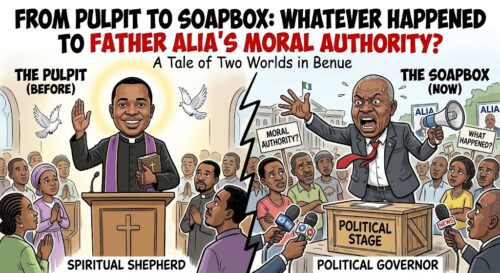
There is a painful irony when a man who once stood before an altar preaching compassion finds himself at the centre of a political controversy over whether another Nigerian should be allowed to reach grieving citizens.
That irony now hangs heavily over Benue State Governor, Reverend Father Hyacinth Iormem Alia.
When Father Alia exchanged the sacred vestments of the Catholic priesthood for the political attire of a governor in 2023, many Benue people did not see merely another politician taking office. They saw an alternative to the old order.
His emergence was wrapped in the language of redemption. His “Yes, Father” campaign resonated with citizens who yearned for honesty, compassion, accountability and a government that would treat public office as a trust rather than an inheritance.
He entered government carrying something increasingly rare in Nigerian politics: moral authority. Three years later, that authority appears to be facing a difficult test. The reported obstruction of Peter Obi’s convoy while the former presidential candidate of the Labour Party attempted to visit Yelwata has raised questions that go far beyond the immediate dispute between Obi and the Benue Government.
At the heart of the controversy is a disturbing question: “what happens when political protocol begins to compete with human compassion?”
On September 8, Obi said his convoy was stopped on the Makurdi-Gboko road by youths chanting that he should return. He said he was travelling to Yelwata to sympathize with families affected by the 2025 massacre in which more than 270 people were reportedly killed.
The Benue Government has denied any involvement, insisting that Governor Alia neither sponsored nor deployed thugs against Obi. It has also accused the opposition politician of failing to properly notify the state government and security authorities about his visit. That disagreement should be settled by evidence.
If the government was not informed, it should be able to establish that. If the relevant authorities were notified, that too should be established. The truth should not be determined by partisan claims or counterclaims.
But the controversy has already grown beyond the question of who organized the roadblock. It has become a test of political tolerance, the temperament of power and, more importantly, the moral responsibility of government in a state already traumatized by violence.
That is where Father Alia’s past becomes impossible to ignore. There is nothing inherently wrong with security protocol. A prominent political figure visiting a conflict-affected community should coordinate with security agencies. Government has a responsibility to protect lives, including the life of the visitor.
But protocol should facilitate compassion, not frustrate it. If Obi’s visit required security coordination, the sensible response should have been to provide the necessary coordination. If there were legitimate concerns about his movement, those concerns could have been communicated through the appropriate authorities. What should not happen is for a dispute over notification to degenerate into a roadside political confrontation. That distinction matters.
Peter Obi is not an ordinary private citizen in the Nigerian political space. He is a prominent opposition politician and former presidential candidate. His political motives, like those of every politician, may reasonably be scrutinized. But political suspicion should never become a licence for political hostility.
If he came to Yelwata to offer condolences, the gesture should have been allowed to take place under proper security arrangements. If he came with political motives, the answer should still have been democratic engagement. If he breached protocol, the government could have reminded him of the rules without turning the matter into a confrontation. That is what mature governance looks like. And this is precisely where the former priest in Governor Alia ought to have something to say to the politician.
The priesthood, at its best, is built around compassion for the wounded, the grieving and the vulnerable. A priest does not ordinarily ask a mourner which political party he supports before offering consolation. Government should not be radically different.
A governor may belong to the APC. He may have political rivals. He may disagree with opposition politicians. He may have electoral calculations to make. He may even regard some political visitors as opponents. But the victims of Yelwata do not belong to the APC, PDP, Labour Party or any other political party. They belong to Benue. That is why the image of a political visitor being prevented from reaching grieving citizens is so disturbing, irrespective of who eventually proves responsible for the obstruction. It creates the impression that grief itself has become politicized. That is dangerous. Benue has suffered too much violence for politics to be allowed to overshadow the humanity of its victims. The state has witnessed killings, displacement and the destruction of communities. Families have buried loved ones. Farmers have lost their livelihoods. Thousands have been forced from their homes.
In such circumstances, the first duty of government should be to protect life, comfort the traumatized and create an atmosphere in which every legitimate effort to support victims is welcomed. Instead, the Yelwata controversy has produced another political quarrel. And there is an uncomfortable irony in that. A governor who entered politics carrying the moral symbolism of the pulpit risks being judged by the rougher standards of the political soapbox. The difference is profound.
Without a doubt, the pulpit speaks to conscience. The soapbox speaks to constituencies. The pulpit asks what is right. The soapbox often asks what is politically useful. The pulpit seeks to reconcile. Politics sometimes thrives on division.
Governor Alia may not have personally ordered anyone to obstruct Obi. Indeed, the state government has strongly denied involvement. Reports that the police have arrested 46 people in connection with the incident make an impartial investigation even more necessary. But even if the governor is completely vindicated of direct involvement, a serious question remains. “Why did a situation involving a visit to grieving citizens become so politically combustible in the first place?” That is the question of leadership. Leadership is not merely about what a governor personally orders. It is also about the political atmosphere created under his watch.
A government confident in its legitimacy should not appear threatened by an opposition politician visiting its citizens. Nor should every opposition activity be interpreted through the lens of conspiracy.
In fact, when every criticism becomes an attack, every political visit becomes suspicious and every rival becomes a threat, governance begins to resemble a bunker mentality. That is not strength. It is insecurity.
In fact, the matter should also concern Governor Alia because even voices within his own political family have reportedly condemned the treatment of Obi and called for an apology to Obi, President Bola Tinubu and the people of Benue. That should prompt reflection.
It is easy for a governor to dismiss criticism from opposition politicians as partisan politics. It becomes harder to dismiss when concerns are raised from within the same political camp. Political loyalty should never become an excuse for refusing uncomfortable truths. Perhaps this is where Father Alia’s old moral compass is most needed.
The political Alia may be tempted to see Peter Obi through the prism of party rivalry, electoral calculations and the approaching 2027 contest. The priestly Alia should see something else: a fellow Nigerian attempting to reach people who have suffered a terrible tragedy. That does not require Governor Alia to endorse Obi. It does not require him to support Obi politically.
It does not even require him to agree with Obi’s politics. It simply requires him to recognize that compassion is not partisan. And that is the moral distinction at stake.
A government can control access. It can control official information. It can deploy security personnel. It can exercise the authority of the state. But none of these automatically produces moral authority. Moral authority is earned. It is earned when power is exercised with restraint. It is earned when opponents are treated as citizens rather than enemies. It is earned when government rises above political calculations at moments of human suffering. That is why the Yelwata controversy should concern Governor Alia beyond the immediate political noise. The issue is not ultimately Peter Obi. The issue is Benue. It is whether Nigerians of different political persuasions can enter the state to mourn, sympathize with victims, support displaced communities and engage citizens without being treated as intruders.
It is whether a state battered by violence can become a theatre for political intimidation. It is whether democracy in Benue means more than winning elections and controlling political space. Most importantly, it is whether Governor Alia can preserve the moral authority that helped distinguish him from the political establishment he once appeared to challenge.
In fact, politics has a way of eroding moral capital. It teaches politicians to calculate before they act. It rewards loyalty. It encourages suspicion. It turns humanitarian gestures into potential campaign strategies and transforms political opponents into permanent adversaries.
But the people of Benue need something better. They need a governor who can rise above partisan instinct when human suffering is involved. Governor Alia should therefore resist the temptation to make Peter Obi the issue. The issue is bigger than Obi. The issue is whether the governor who once spoke from the pulpit can still hear the voice of conscience above the noise of the political soapbox.
Because power will eventually end. Political alliances will change. 2027 will come and go. Those who are friends today may become enemies tomorrow, while today’s opponents may become tomorrow’s allies.
But the manner in which a government responds when its people are grieving will remain part of its history. For a former priest entrusted with the affairs of a traumatized state, that may be the most important sermon of all. The question, therefore, is not simply what happened on the Makurdi-Gboko road. The deeper question is this: “Whatever happened to Father Alia’s moral authority?”
And perhaps, before the political soapbox completely drowns out the voice that once spoke from the pulpit, Governor Alia needs to find the answer himself.



















You must be logged in to post a comment Login